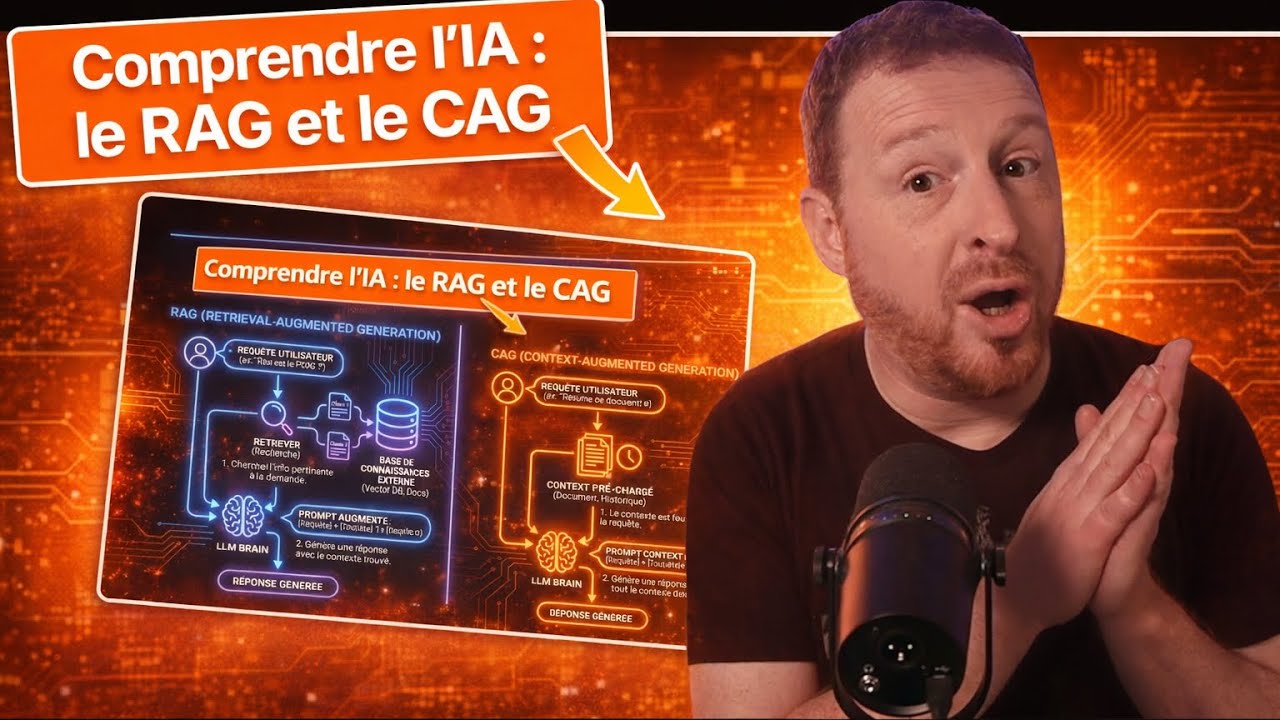
Comprendre l'IA : le RAG et le CAG
Understanding AI: RAG and CAG
Keywords
Summary
169 words
Critical Evaluation
Value of the Information & Strength of the Argument
The video provides a valuable introduction to RAG and CAG, explaining their purpose and practical implementation in a clear, accessible manner. The argumentation is based on the presenter’s experience and demonstrations, which effectively illustrate the concepts. However, the video lacks a critical analysis of the limitations and trade-offs of each approach, and the comparison between RAG and CAG is somewhat superficial. The presenter’s enthusiasm is persuasive, but the technical depth is limited, and the argumentation would benefit from more rigorous examples and references.
Scientific Rigor, Source Quality, Title Accuracy
The video does not cite specific academic or technical sources, relying instead on the presenter’s explanations and demonstrations. The title accurately reflects the content, which is a tutorial on RAG and CAG. The absence of formal citations reduces the scientific rigor, but the practical examples and clear explanations contribute to the video’s educational value. The presenter’s credibility is established through his experience, but the lack of external references limits the video’s authority.
170 words
Title / Content Match
The title accurately reflects the content, which focuses on explaining RAG and CAG in the context of AI systems.
Quality & Reliability
6/10
The video provides a clear, accessible explanation of RAG and CAG concepts, with practical examples and demonstrations. However, it lacks in-depth technical detail, formal citations, and a rigorous comparison of the two architectures. The presenter's enthusiasm is evident, but the content remains at an introductory level.
Key Moments
Markers derived by PSI from the transcript: the creator did not define chapters.
- Introduction to the video and the topic of RAG and CAG.
- Explanation of the limitations of standard AI models regarding recent data and hallucinations.
- Introduction to RAG: concept of creating a vector database from user documents.
- Demonstration of RAG using OpenAI's assistant feature and NotebookLM.
- Explanation of how RAG retrieves relevant information during a conversation.
- Example of setting up RAG with n8n and Supabase.
- Introduction to CAG: preloading context data into every conversation.
- Comparison of RAG and CAG, highlighting when to use each.
- Importance of structuring data for effective RAG.
- Promotion of the presenter's training club and conclusion.
Cited Sources
- Renaud Dékode website — Mentioned as a resource for further information and training.
Concurring Sources
- Retrieval-Augmented Generation for Knowledge-Intensive NLP Tasks — The original RAG paper, which the video's explanation aligns with.
Dissenting Sources
- Cache-Augmented Generation — The video's explanation of CAG is simplified and may not fully capture the technical nuances presented in the paper.
Contribution & Novelties
The video offers a practical, accessible introduction to RAG and CAG, demystifying these concepts for a general audience. It provides concrete examples of implementation using popular tools, which is valuable for beginners. However, it does not introduce novel technical insights or advanced techniques.
Pour aller plus loin :
- Retrieval-Augmented Generation for Knowledge-Intensive NLP Tasks — The original RAG paper, providing foundational understanding.
- Cache-Augmented Generation — A recent paper on CAG, offering a formal comparison with RAG.
- Vector Database — Overview of vector databases, the underlying technology for RAG.
88 words
Radar Profile
The radar profile shows a balanced but moderate performance across all dimensions, with slightly higher scores in information quantity and quality, reflecting the video's educational value. The technical level is lower, indicating an introductory approach. Overall, the video is a decent starting point for understanding RAG and CAG.
💬 Sur les 0 commentaires analysés, aucune tendance n'est disponible.