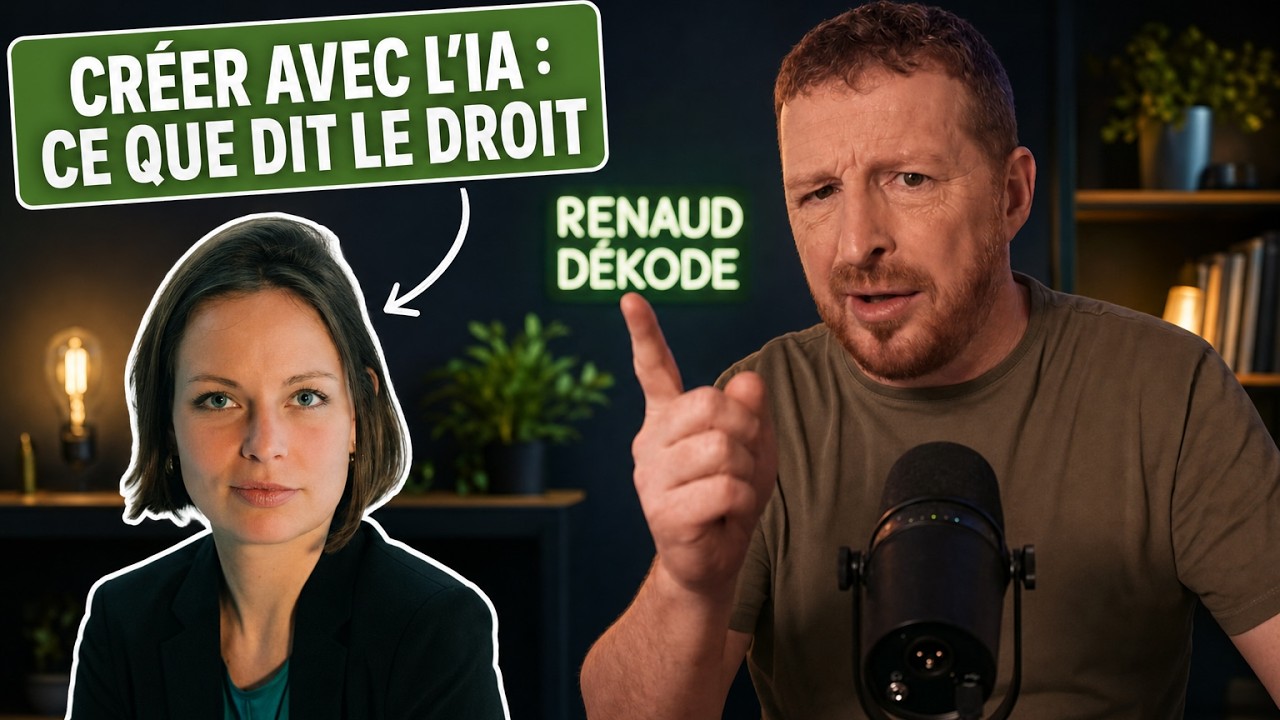
Créer avec l'IA : ce que vous avez vraiment le droit de faire (avec Betty Jeulin, avocate)
Creating with AI: What You Are Really Allowed to Do (with Betty Jeulin, Attorney)
Keywords
Summary
157 words
Critical Evaluation
Value of the Information & Strength of the Argument
The video provides valuable, practical legal information for creators and businesses using generative AI. Betty Jeulin’s expertise lends credibility, and she clearly explains complex topics like the AI Act’s risk categories, copyrightability of AI outputs, and the role of platforms under the DSA. The argumentation is solid, based on current legal frameworks and recent examples (e.g., the Friend.com case). However, the conversational format sometimes leads to oversimplification, and the lack of specific legal citations or case references limits the depth for a legally sophisticated audience. The discussion is well-structured, addressing common concerns such as ownership, responsibility, and contractual clauses.
Scientific Rigor, Source Quality, Title Accuracy
The video demonstrates a good level of scientific rigor, with the guest lawyer providing accurate and up-to-date information on AI regulations. The sources mentioned are primarily the lawyer’s own website and LinkedIn, which are credible but not primary legal sources. The title accurately reflects the content, focusing on legal rights and risks in AI creation. The discussion is well-informed, referencing the AI Act, GDPR, DSA, and recent regulatory actions. However, the video does not provide detailed citations or links to specific legal texts, which would enhance its rigor. The title is appropriate and does not overpromise.
210 words
Title / Content Match
The title accurately reflects the content: a discussion about legal rights and risks when creating with AI, featuring a lawyer.
Quality & Reliability
7/10
The video features a specialized lawyer (Betty Jeulin) providing expert analysis on AI regulation, copyright, and practical legal risks. The information is generally accurate and up-to-date, referencing key regulations (AI Act, GDPR, DSA) and recent cases (e.g., Friend.com suspension). However, the discussion is conversational and lacks detailed citations or legal references, and some statements are simplified for a general audience.
Key Moments
Markers derived by PSI from the transcript: the creator did not define chapters.
- Introduction of Betty Jeulin and her background in music law and AI regulation.
- Overview of global AI regulation: China first, US piecemeal, EU AI Act.
- Explanation of the AI Act's risk-based classification and the Friend.com case.
- Discussion on copyright of AI-generated works: no protection for purely AI outputs, but human-edited works may be protected.
- Practical advice on contracts, platform terms, and transparency obligations for creators.
Cited Sources
- Site de Betty Jeulin — Mentioned as a resource for legal services and information.
- LinkedIn de Betty Jeulin — Recommended for following her legal insights.
- Site de Renaud Dékode — Mentioned for community and further discussions.
- Klub Renaud Dékode — Promoted for AI learning and community.
Concurring Sources
- US Copyright Office Report on AI and Copyright — Mentioned in the video regarding copyrightability of AI-generated works.
Contribution & Novelties
The video offers a clear, expert-led explanation of the legal framework surrounding generative AI, particularly for European creators. It clarifies that purely AI-generated works are not copyrightable, but human-edited ones may be, and highlights the AI Act’s obligations. The discussion on platform responsibility under the DSA and the geopolitical context of AI regulation adds depth. The practical advice on contracts and transparency is actionable.
Pour aller plus loin :
- AI Act (European Parliament) — Official overview of the AI Act.
- Copyright in the Digital Single Market (EU Directive) — Relevant EU copyright directive.
- Digital Services Act (DSA) — EU regulation on platform responsibilities.
103 words
Radar Profile
The radar profile shows high scores in information quantity and quality, reflecting the expert interview's depth. The technical level is moderate, suitable for a general audience, while reliability is strong due to the lawyer's expertise. The overall balance indicates a valuable resource for understanding AI legal issues.