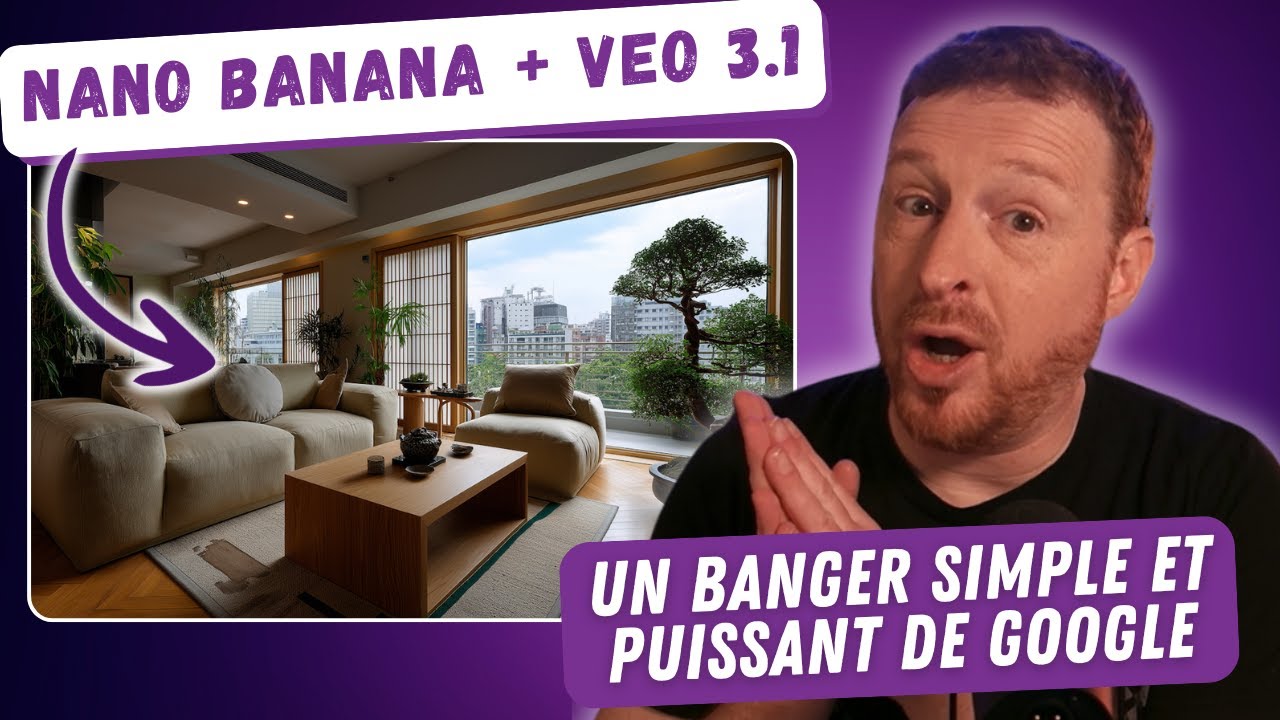
Révolution créative : donnez vie à vos images avec la magie de Nano Banana et Veo 3.1 !
Creative revolution: bring your images to life with the magic of Nano Banana and Veo 3.1!
Keywords
Summary
145 words
Critical Evaluation
Value of the Information & Strength of the Argument
The video’s value lies in its practical, hands-on demonstration of a specific AI workflow. It provides a clear, step-by-step guide that viewers can replicate, which is more actionable than a purely theoretical discussion. The argumentation is based on the creator’s direct experience, showing real examples of successes and failures (e.g., the need for multiple attempts). This lends credibility to the claims about the tools’ capabilities. However, the video does not delve into the underlying technology or compare it systematically with alternatives, limiting its depth.
Scientific Rigor, Source Quality, Title Accuracy
The video is a tutorial, not a scientific presentation, so the rigor is appropriate for that format. The creator does not cite external sources, but he does reference the tools themselves (Nano Banana, Veo 3.1) and the platform (Google AI Studio). The title accurately describes the content, which is a creative demonstration of these tools. The video’s claims are based on personal observation, which is acceptable for a tutorial but not for a formal review. The description includes a link to the creator’s website, but no other sources are provided.
189 words
Title / Content Match
The title accurately reflects the content, which focuses on combining Nano Banana and Veo 3.1 for creative video generation.
Quality & Reliability
7/10
The video is a practical tutorial demonstrating a specific workflow using Google's Nano Banana and Veo 3.1. The information is accurate and based on direct experience, but it lacks in-depth technical details and external sources. The creator's enthusiasm is clear, but the content is primarily anecdotal.
Key Moments
Markers derived by PSI from the transcript: the creator did not define chapters.
- Introduction: presenting the combo of Nano Banana and Veo 3.1 for creative video generation.
- First example: using Nano Banana to remove furniture from a room while preserving the view.
- Explanation of Nano Banana's capabilities: editing images while maintaining context and perspective.
- Introducing Veo 3.1 and its start-frame/end-frame feature for video generation.
- Demonstration: generating a video where furniture appears in a room, using two images as start and end frames.
- Mention of Veo 3.1's audio generation capability and a tip about trimming the final fraction of a second.
- Second example: transforming a suitcase image from open to closed, showing the iterative process.
- Conclusion: encouraging viewers to experiment and share their creations on the community site.
Cited Sources
- Renaud Dékode website — The creator's community site, mentioned for sharing creations and discussions.
Concurring Sources
- Google AI Studio — The platform used to access Nano Banana and Veo 3.1, as mentioned in the video.
Contribution & Novelties
The video’s original contribution is the clear demonstration of a practical workflow combining two specific Google AI tools (Nano Banana and Veo 3.1) to create dynamic videos from static images. It highlights the ease of use and the creative potential of this combination, which is not widely covered in other tutorials. The focus on the start-frame/end-frame feature of Veo 3.1 is particularly useful for creators.
Pour aller plus loin :
- Google AI Studio — The platform used to access Nano Banana and Veo 3.1.
- Veo 3.1 documentation — Official information about Veo 3.1.
- Gemini 2.5 Flash Image — The underlying model for Nano Banana.
- Midjourney — The image generation tool mentioned as a source of inspiration.
116 words
Radar Profile
The radar profile shows a balanced performance across all dimensions, with slightly higher scores in quality and reliability compared to quantity and technical depth. This reflects a practical, hands-on tutorial that is trustworthy but not exhaustive.