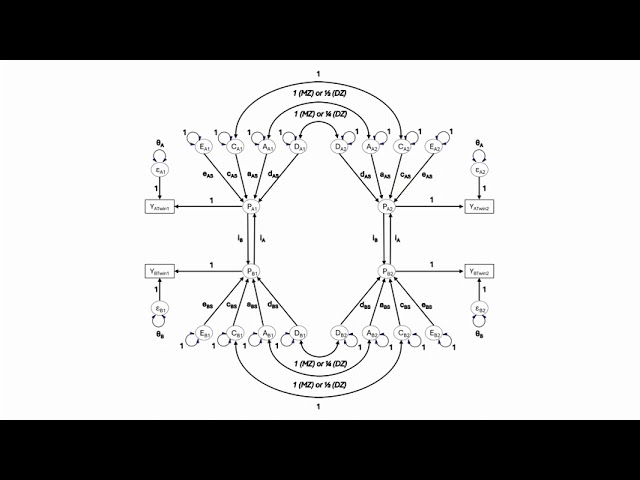
Direction of Causation Modeling in the Classical Twin Design Part 2
Keywords
Summary
182 words
Critical Evaluation
Value of the Information & Strength of the Argument
The video provides valuable information for researchers interested in twin modeling, particularly in understanding the identification of DOC models. It clearly explains the counting of informative statistics and the assumptions that reduce the number of independent pieces of information. The argumentation is logical and well-structured, with a step-by-step derivation of the nine informative statistics. The presenter effectively uses visual aids (covariance matrices) to illustrate the concepts. The explanation of why certain parameters must be dropped to achieve identification is convincing, and the nesting of the reciprocal causation model within the general bivariate model is correctly presented. The video does not delve into alternative approaches or potential criticisms, but within its scope, the argumentation is solid.
Scientific Rigor, Source Quality, Title Accuracy
The video demonstrates scientific rigor in its technical explanations, but it does not cite specific sources or references. The content is consistent with standard biometrical genetics literature, but the lack of citations reduces the verifiability of the claims. The title accurately reflects the content, which is a continuation of a tutorial on DOC modeling. The video does not mention any external sources, and the description provides no links. Therefore, the scientific rigor is high in terms of internal consistency, but the absence of citations limits the ability to cross-check the information. The title is appropriate and does not overpromise.
229 words
Title / Content Match
The title accurately reflects the content, which focuses on the identification and parameterization of direction of causation models in twin designs.
Quality & Reliability
8/10
The video is a technical tutorial on statistical modeling in twin studies. It provides a clear, step-by-step explanation of model identification, parameter counting, and assumptions. The content is logically structured and mathematically sound, though it lacks explicit citations to external sources. The presenter appears knowledgeable, and the explanations are consistent with standard biometrical genetics theory.
Key Moments
Markers derived by PSI from the transcript: the creator did not define chapters.
- Introduction to the video's focus on model identification and information sources.
- Explanation of the unidentified model and the necessary condition for identification.
- Presentation of covariance matrices for MZ and DZ twins, noting the naive count of 20 statistics.
- Discussion of assumptions about equal variances across twins and zygosity, reducing information to one piece for YA variance.
- Explanation of the variance of YB providing one additional piece of information.
- Introduction of cross-trait covariance as the third piece of information.
- Explanation of cross-twin covariances for YA and YB, providing four pieces of information.
- Discussion of cross-twin cross-trait covariances, providing two final pieces of information, totaling nine.
- Introduction of the general bivariate twin model using all nine pieces of information.
- Explanation of dropping dominance and common environmental effects to reduce parameters.
- Discussion of dropping measurement error terms to further reduce parameters.
- Presentation of the reciprocal causation model with eight parameters and nine pieces of information.
- Explanation of nesting of reciprocal causation model within general bivariate model and testing via likelihood ratio.
- Discussion of testing unidirectional models and comparison using AIC.
- Conclusion and preview of next video on causal inference information.
Contribution & Novelties
This video provides a clear and detailed explanation of the identification of direction of causation models in twin studies, specifically focusing on the counting of informative statistics and the assumptions that reduce the number of independent pieces of information. It is a valuable educational resource for researchers and students in quantitative genetics. The video does not present new research but rather synthesizes existing knowledge in an accessible manner.
Pour aller plus loin :
- Twin studies and structural equation modeling — Provides background on twin studies and their use in genetics.
- Structural equation modeling — Overview of SEM, which is the framework used in the video.
- Biometrical genetics — Discusses the genetic modeling of twin data.
- Model identification — General concept of identifiability in statistical models.
125 words
Radar Profile
The radar profile shows high scores across all dimensions, indicating a technically rigorous and informative tutorial. The video excels in providing clear explanations and accurate statistical content, with a strong focus on model identification. The lack of citations is a minor weakness, but the overall quality is high.