Polygenic Prediction: Part 4 Bayesian methods for PGS prediction
Keywords
Summary
133 words
Critical Evaluation
Value of the Information & Strength of the Argument
The video provides a comprehensive and well-structured introduction to Bayesian methods for PGS prediction. It clearly explains the theoretical foundations, including the Bayes theorem and prior distributions, and connects them to practical algorithms like MCMC. The argumentation is solid, using examples and comparisons to illustrate the advantages of Bayesian approaches over BLUP. The instructor also addresses practical challenges, such as convergence and LD estimation, which adds depth and realism. The content is highly valuable for researchers or students in statistical genetics seeking a conceptual understanding of these methods.
97 words
Title / Content Match
The title accurately reflects the content, which focuses on Bayesian methods for polygenic score prediction.
Quality & Reliability
8/10
The video is a technical lecture from an academic workshop, presenting established statistical methods (Bayesian alphabet, MCMC) with clear explanations and references to key literature. The content is accurate and well-structured, though it lacks formal citations within the video itself.
Key Moments
Markers derived by PSI from the transcript: the creator did not define chapters.
- Introduction to Bayesian methods for polygenic prediction and comparison with BLUP.
- Explanation of the infinitesimal model and its limitations.
- Introduction of BayesA and the use of t-distribution for SNP effects.
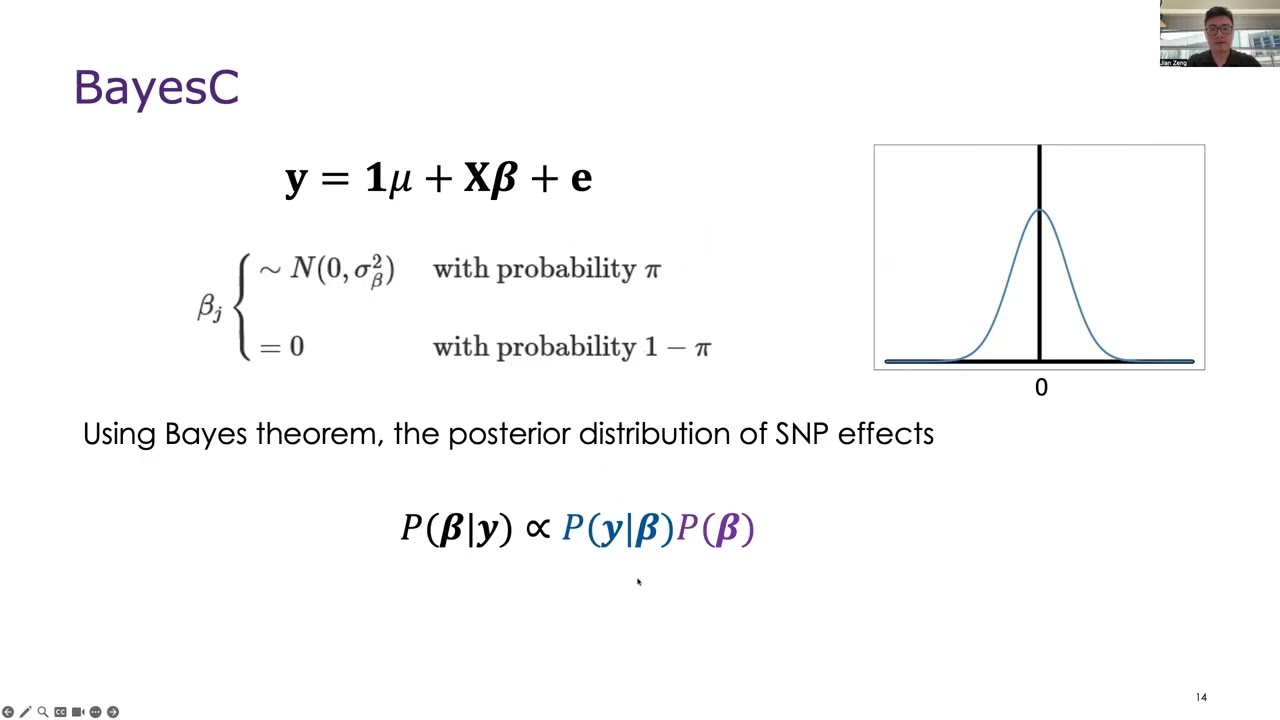
- Overview of Bayesian alphabet methods (BayesB, BayesC, BayesR) and their features.
- Explanation of Bayes theorem and its application in estimating parameters.
- Example of estimating average height using prior and likelihood.
- Derivation of posterior distribution and connection to BLUP.
- Introduction to MCMC algorithm for sampling from posterior distribution.
- Discussion of trace plots, burn-in, and posterior inclusion probability (PIP).
- Transition to summary-statistics-based methods and their advantages.
- Derivation of summary-level model from individual-level model.
- Discussion of convergence issues and practical recommendations.
Cited Sources
- Landmark paper on BayesA — Mentioned as the earliest Bayesian model for genomic prediction.
- PRS-CS — Mentioned as a continuous shrinkage prior method.
- LDpred2 — Mentioned as a spike-and-slab or normal mixture model.
- SBayesR — Mentioned as a multi-component mixture model.
Concurring Sources
- Meuwissen et al. (2001) Prediction of total genetic value using genome-wide dense marker maps — Foundational paper introducing BayesA and BayesB.
- Vilhjálmsson et al. (2015) Modeling Linkage Disequilibrium Increases Accuracy of Polygenic Risk Scores — Introduces LDpred, a Bayesian method for PGS.
- Lloyd-Jones et al. (2019) Improved polygenic prediction by Bayesian multiple regression on summary statistics — Introduces SBayesR, a summary-statistics-based Bayesian method.
Contribution & Novelties
The video provides a clear and accessible explanation of Bayesian methods for polygenic prediction, bridging theoretical concepts with practical implementation. It emphasizes the flexibility of Bayesian priors and the importance of MCMC for posterior inference. The discussion of summary-statistics-based methods and convergence issues is particularly valuable for practitioners.
Pour aller plus loin :
- Bayesian statistics — Overview of Bayesian inference.
- Markov chain Monte Carlo — Explanation of MCMC algorithms.
- Genome-wide association study — Background on GWAS and summary statistics.
79 words
Radar Profile
The radar profile shows high scores across all dimensions, indicating a well-balanced and reliable educational resource. The video excels in technical depth and clarity, making it suitable for an audience with some background in genetics and statistics.
💬 No comments were provided for analysis.