Modeling genetic and environmental sources of variation in multiple traits
Keywords
Summary
152 words
Critical Evaluation
Value of the Information & Strength of the Argument
The lecture provides a clear and systematic explanation of bivariate twin modeling, building logically from univariate concepts. It emphasizes the interpretation of cross-twin cross-trait correlations and distinguishes between different summary statistics, which is valuable for researchers. The argumentation is solid, grounded in established quantitative genetics theory. The presentation is technical but accessible to those with a background in twin modeling.
Scientific Rigor, Source Quality, Title Accuracy
The scientific rigor is high, as the content aligns with standard methods in statistical genetics. However, the video does not cite specific sources within the lecture, though the description mentions links to scripts and publications on the workshop website. The title accurately reflects the content, which is a focused lecture on multivariate twin models. No comments were provided for analysis.
135 words
Title / Content Match
The title accurately reflects the content, which focuses on extending twin models to multiple traits.
Quality & Reliability
8/10
The content is presented by an established workshop series (40 years), likely by an expert in statistical genetics. The lecture is technically accurate and follows standard quantitative genetics methodology. However, no specific sources are cited within the video, and the presenter's credentials are not explicitly stated.
Key Moments
Markers derived by PSI from the transcript: the creator did not define chapters.
- Introduction and outline of the lecture on multivariate twin models.
- Explanation of sources of covariation and the cross-twin cross-trait correlation.
- Discussion of the 4x4 covariance matrix and its key elements.
- Specification of the bivariate correlated factors model in OpenMx.
- Summarizing results: proportions of covariation vs. genetic/environmental correlations.
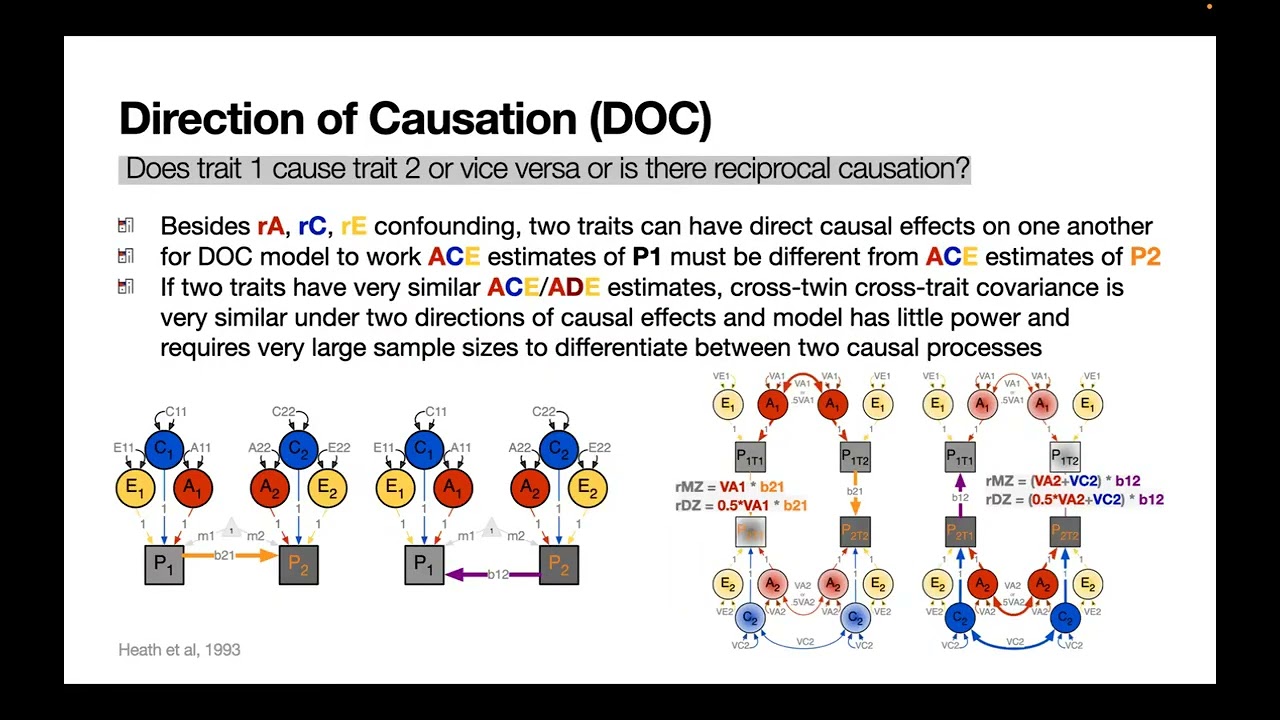
- Introduction to the direction of causation (DOC) model and its assumptions.
- Multivariate extensions: common pathway and independent pathway models.
- Overview of other genetically informative models (longitudinal, GxE, Mendelian randomization).
- Acknowledgements and closing remarks.
Cited Sources
- Workshop website with scripts and publications — Mentioned at the end of the video as a resource for scripts and referenced publications.
Concurring Sources
- Neale & Cardon (1992) Methodology for Genetic Studies of Twins and Families — Classic textbook covering twin model methodology.
Contribution & Novelties
The lecture provides a concise and clear introduction to bivariate and multivariate twin models, emphasizing the interpretation of cross-twin cross-trait correlations. It bridges univariate and multivariate approaches, making it a valuable educational resource. The distinction between bivariate heritability and genetic correlations is particularly useful.
Pour aller plus loin :
- Twin studies and heritability — Background on twin methodology.
- OpenMx software — Software used for fitting these models.
- Direction of causation models — Further reading on causal inference in twin studies.
80 words
Radar Profile
The radar profile shows high scores across all dimensions, indicating a well-balanced and informative lecture. The technical level is high, but the clarity of explanation ensures accessibility. The content is reliable and provides a solid foundation for further study.