Expression quantitative trait locus (eQTL) mapping: Context, GTEx, and interpretation
Keywords
Summary
170 words
Critical Evaluation
Value of the Information & Strength of the Argument
The lecture provides valuable insights into the complexity of eQTL interpretation, supported by examples from major studies. The argumentation is solid, building from early findings to the comprehensive GTEx resource, and effectively conveys the importance of context. The speaker’s expertise is evident, and the logical flow enhances the educational value.
Scientific Rigor, Source Quality, Title Accuracy
The scientific rigor is high, as the content is based on well-established consortium findings (GTEx, Geuvadis) and standard methodologies. However, specific citations are not provided in the video, limiting direct source verification. The title accurately reflects the content, which is appropriately focused on context and interpretation.
111 words
Title / Content Match
The title accurately reflects the content, which focuses on the context-dependence and interpretation of eQTLs, with GTEx as a central example.
Quality & Reliability
8/10
Lecture by a recognized expert in statistical genetics, presenting established findings from major consortia (GTEx, Geuvadis) with appropriate nuance. No citations to primary literature are given in the video, but the content aligns with current scientific consensus.
Key Moments
Markers derived by PSI from the transcript: the creator did not define chapters.
- Introduction to the lecture and the central theme of context-dependent genetic regulatory effects.
- Discussion of early eQTL studies in lymphoblastoid cell lines and the clustering of cis-eQTLs near transcription start sites.
- Explanation of context specificity with examples of presence/absence, effect size differences, and allelic direction flips.
- Overview of key context dimensions: ancestry, tissue/cell type, stimulation, sex, age, and environmental exposures.
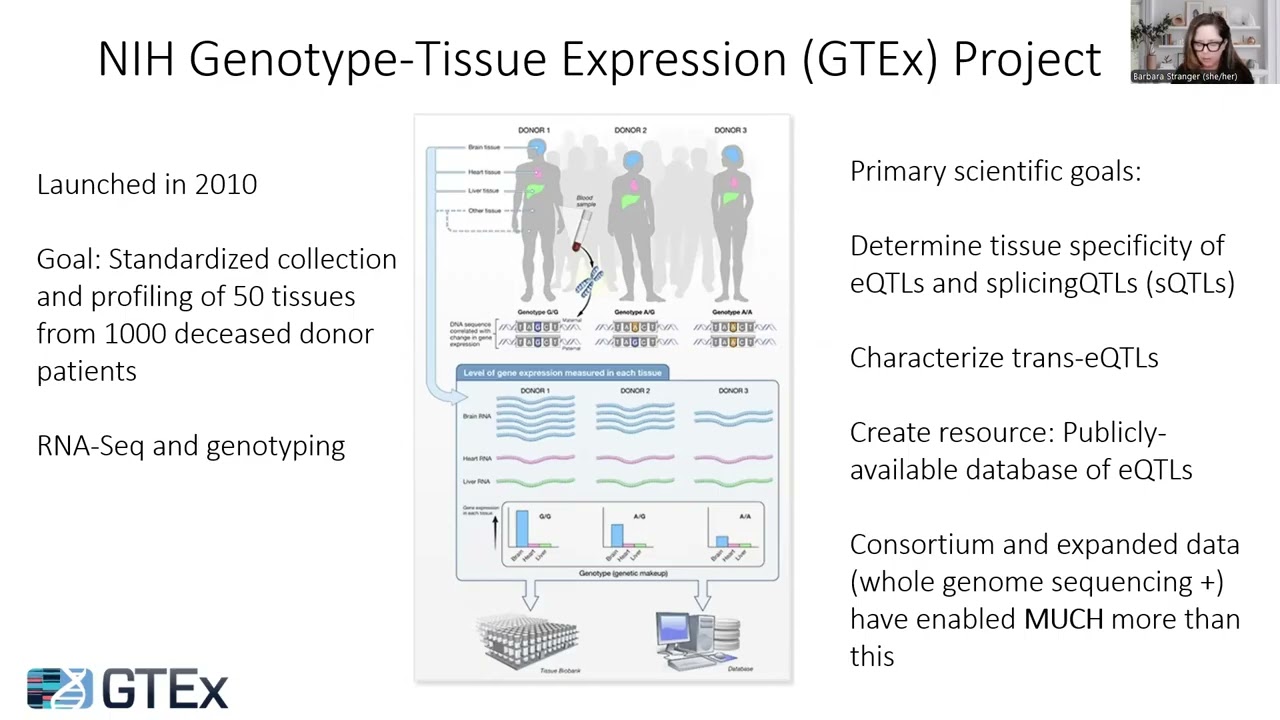
- Introduction to the GTEx project, its scale, and its goal to create a comprehensive catalog of eQTLs across tissues.
- Presentation of GTEx findings: widespread eQTLs, tissue-specific patterns, and the identification of trans-eQTLs.
- Discussion of sex-biased eQTLs and the importance of modeling genotype-by-sex interactions.
- Introduction to colocalization methods for linking eQTLs to disease and the summary of key takeaways.
Cited Sources
- GTEx Portal — Mentioned as a resource for exploring eQTL data interactively.
- eQTLGen Consortium — Mentioned as a complementary resource with large sample sizes in blood.
Concurring Sources
- GTEx Consortium — The main resource discussed, providing extensive eQTL data across tissues.
- eQTLGen Consortium — Complementary resource for blood eQTLs with large sample sizes.
Contribution & Novelties
The lecture provides a clear synthesis of eQTL context-dependence, drawing on major consortia findings. It emphasizes the importance of considering multiple biological contexts for accurate interpretation, which is a key takeaway for researchers. The discussion of sex-biased eQTLs and the need for context-specific studies adds depth.
Pour aller plus loin :
- GTEx Consortium paper — Key paper describing the GTEx resource and findings.
- eQTLGen Consortium paper — Large-scale eQTL meta-analysis in blood.
- Colocalization methods review — Overview of statistical approaches for colocalization.
82 words
Radar Profile
The radar profile shows high scores in quality and reliability, reflecting the expert presentation and established content. The moderate score in technical level indicates that while the lecture is accessible, it still requires some background in genetics. The quantity of information is good, but the lack of specific citations slightly reduces the overall score.
💬 No comments were provided for analysis.