Colocolization theory
Keywords
Summary
180 words
Critical Evaluation
Value of the Information & Strength of the Argument
The lecture provides a valuable overview of co-localization methods, explaining the conceptual basis and the evolution of statistical approaches. The argumentation is clear and logical, building from the initial problem to the development of more sophisticated methods. Neale effectively communicates the key insight that co-localization tests whether the same causal variant drives association signals in two traits, and he discusses the strengths and limitations of different approaches. The presentation is well-structured and accessible to an audience with some background in genetics.
90 words
Title / Content Match
The title 'Colocolization theory' is a slight misspelling of 'colocalization', but the content directly addresses the theory and methods of co-localization in statistical genetics.
Quality & Reliability
8/10
The lecture is delivered by a recognized expert in statistical genetics, providing a clear and accurate overview of co-localization methods. It references key papers and methods (Plagnol et al., Wallace et al., coloc, eCAVIAR) and discusses limitations and practical considerations. The content is technically sound and well-structured, though it is a high-level overview without detailed mathematical derivations.
Key Moments
Markers derived by PSI from the transcript: the creator did not define chapters.
- Introduction and motivation for co-localization
- Heuristic approach by Plagnol et al. (2009)
- Formalization by Wallace et al. and the beta1 proportional to beta2 test
- Introduction of the coloc package and its five hypotheses
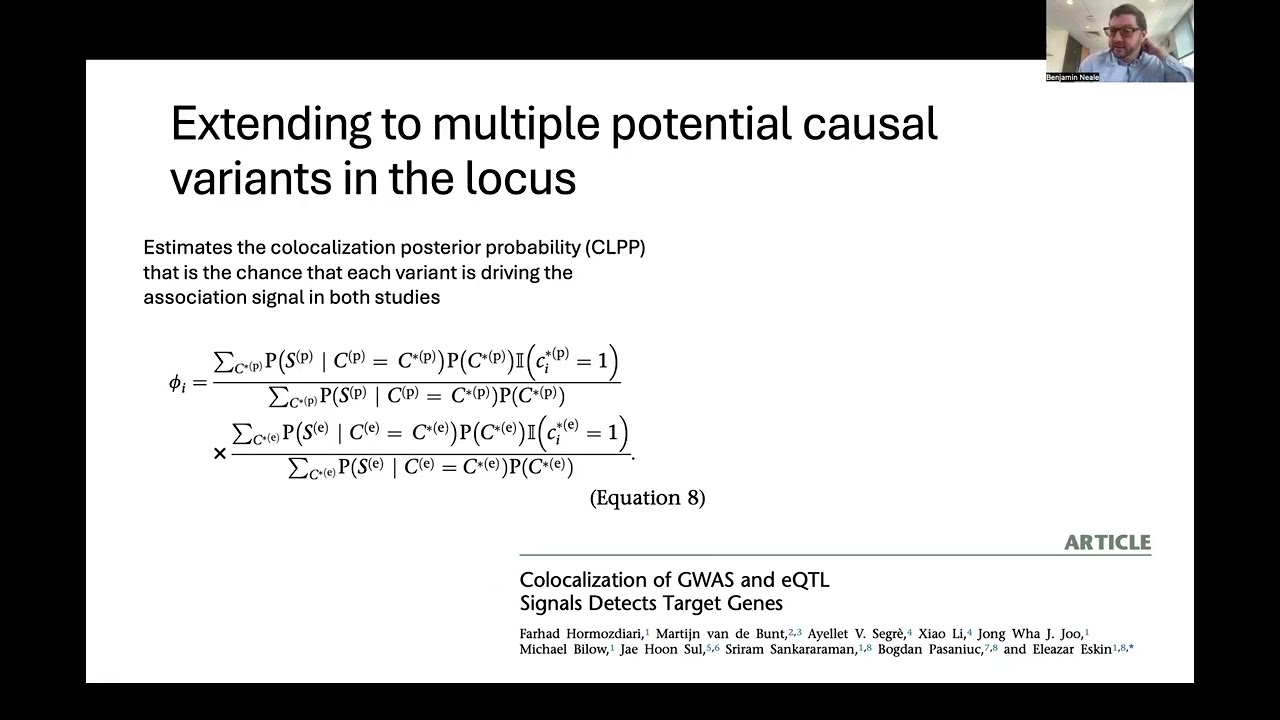
- Limitations of single causal variant assumption and extensions like eCAVIAR
- Conclusion: widespread functional variation and data quality considerations
Cited Sources
- Plagnol et al. (2009) - A unified approach to identifying shared genetic variants — Referenced as the initial heuristic approach to co-localization
- Wallace et al. - Formalization of co-localization test — Referenced as the formalization of the beta1 proportional to beta2 test
- Coloc package by Chris Wallace — Referenced as the implementation of the Bayesian co-localization framework
- eCAVIAR by Hormozdiari et al. — Referenced as an extension allowing multiple causal variants
Concurring Sources
- Plagnol et al. (2009) — Initial co-localization method
- Wallace et al. — Formalization of co-localization test
- Coloc package — Bayesian co-localization framework
- eCAVIAR — Extension for multiple causal variants
Contribution & Novelties
The lecture provides a clear and concise introduction to co-localization theory, synthesizing the key concepts and methods. It highlights the evolution from heuristic approaches to Bayesian frameworks and discusses practical considerations. The speaker’s expertise adds credibility, and the content is up-to-date with current methods.
Pour aller plus loin :
- Co-localization (Wikipedia) — Provides a general overview of co-localization in genetics.
- GWAS (Wikipedia) — Background on genome-wide association studies.
- Fine-mapping (Wikipedia) — Related concept of identifying causal variants.
- Coloc R package documentation — Official documentation for the coloc package.
- eCAVIAR paper — Original paper describing eCAVIAR method.
96 words
Radar Profile
The radar profile shows high scores in quality and reliability, with moderate scores in quantity and technical level. This indicates a well-presented, expert lecture that provides a solid overview but may not delve into deep technical details. The balance suggests a good introductory resource for those familiar with genetics.