Modeling/Estimating genetic and environmental components
Keywords
Summary
169 words
Critical Evaluation
Value of the Information & Strength of the Argument
The video provides a solid introduction to key concepts in quantitative genetics, with clear explanations of heritability, genetic relatedness, and the Haseman-Elston regression. The argumentation is logical, building from theory to practical implementation. The presenter effectively contrasts SNP-based and twin-based heritability estimates, highlighting assumptions and potential discrepancies. The tutorial on OpenMx is well-structured, demonstrating the translation of a simple linear regression into a structural equation model, which is valuable for researchers new to SEM. The value lies in bridging theoretical concepts with practical software application, making it a useful resource for students and researchers.
Scientific Rigor, Source Quality, Title Accuracy
The video is scientifically rigorous, adhering to established quantitative genetics theory. The presenter references software like GCTA and OpenMx, which are widely used and documented. The title accurately reflects the content. No external sources are cited in the video, but the methods discussed are standard in the field. The presentation is clear and well-organized, with appropriate technical depth. The lack of citations is a minor weakness, but the content is consistent with peer-reviewed literature.
183 words
Title / Content Match
The title accurately reflects the content, which focuses on modeling and estimating genetic and environmental components of traits.
Quality & Reliability
8/10
The video is a tutorial from an established workshop (International Statistical Genetics Workshop) presented by an expert (Hermine Maes). It covers established methods (Haseman-Elston regression, twin design, OpenMx) with clear explanations and references to software (GCTA, OpenMx). No claims are made without basis, and the content aligns with standard quantitative genetics theory.
Key Moments
Markers derived by PSI from the transcript: the creator did not define chapters.
- Introduction to the topic and overview of the four parts.
- Definition of heritability and its estimation from genetic relatedness.
- Introduction to Haseman-Elston regression and its use with SNP data.
- Comparison of SNP heritability and twin heritability methods.
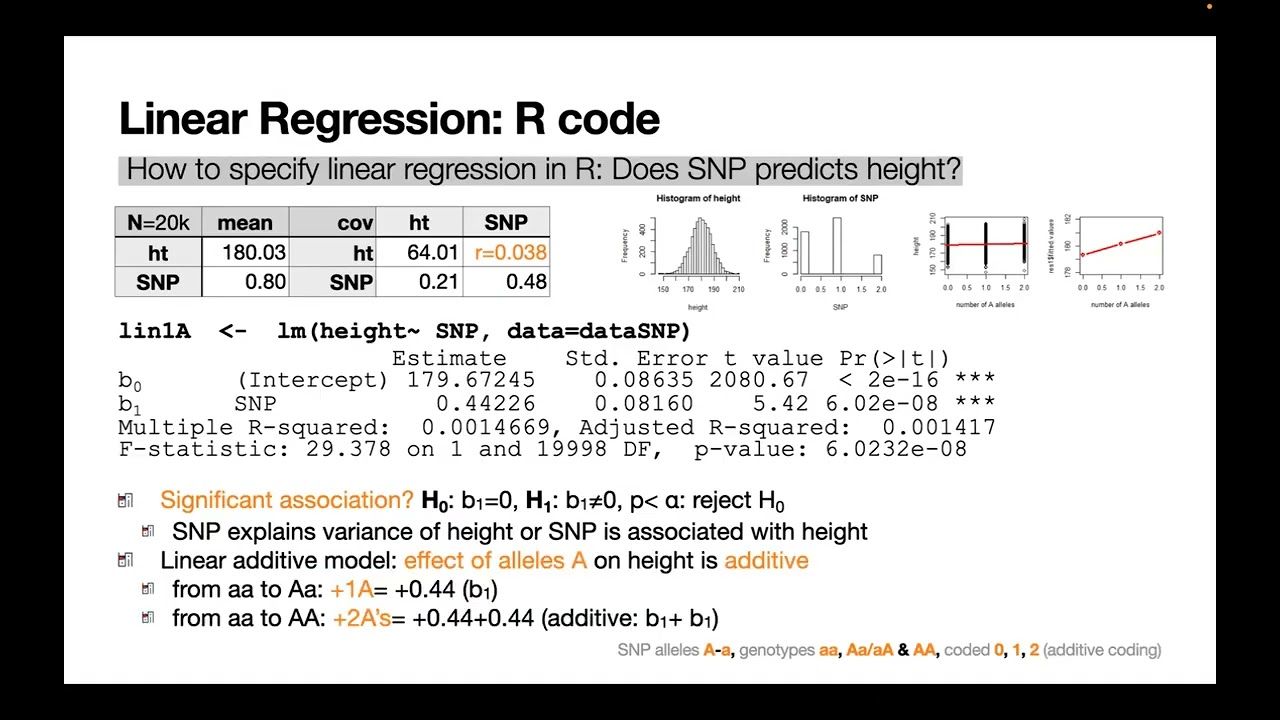
- Introduction to linear regression and its representation in R.
- Explanation of path analysis conventions and rules.
- Translation of linear regression into a path model.
- Introduction to OpenMx and its basic structure.
- Step-by-step OpenMx code for linear regression.
- Comparison of R and OpenMx results and advantages of OpenMx.
Cited Sources
- OpenMx website — Referenced as the source for OpenMx software and its documentation.
Concurring Sources
- OpenMx website — The video's tutorial aligns with OpenMx's official documentation and examples.
Contribution & Novelties
The video provides a clear pedagogical bridge between classical quantitative genetics methods (twin studies) and modern SNP-based approaches (Haseman-Elston regression), and demonstrates how to implement these models in OpenMx. It is particularly useful for researchers transitioning from basic linear regression to structural equation modeling for genetically informative data.
Pour aller plus loin :
- Haseman-Elston regression — Overview of the method and its historical context.
- Twin study — General information on twin designs and heritability estimation.
- OpenMx documentation — Official software documentation and tutorials.
- GCTA software — Tool for estimating genetic relatedness and heritability from SNP data.
96 words
Radar Profile
The radar profile shows high scores in quantity and quality of information, with moderate technical level and high reliability. This indicates a well-balanced educational resource that is both informative and trustworthy, suitable for intermediate learners.