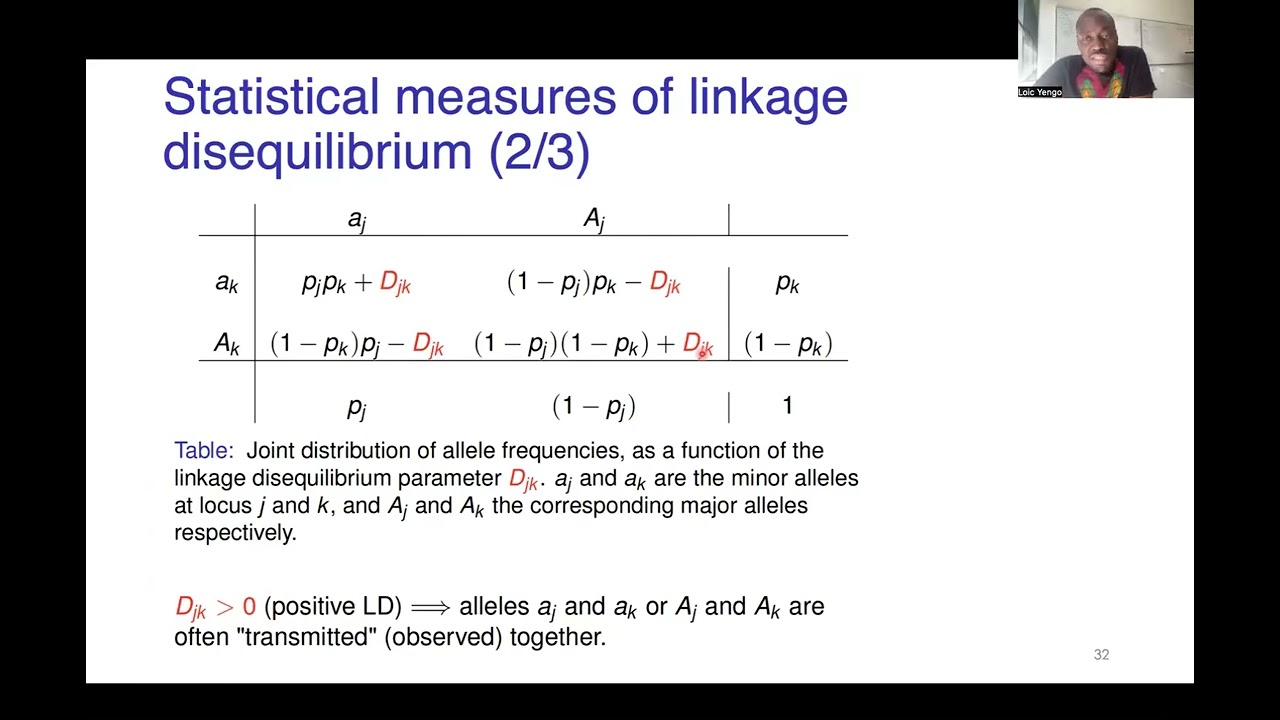
Introduction to population genetics: Part 4: Linkage disequilibrium
Keywords
Summary
143 words
Critical Evaluation
Value of the Information & Strength of the Argument
The lecture provides a clear and thorough explanation of linkage disequilibrium, building from biological mechanisms to statistical definitions. It uses intuitive examples and mathematical derivations to solidify understanding. The argumentation is solid, with logical progression from concept to application, and it effectively ties LD to evolutionary processes and population differences.
Scientific Rigor, Source Quality, Title Accuracy
The scientific rigor is high, with accurate definitions and formulas. The lecture references a 2015 paper from the 1000 Genomes project but does not provide full citation details, which is a minor weakness. The title accurately reflects the content, and the lecture is well-structured and pedagogically sound.
112 words
Title / Content Match
The title accurately reflects the content, which focuses on linkage disequilibrium as part of a series on population genetics.
Quality & Reliability
8/10
The lecture is scientifically rigorous, clearly explaining concepts with mathematical definitions and examples. It references a specific study (2015 paper using 1000 Genomes data) but does not provide full citation details. The content is well-structured and accurate, though it lacks explicit source citations for some claims.
Key Moments
Markers derived by PSI from the transcript: the creator did not define chapters.
- Introduction to linkage disequilibrium and meiosis
- Explanation of recombination and transmission of chromosome blocks
- Definition of haplotypes and their role in LD
- Statistical definition of LD: D, D', and r²
- Example calculation of LD from allele counts
- Decay of LD over time due to recombination
- Variation of LD between populations, citing 2015 study
- Summary and conclusion of the lecture series
Cited Sources
- 1000 Genomes Project — Mentioned as the source of data for the 2015 paper on LD variation across populations.
Concurring Sources
- Linkage disequilibrium — General reference supporting the definition and properties of LD.
Contribution & Novelties
This lecture provides a clear and accessible introduction to linkage disequilibrium, bridging biological concepts with statistical formulations. It emphasizes the decay of LD over time and its variation across populations, which is crucial for understanding evolutionary processes and applications in genetics.
Pour aller plus loin :
- Linkage disequilibrium — Comprehensive overview of LD, including definitions and applications.
- Haplotype — Explanation of haplotypes and their significance in genetics.
- Recombination (biology) — Detailed description of recombination mechanisms and consequences.
77 words
Radar Profile
The radar profile shows high scores in information quantity and quality, with slightly lower technical level, indicating a well-balanced lecture that is informative and accessible.