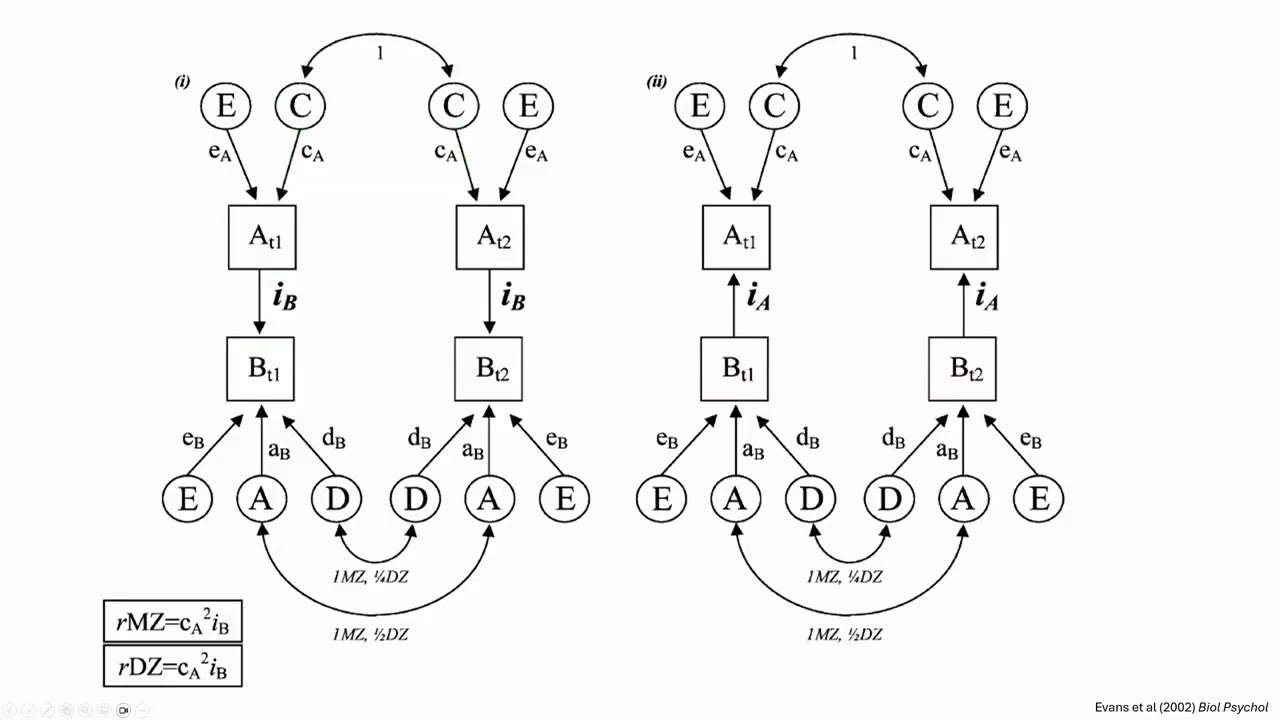
Direction of Causation Modeling in the Classical Twin Design Part 3
Keywords
Summary
146 words
Critical Evaluation
Value of the Information & Strength of the Argument
The video provides a clear and rigorous explanation of the statistical principles underlying direction of causation inference in twin studies. It carefully derives the expected covariances using path analysis, highlighting the key role of cross-twin cross-trait covariances. The argumentation is logical and well-structured, building from a simple model to the general principle. The presenter emphasizes the importance of distinct etiologies for power, which is a valuable insight. The tutorial is self-contained, assuming only basic knowledge of twin models and path analysis, and it encourages active learning by prompting viewers to pause and calculate. Overall, the content is highly informative and technically sound.
Scientific Rigor, Source Quality, Title Accuracy
The video is scientifically rigorous, with accurate path tracing and correct covariance derivations. It references a video by Matt Keller for path analysis rules, but does not cite specific scientific papers or external sources. The title accurately reflects the content, which is a focused tutorial on direction of causation modeling. The presentation is clear and well-organized, with visual aids that enhance understanding. No comments were provided for analysis.
185 words
Title / Content Match
The title accurately reflects the content, which focuses on modeling the direction of causation in twin studies.
Quality & Reliability
8/10
The video provides a rigorous mathematical derivation of expected covariances in twin models, with clear step-by-step path tracing. The content is technically accurate and well-explained, though it lacks citations to external sources and is presented as an educational tutorial rather than a peer-reviewed study.
Key Moments
Markers derived by PSI from the transcript: the creator did not define chapters.
- Introduction to the video and the model setup with two traits A and B.
- Explanation of the latent factors (A, D, C, E) and the assumption of variance 1.
- Introduction of the causal path from A to B and the concept of cross-twin cross-trait covariances.
- Step-by-step calculation of expected covariance for MZ twins under A causing B.
- Explanation of why only one path is valid and the result c_A^2 * i_B.
- Transition to the model where B causes A and calculation of expected covariances.
- Derivation of covariance contributions through A and D paths for MZ and DZ twins.
- Summary of expected covariances under both causal directions and the key difference between MZ and DZ.
- Conclusion and preview of the next video on problems with the model.
Cited Sources
- Matt Keller's video on path analysis — Referenced as a resource for path analysis rules.
Concurring Sources
- Twin studies and causal inference — General background on twin studies and their use in causal inference.
Contribution & Novelties
This video provides a clear pedagogical explanation of how direction of causation can be inferred in twin studies, focusing on the statistical information source. It emphasizes the role of cross-twin cross-trait covariances and the importance of distinct etiologies for power. The step-by-step derivations are valuable for students and researchers.
Pour aller plus loin :
- Direction of causation in twin models — Overview of twin studies and their applications.
- Structural equation modeling — General framework for modeling causal relationships.
- Path analysis (statistics) — Technique used in the video for covariance decomposition.
90 words
Radar Profile
The radar profile shows high scores in technical level and information quality, reflecting the video's rigorous mathematical content. The quantity of information is moderate, and the global reliability is strong, indicating a trustworthy educational resource.