Mathematical motivation for fine mapping
Keywords
Summary
214 words
Critical Evaluation
Value of the Information & Strength of the Argument
The video provides a high-value explanation of the mathematical underpinnings of fine-mapping, which is often treated as a black box. The argumentation is solid, building from basic linear regression to the Bayesian framework, and clearly justifies each step. The toy examples effectively illustrate the concepts and the limitations of naive approaches. The presenter also addresses common questions and concerns, such as the M>N problem and the issue of highly correlated variants, providing a thorough understanding of why fine-mapping methods are necessary. The explanation of ABF is particularly valuable, as it forms the basis for more complex methods. The discussion of computational challenges and the two main strategies to overcome them (search space reduction and decomposition) is insightful and sets the stage for understanding modern fine-mapping tools.
Scientific Rigor, Source Quality, Title Accuracy
The scientific rigor is high. The presenter demonstrates a deep understanding of the statistical concepts and correctly explains the mathematical details. The video is well-structured and the content is accurate. The sources cited are relevant and include key papers in the field, such as the original ABF paper and methods like FINEMAP and SuSiE. The title accurately reflects the content, which focuses on the mathematical motivation and foundations of fine-mapping. The presentation is clear and the mathematical derivations are correct. The video does not include any obvious errors or misleading statements. The description also provides a good summary of the content.
242 words
Title / Content Match
The title accurately reflects the content, which focuses on the mathematical motivation and foundations of fine-mapping.
Quality & Reliability
8/10
The video provides a clear and rigorous mathematical explanation of fine-mapping, with a solid foundation in Bayesian statistics. It correctly describes the limitations of simple linear regression in GWAS and the rationale for fine-mapping. The presentation is well-structured and includes toy examples that illustrate the concepts. The speaker demonstrates a deep understanding of the subject and cites relevant literature. The content is accurate and up-to-date, with no obvious errors or misleading statements.
Key Moments
Markers derived by PSI from the transcript: the creator did not define chapters.
- Introduction and overview of the video's purpose.
- Explanation of simple linear regression and its role in GWAS.
- Toy example showing how correlation can inflate effect sizes in simple regression.
- Introduction to multiple linear regression and its ability to recover true causal variants.
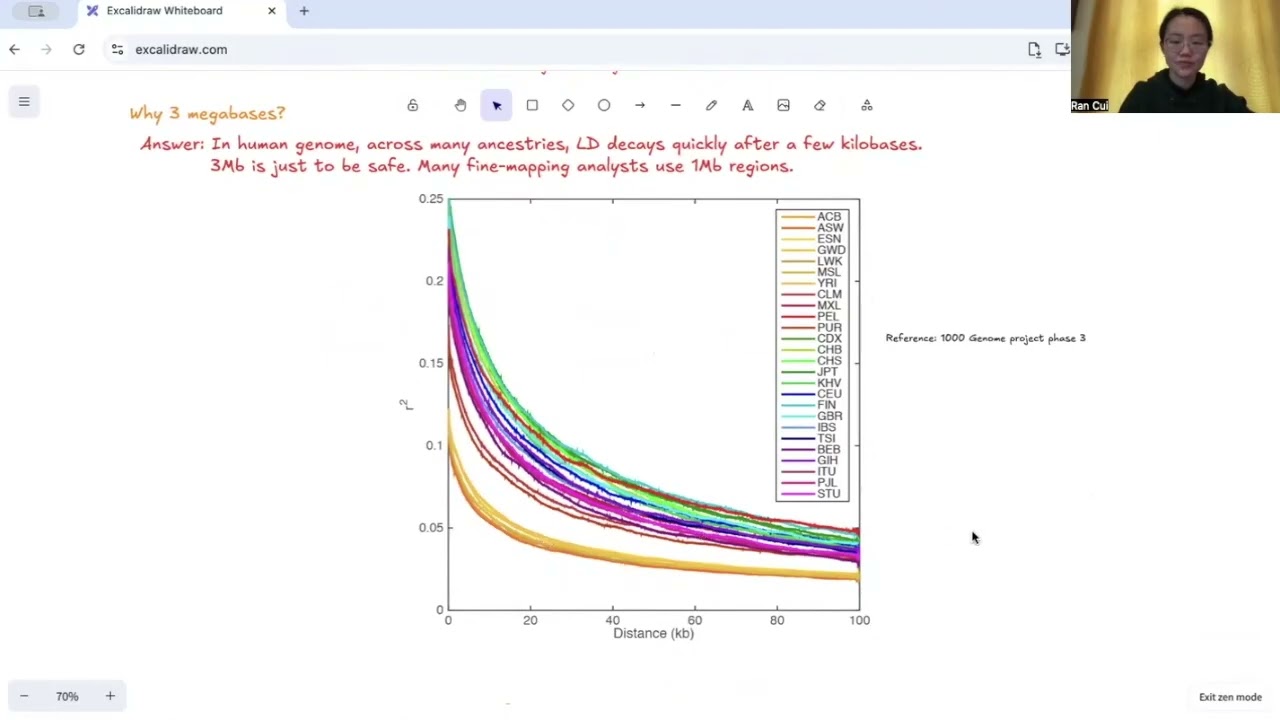
- Discussion on the need for fine-mapping and the concept of LD-independent regions.
- Explanation of how genomic regions are defined iteratively around lead SNPs.
- Introduction to the M>N problem and the issue of highly correlated variants.
- Transition to Bayesian fine-mapping and the concept of posterior probability.
- Derivation of the Bayes factor and its computation from GWAS summary statistics.
- Discussion of causal priors and the calculation of posterior inclusion probabilities.
- Limitations of ABF and introduction to methods for multiple causal variants (FINEMAP, SuSiE).
- Conclusion and list of recommended papers for further reading.
Cited Sources
- Approximate Bayes factors and the detection of associations in genome-wide studies — Original paper introducing the Approximate Bayes Factor method for fine-mapping.
- FINEMAP: efficient variable selection using summary data from genome-wide association studies — Paper describing the FINEMAP method for fine-mapping with multiple causal variants.
- SuSiE: A scalable and accurate fine-mapping method — Paper describing the SuSiE method for fine-mapping.
- DAP-G: A Bayesian fine-mapping method using deterministic search — Paper describing the DAP-G method for fine-mapping.
Concurring Sources
- Approximate Bayes factors and the detection of associations in genome-wide studies — The ABF method described in the video is based on this paper.
- FINEMAP: efficient variable selection using summary data from genome-wide association studies — FINEMAP is mentioned as a method that builds on ABF.
- SuSiE: A scalable and accurate fine-mapping method — SuSiE is mentioned as a method that builds on ABF.
Contribution & Novelties
This video provides a clear and accessible mathematical introduction to fine-mapping, which is often presented as a black box. It demystifies the underlying Bayesian framework and explains the key concepts of posterior probabilities, Bayes factors, and causal priors. The presenter uses intuitive toy examples to illustrate the challenges of correlated variants and the advantages of multiple regression. The video also discusses the computational burden of modeling multiple causal variants and introduces two main strategies to address it: stochastic/deterministic search (FINEMAP, DAP-G) and decomposition (SuSiE). This makes it a valuable resource for students and researchers new to the field.
Pour aller plus loin :
- Linkage disequilibrium — A fundamental concept in genetics that underpins fine-mapping.
- Bayesian inference — The statistical framework used in fine-mapping.
- Genome-wide association study — The context in which fine-mapping is applied.
134 words
Radar Profile
The radar profile shows high scores in information quality, technical level, and reliability, indicating a well-explained and accurate tutorial. The quantity of information is also high, covering both theoretical foundations and practical considerations. The overall profile suggests a highly informative and trustworthy educational resource.