Introduction to population genetics part3: Practical: Changes of allele and genotype frequencies
Keywords
Summary
165 words
Critical Evaluation
Value of the Information & Strength of the Argument
The video provides valuable information for understanding key concepts in population genetics, particularly the role of genetic drift and the interpretation of FST. The argumentation is clear and logical, building from basic definitions to more complex applications. The speaker uses intuitive analogies (e.g., random sampling) and visual aids to explain abstract concepts. The discussion of different FST estimators and their contexts adds depth. However, the video is primarily a lecture overview, and some claims could benefit from more explicit evidence or citations within the presentation.
Scientific Rigor, Source Quality, Title Accuracy
The scientific rigor is high, with references to seminal papers (Bhatia et al., Martin et al., Layer et al.) and the 1000 Genomes dataset. The speaker accurately describes the concepts and acknowledges limitations (e.g., simplified demographic history). The title accurately reflects the content, which is a practical introduction to allele and genotype frequency changes. The video’s focus on FST is a natural extension of the practical’s theme. No comments were provided for analysis.
173 words
Title / Content Match
The title accurately reflects the content, which introduces practical aspects of population genetics, focusing on changes in allele and genotype frequencies, and includes a theoretical segment on FST.
Quality & Reliability
8/10
The content is scientifically accurate, well-structured, and based on established population genetics concepts. The speaker references key literature (e.g., Bhatia et al., Martin et al., Layer et al.) and provides clear explanations. Minor limitations include a lack of formal citations in the video itself and a focus on conceptual overview rather than detailed derivations.
Key Moments
Markers derived by PSI from the transcript: the creator did not define chapters.
- Introduction to the practical and overview of evolutionary forces.
- Explanation of genetic drift as a random sampling process.
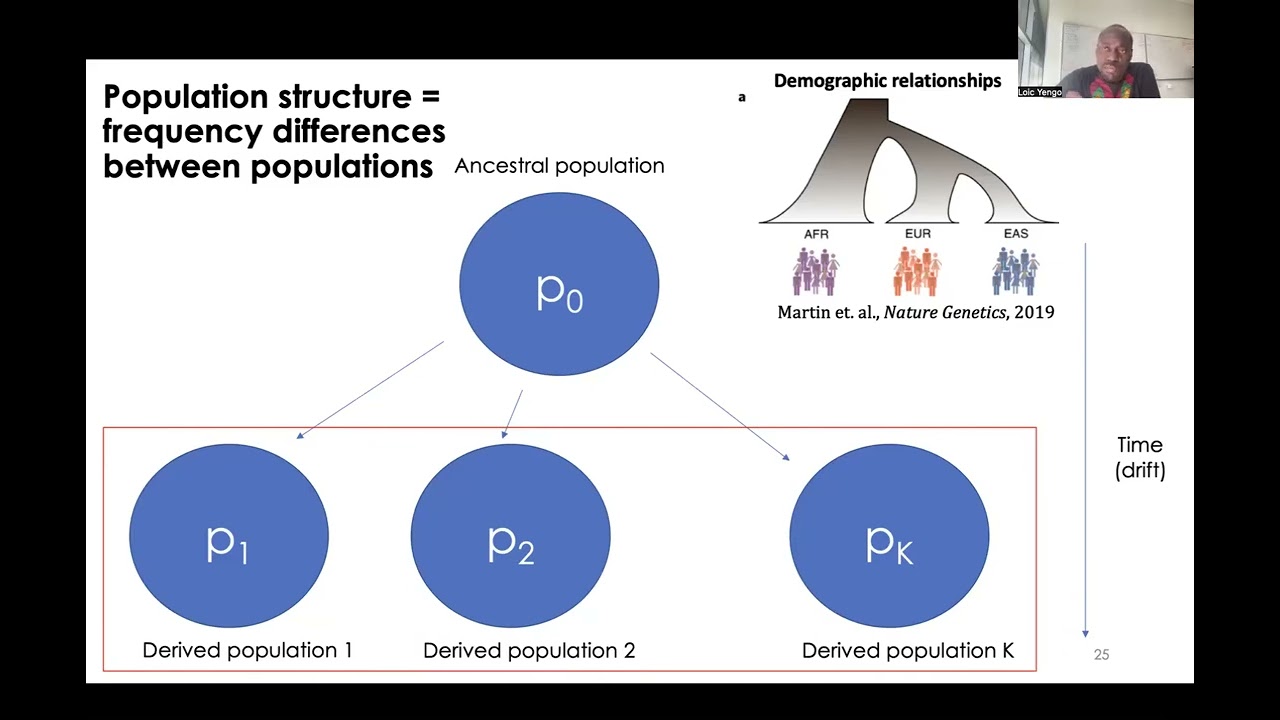
- Definition of population structure and its approximation with a tree model.
- Introduction to FST as a measure of genetic differentiation.
- Definition of FST using variance of allelic states.
- Interpretation of FST values (0 to 1) and typical ranges.
- Discussion of FST estimators and the Bhatia et al. paper.
- Genome-wide variation in FST and examples from Layer et al.
- Summary and preview of next part on linkage equilibrium.
Cited Sources
- Martin et al. 2019 (schematic of human population structure) — Referenced for a schematic of human population structure.
- Bhatia, Patterson, Sankararaman, and Price (paper on FST definition and interpretation) — Recommended for a comprehensive overview of FST estimators and interpretation.
- Layer et al. (paper on genome-wide FST variation) — Referenced for empirical examples of FST variation across the genome.
- 1000 Genomes dataset — Mentioned as a publicly available dataset used for comparisons.
Concurring Sources
- Bhatia et al. 2013 (Estimating and interpreting FST) — The video recommends this paper for a comprehensive overview of FST estimators, which aligns with its content.
- Weir and Hill 2002 (Estimating F-statistics) — The video discusses the Weir and Hill definition of FST, which is a key reference.
Contribution & Novelties
This video provides a clear and accessible introduction to FST and genetic drift, bridging theoretical concepts with practical simulation exercises. It emphasizes the importance of understanding different FST definitions and estimators, which is valuable for researchers. The video also highlights the genome-wide variability of FST, a nuance often overlooked.
Pour aller plus loin :
- Wright’s F-statistics — Overview of F-statistics in population genetics.
- Genetic drift — Detailed explanation of genetic drift and its effects.
- Population structure — Concepts and methods for studying population structure.
- 1000 Genomes Project — Information on the dataset mentioned in the video.
96 words
Radar Profile
The radar profile shows balanced scores across information quantity, quality, technical level, and reliability, indicating a well-rounded educational resource. The high technical level and reliability scores suggest the content is suitable for an audience with some background in genetics, while the information quantity is moderate due to the lecture's concise duration.