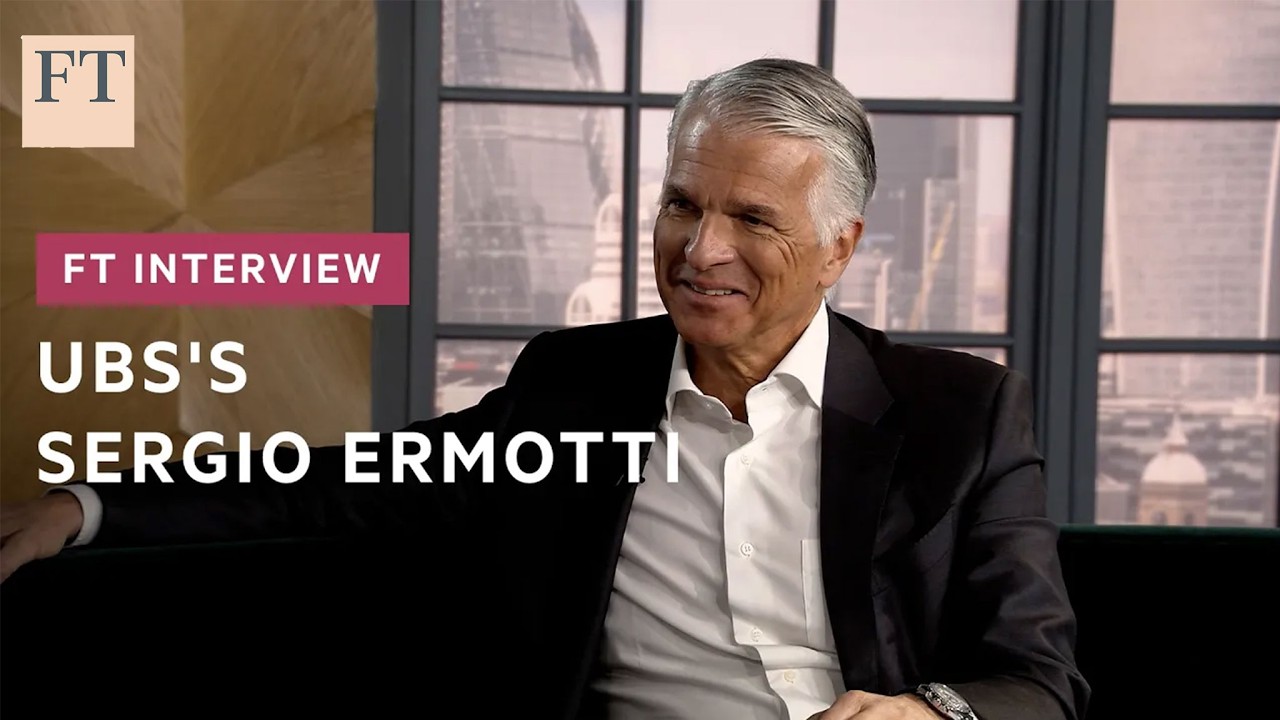
UBS's Sergio Ermotti on Swiss plans for stringent capital requirements | FT Interviews
Keywords
Summary
180 words
Critical Evaluation
The interview provides valuable insights into the strategic thinking of a major banking CEO during a critical period. Ermotti’s arguments are coherent and well-articulated, but they are inherently partisan, representing UBS’s interests. The discussion of capital requirements is framed as a conflict between the bank and Swiss authorities, with Ermotti presenting the bank’s position as reasonable and the regulators’ as excessive. While he provides some data points, such as the cultural integration metrics and headcount reductions, these are self-reported and not independently verified. The interview lacks critical probing on certain points; for instance, when Ermotti claims the regulatory framework worked, the interviewer does not challenge the fact that Credit Suisse still collapsed. The discussion of potential headquarters relocation is handled diplomatically, but the interviewer does not press for specifics. The broader critique of European over-regulation is a common theme among business leaders, but Ermotti offers no concrete solutions. The interview is informative for understanding UBS’s perspective, but it should be viewed as a corporate communication rather than an objective analysis. The adéquation titre/contenu is strong, as the title accurately reflects the main topic. Overall, the content is of good quality for its genre, but it lacks independent verification and critical balance.
201 words
Title / Content Match
The title accurately reflects the content, focusing on Sergio Ermotti's views on Swiss capital requirements and the broader regulatory standoff.
Quality & Reliability
8/10
The interview features a high-level executive discussing factual details about UBS's integration of Credit Suisse and regulatory debates. The information is presented as the CEO's perspective, with some quantitative data (e.g., headcount, cultural integration metrics) that appear credible. However, the content is primarily opinion and advocacy, with no independent verification or external sources cited within the video.
Key Moments
Markers derived by PSI from the transcript: the creator did not define chapters.
- Introduction of Sergio Ermotti and his background.
- Discussion on the integration of Credit Suisse and cultural integration metrics.
- Ermotti on the root causes of Credit Suisse's failure and lessons learned.
- Headcount reduction plans and the most painful part of integration.
- Ermotti on his tenure and future plans.
- Standoff with Swiss authorities over capital requirements.
- Discussion on potential headquarters relocation and contingency planning.
- Critique of European over-regulation and the Draghi report.
- Ermotti on UBS's profitability and tax contributions.
Cited Sources
- FT Edit — Promotional link for FT subscription, mentioned in the video description.
- FT Podcasts — Link to FT podcasts, mentioned in the video description.
Concurring Sources
- UBS Annual Report 2024 — UBS's official annual report, which may contain data on integration progress and financials.
Dissenting Sources
- Swiss Federal Council statement on too-big-to-fail reforms — The Swiss government's position on capital requirements may differ from Ermotti's perspective, as they argue for stricter measures to prevent future crises.
Contribution & Novelties
The interview provides a first-hand account from UBS’s CEO on the integration of Credit Suisse and the regulatory challenges, offering insights into the bank’s perspective on capital requirements and its future strategy. It highlights the cultural integration success and the bank’s operational achievements.
Pour aller plus loin :
- Draghi report on European competitiveness — The report referenced in the interview, discussing European economic challenges.
- Credit Suisse crisis overview — Background on Credit Suisse’s collapse and rescue.
- Swiss banking regulation — The Swiss Financial Market Supervisory Authority, relevant to the regulatory debate.
91 words
Radar Profile
The radar profile shows high scores in quality of information and reliability, reflecting the credibility of the interviewee and the professional production. The quantity of information is moderate, and the technical level is adequate for a general audience. The overall balance indicates a solid interview with valuable insights, though it is primarily opinion-based.
💬 No comments were provided for analysis.