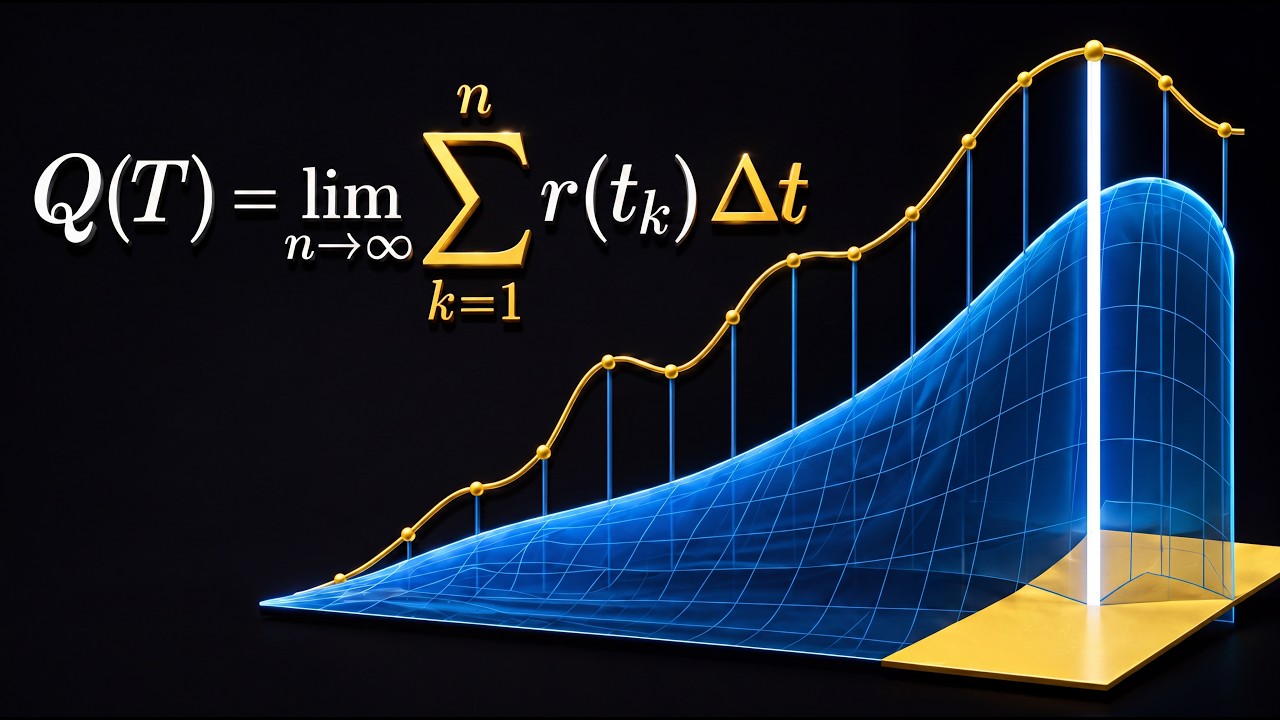
Calculus Explained Better Than College Ever Did!
Keywords
Summary
153 words
Critical Evaluation
Value of the Information & Strength of the Argument
The video’s value lies in its clear, step-by-step construction of calculus concepts from first principles, avoiding the common ‘rulebook’ approach. It provides strong geometric and physical intuitions (e.g., water flow, rocket motion) that make abstract ideas tangible. The argumentation is solid: the proof of the Fundamental Theorem is rigorous yet accessible, carefully handling limits and continuity. The video also addresses common misconceptions (e.g., why +C is needed, why signed area matters) which enhances its educational value. The use of multiple representations (graphical, algebraic, physical) strengthens the explanation.
Scientific Rigor, Source Quality, Title Accuracy
The video demonstrates high scientific rigor by correctly presenting the definitions and proofs of calculus. It cites original works by Barrow, Newton, and Leibniz, as well as modern open educational resources like OpenStax and MIT OpenCourseWare, which are reputable. The title accurately reflects the content, as the video indeed explains calculus more intuitively than typical college courses. The description also includes a note that animations are original, and the creator invites corrections, showing a commitment to accuracy.
179 words
Title / Content Match
The title accurately reflects the content: the video explains calculus concepts more intuitively than typical college courses, focusing on understanding rather than rote memorization.
Quality & Reliability
9/10
The video provides a rigorous, intuitive explanation of calculus, building concepts from first principles with clear geometric and physical interpretations. It correctly handles limits, the Fundamental Theorem of Calculus, and common pitfalls (e.g., +C, signed area). The historical references and links to open educational resources (OpenStax, MIT OCW) support its reliability. Minor simplifications (e.g., 'continuity' definition) are appropriate for the target audience and do not undermine accuracy.
Chapters
Cited Sources
- Isaac Barrow, The Geometrical Lectures of Isaac Barrow — Historical source for the geometric form of the inverse relationship between tangents and areas.
- Isaac Newton, The Method of Fluxions and Infinite Series — Original work by Newton on calculus, cited for historical context.
- Gottfried Wilhelm Leibniz, The Early Mathematical Manuscripts of Leibniz — Original manuscripts by Leibniz, cited for historical context.
- Andrew Leahy, James Gregory and the Pappus-Guldin Theorem, Mathematical Association of America — Historical article on James Gregory's contributions, cited in the video.
- OpenStax, Calculus Volume 1, Section 5.3: The Fundamental Theorem of Calculus — Free textbook reference for the Fundamental Theorem of Calculus.
- MIT OpenCourseWare, 18.01SC Single Variable Calculus — Free course material for single variable calculus.
Concurring Sources
- OpenStax Calculus Volume 1 — The textbook presents the same theorem and proof structure, confirming the video's accuracy.
- MIT OpenCourseWare 18.01SC — The course materials cover the same topics and provide additional practice, aligning with the video's content.
Contribution & Novelties
The video’s original contribution is its pedagogical approach: it builds the entire calculus narrative around the Fundamental Theorem, showing how derivatives and integrals are two sides of the same coin. It uses a consistent physical metaphor (water flow, rocket motion) to make abstract concepts tangible, and it explicitly addresses common misconceptions (e.g., why +C is needed, why signed area matters). The proof of the Fundamental Theorem is presented in a way that is both rigorous and accessible, emphasizing the cancellation of the shared region and the average height interpretation.
Pour aller plus loin :
- Fundamental theorem of calculus — Provides a comprehensive overview and formal statements.
- Riemann sum — Explains the construction of integrals via sums, which is central to the video’s approach.
- Limit (mathematics) — Foundational concept used throughout the video.
- Derivative — Further details on the definition and properties of derivatives.
- Integral — General overview of integration, including definite and indefinite integrals.
154 words
Radar Profile
The radar profile shows high scores across all dimensions, with a slight dip in technical level (8) compared to information quantity and quality (9). This indicates a well-balanced video that is both informative and rigorous, though it may not delve into the most advanced technical details, making it accessible to a broad audience.