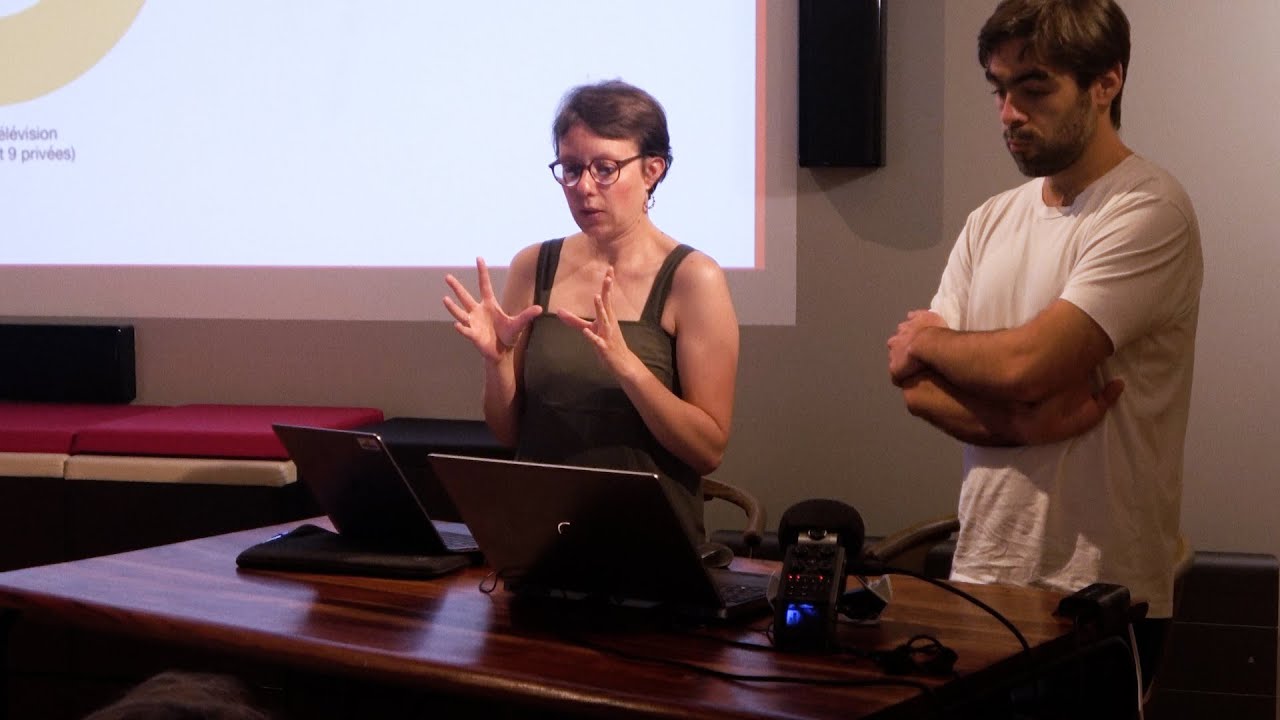
Maëlle Bazin et Arthur Lezer : Le podcast natif, un média paritaire ?
Keywords
Summary
180 words
Critical Evaluation
Value of the Information & Strength of the Argument
The presentation provides valuable insights into gender representation in a relatively understudied medium. The argumentation is solid, based on a large-scale quantitative analysis with a transparent methodology. The use of multiple metrics (overall share, median time ratio, distribution) strengthens the analysis. The comparison with traditional media and the identification of the ‘green ceiling’ effect are compelling. The qualitative observations on thematic segregation add depth. The study’s limitations are acknowledged, such as the exclusion of self-produced podcasts and paywalled content, which shows intellectual honesty.
Scientific Rigor, Source Quality, Title Accuracy
The study demonstrates scientific rigor through its systematic corpus construction and the use of a validated tool (INA Speech Segmenter). The sources cited include the INA archives and the Observatoire du podcast, which are relevant. The title accurately reflects the content. The presentation is part of a seminar series, and the methodology is explained in sufficient detail. However, the study is not peer-reviewed, and the results are preliminary. The discussion touches on the ARCOM’s regulatory role, but no specific sources are cited for that.
182 words
Title / Content Match
The title accurately reflects the content, which investigates gender parity in native podcasts.
Quality & Reliability
8/10
The presentation is based on a systematic study using a large corpus (1,573 podcasts, 24,000 hours) and a validated speech segmentation tool (INA Speech Segmenter). The methodology is transparent, and the results are contextualized with existing research. However, the study has limitations (e.g., missing paywalled podcasts, self-produced podcasts) and the presentation is a seminar talk, not a peer-reviewed publication.
Key Moments
Markers derived by PSI from the transcript: the creator did not define chapters.
- Introduction and context of the study
- Definition of native podcast and research objectives
- Corpus construction: 1,573 titles, 24,000 hours
- Methodology: INA Speech Segmenter for gender classification
- Key result: 36% women's speaking time in 2022
- Comparison by producer type: studios and platforms better than traditional media
- Thematic segregation: men in politics, women in daily life
- Conclusions and future research directions
Cited Sources
- INAthèque — Mentioned as the archive source for the podcast corpus.
- INA le lab hypotheses — Mentioned as the blog for the seminar and project information.
Concurring Sources
- ARCOM studies on gender representation in media — The study's finding of 36% women's speaking time aligns with ARCOM's observations for TV and radio.
Dissenting Sources
- Common perception of podcasts as more egalitarian — The study contradicts the popular belief that podcasts offer better gender representation than traditional media.
Contribution & Novelties
This study provides the first large-scale quantitative analysis of gender parity in native French podcasts, revealing that despite the medium’s novelty, it reproduces traditional gender inequalities. The use of a speech segmentation tool on a massive corpus is innovative. The identification of the ‘green ceiling’ effect and the polarized distribution of speaking time are novel contributions.
Pour aller plus loin :
- Gender Equality Monitor — Project page with related publications.
- INA Speech Segmenter — Open-source tool used for analysis.
- Observatoire du podcast — Source of podcast metadata.
- ARCOM gender studies — Context on traditional media gender representation.
97 words
Radar Profile
The radar profile shows high scores in information quantity, quality, and reliability, with a slightly lower technical level. This indicates a well-founded and informative presentation, though not highly technical in its delivery.
💬 No comments were provided for analysis.