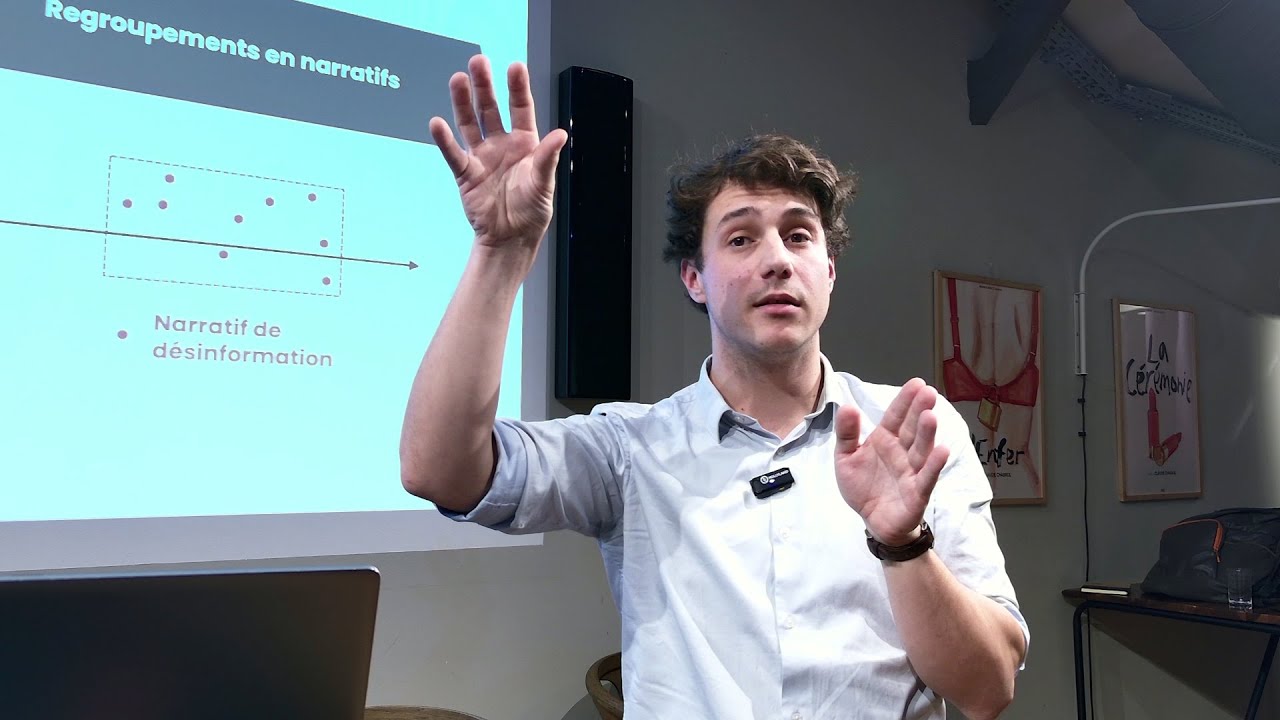
Jean Sauvignon : Désinformation climatique dans les médias audiovisuels
Keywords
Summary
171 words
Critical Evaluation
Value of the Information & Strength of the Argument
The talk provides valuable insights into the landscape of climate disinformation, particularly in traditional media, which is often overlooked in favor of social media. Sauvignon argues that traditional media have a greater causal impact on public opinion and are crucial for informing decision-makers. He supports his arguments with references to research and reports, such as the IPI report and UNESCO studies. The argumentation is structured and logical, moving from definitions to methodology to results. He acknowledges the limitations of his approach and emphasizes the importance of transparency and open-source methods. The discussion of the ‘coalition of the unwilling’ and the risks to democracy adds depth. However, some claims could benefit from more specific citations, and the talk is more of an expert opinion than a systematic review.
Scientific Rigor, Source Quality, Title Accuracy
The talk demonstrates scientific rigor through a clear methodological framework, including the use of a frugal and explainable AI model, and the distinction between disinformation and misinformation. Sauvignon cites several sources, including the IPCC, UNESCO, and the IPI, though not all claims are directly referenced. The title accurately reflects the content, focusing on climate disinformation in audiovisual media. The talk is part of a seminar series by INA, which adds credibility. However, as a presentation, it lacks the depth of a peer-reviewed publication, and some arguments rely on the speaker’s expertise rather than extensive citations.
237 words
Title / Content Match
The title accurately reflects the content, which focuses on climate disinformation in audiovisual media.
Quality & Reliability
8/10
The talk is based on documented research and data from an observatory, with a clear methodological approach and references to academic and institutional sources. However, it is an expert opinion rather than a peer-reviewed study, and some claims lack direct citations.
Key Moments
Markers derived by PSI from the transcript: the creator did not define chapters.
- Introduction and reading of examples of climate disinformation in French media.
- Discussion on the trust in traditional media and the limited impact of social media on public opinion.
- Definition of disinformation and misinformation, and the importance of intentionality.
- Presentation of the methodology: keyword-based classification and the use of a fine-tuned GPT-4-mini model.
- Discussion on the actors behind climate disinformation, including the 'coalition of the unwilling'.
- Examples of misinformation during extreme weather events and the impact on public trust.
- The role of traditional media in informing decision-makers and the need for advocacy.
- Discussion on the risks to democracy, security, and sovereignty, and the importance of protecting journalism.
- Conclusion and call for action, emphasizing the need for regulation and quality journalism.
Cited Sources
- INAthèque — Mentioned as a potential source of data for media analysis.
- INA le lab — Seminar series where the talk was given.
Concurring Sources
- IPCC Reports — The talk references the IPCC's role in highlighting the importance of media in shaping public perception.
- UNESCO Report on Safety of Journalists — The talk cites a UNESCO study indicating that 70% of environmental journalists have faced attacks.
Contribution & Novelties
The talk provides a novel perspective on climate disinformation by focusing on traditional media rather than social media, and by presenting a frugal and explainable AI methodology. It highlights the importance of distinguishing between disinformation and misinformation, and the need for human validation in automated detection. The discussion on the ‘coalition of the unwilling’ and the risks to democracy adds depth.
Pour aller plus loin :
- IPCC Reports — The IPCC reports are the scientific basis for climate change consensus, referenced in the talk.
- UNESCO Report on Safety of Journalists — The talk cites a UNESCO study on attacks against environmental journalists.
- International Panel on Information Environment (IPI) — The IPI is mentioned as a key actor in the fight against disinformation.
- David Chavalarias’ work on manipulation — The talk references David Chavalarias’ research on social media manipulation.
- Science Feedback — The observatory mentioned in the talk is a collaboration with Science Feedback.
153 words
Radar Profile
The radar profile shows high scores in quantity and quality of information, and moderate technical level, indicating a well-informed talk with a solid methodological approach. The global reliability is high, reflecting the use of documented sources and transparent methods.
💬 No comments were provided for analysis.