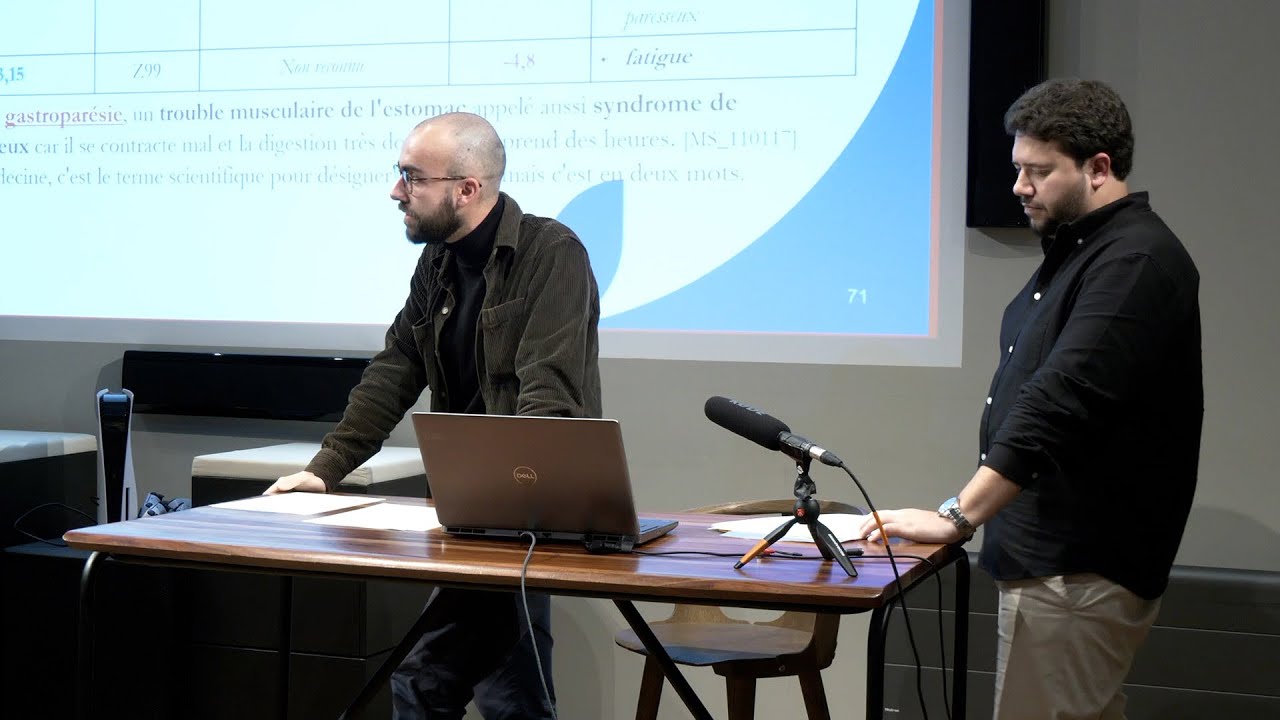
Marius François et Mohammed Hassan : les termes médicaux vulgarisés dans le "Mag de la Santé"
Keywords
Summary
143 words
Critical Evaluation
Value of the Information & Strength of the Argument
The presentation offers valuable insights into the methodology of detecting vulgarized medical terms using statistical measures. The argumentation is solid, grounded in established theories like communicative terminology and cognitive load theory. The presenters clearly explain their steps and justify their choices, such as lowering the specificity threshold. They also critically evaluate their results, acknowledging the low precision and the influence of the semantic tagging tool. The discussion of case studies (e.g., retinoblastoma, glaucoma) illustrates the practical application of their approach. However, the study is preliminary, and the sample size of detected terms is small, limiting the generalizability of the findings.
Scientific Rigor, Source Quality, Title Accuracy
The presentation demonstrates scientific rigor through a transparent methodology and acknowledgment of limitations. The sources cited are primarily the INA corpus and the Wmatrix tool, with references to theoretical frameworks like Cabré’s communicative terminology and Sweller’s cognitive load theory. The title accurately reflects the content, focusing on the vulgarization of medical terms in a specific program. The use of automatic transcription and semantic tagging introduces potential errors, but the presenters address these by manual correction and discussing the impact of Z99 tags. Overall, the scientific quality is good, though the study is not yet peer-reviewed.
210 words
Title / Content Match
The title accurately reflects the content: a presentation by two researchers on the vulgarization of medical terms in a specific TV program.
Quality & Reliability
7/10
The presentation is based on a clear methodological framework, using statistical measures and a defined corpus. However, the study is at an early stage, with acknowledged limitations in precision and reliance on automatic transcription and semantic tagging tools. The presenters are transparent about these limitations.
Key Moments
Markers derived by PSI from the transcript: the creator did not define chapters.
- Introduction and context: shift from paternalistic to participatory patient-doctor model
- Definition of vulgarized terms and communicative terminology
- Research objectives and hypotheses
- Explanation of specificity calculation and Wmatrix tool
- Description of corpora: INA corpus and reference corpus
- Methodology: tagging, lemmatization, and specificity thresholds
- Results: detected vulgarized terms and their counterparts
- Analysis of complexity scale: morphological transparency and frequency
- Case studies: retinoblastoma and glaucoma
- Conclusion and limitations: low precision and future improvements
Cited Sources
- INAthèque — Source of the corpus of 'Le Mag de la Santé' transcriptions
- INA le lab — Seminar series where this presentation was given
Concurring Sources
- Cabré, M. T. (1999). Terminology: Theory, methods and applications. — Theoretical framework for communicative terminology.
- Sweller, J. (1988). Cognitive load during problem solving. — Basis for cognitive load assessment.
Dissenting Sources
- No discordant sources found. — The presentation did not mention any conflicting sources.
Contribution & Novelties
The presentation offers a novel methodological approach to automatically detect vulgarized medical terms using a combination of lexical and semantic specificity measures. This contributes to the field of health communication and terminology by providing a quantitative method to identify terms that are made accessible to the general public. The analysis of specific examples and the complexity scale provides a nuanced understanding of the vulgarization process.
Pour aller plus loin :
- Communicative terminology — Overview of terminology theories, including Cabré’s communicative approach.
- Cognitive load theory — Sweller’s theory used to assess cognitive load in term comprehension.
- Wmatrix — The semantic tagging tool used in the study.
- Whisper — The automatic speech recognition tool used for transcription.
115 words
Radar Profile
The radar profile shows high scores in information quantity and technical level, indicating a detailed and methodologically advanced presentation. The lower scores in information quality and global reliability reflect the preliminary nature of the study and acknowledged limitations. Overall, the presentation is informative but not yet fully validated.
💬 Sur les 0 commentaires analysés, aucune tendance n'a pu être dégagée.