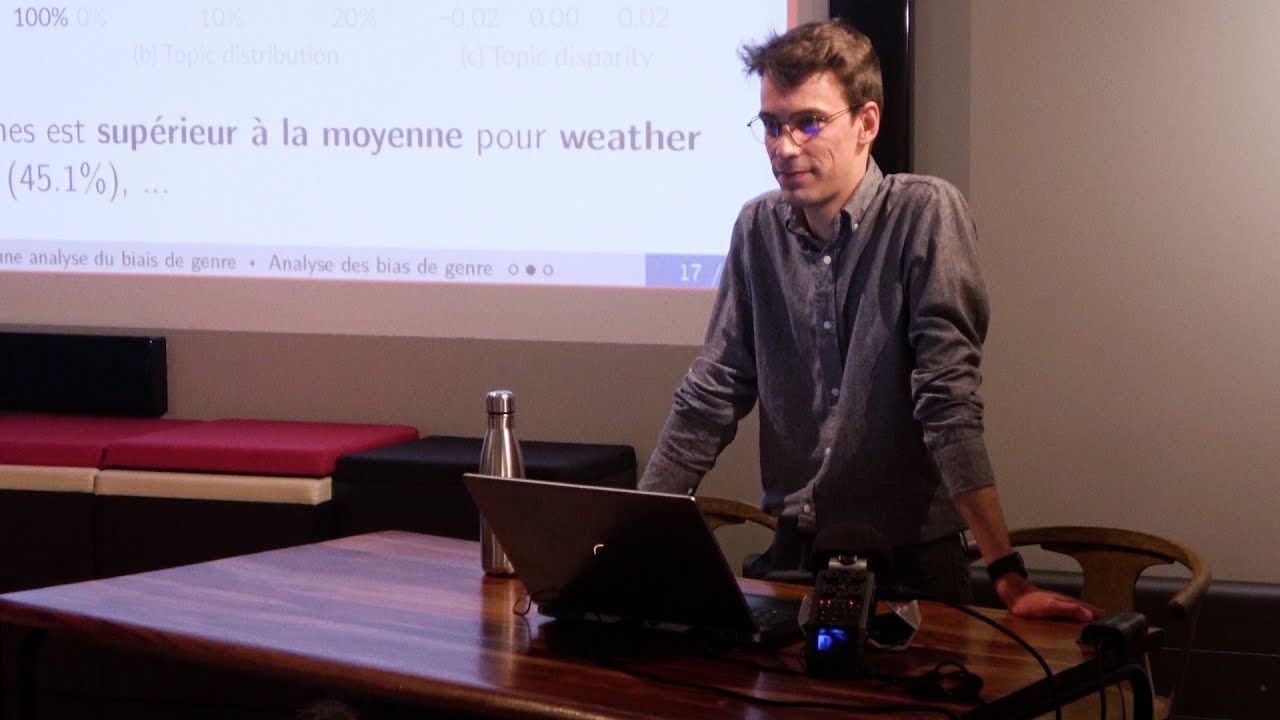
Valentin Pelloin : Classification automatique de sujets de JT et analyse des biais de genre
Keywords
Summary
172 words
Critical Evaluation
Value of the Information & Strength of the Argument
The presentation provides valuable insights into the application of LLMs for large-scale media analysis. The argumentation is solid, with a clear methodology and evaluation. The speaker demonstrates the effectiveness of a teacher-student approach, where a smaller model trained on LLM-generated data can achieve better performance than the LLM itself, while being more efficient. The study’s findings on gender bias are significant and align with previous research. The speaker also honestly discusses limitations, such as the difficulty of the classification task and the binary gender detection.
Scientific Rigor, Source Quality, Title Accuracy
The scientific rigor is high: the study uses a systematic approach, with manual annotation, inter-annotator agreement, and evaluation metrics. The sources are not explicitly cited in the talk, but the speaker mentions collaboration with ARCOM and references the GMMP. The title accurately reflects the content. The presentation is a conference talk, so it lacks the detail of a peer-reviewed paper, but the methodology is transparent.
165 words
Title / Content Match
The title accurately reflects the content: the speaker presents a method for automatic classification of TV news topics and its application to gender bias analysis.
Quality & Reliability
8/10
The presentation is based on a rigorous methodology, including manual annotation with inter-annotator agreement, evaluation of models, and transparent discussion of limitations. The study is conducted in collaboration with ARCOM and uses established techniques. However, the presentation is a conference talk, not a peer-reviewed publication, and some details are omitted.
Key Moments
Markers derived by PSI from the transcript: the creator did not define chapters.
- Introduction and context: ARCOM's mission and the study's goal.
- Description of the dataset: 11,000 hours of news content from 2023.
- Overview of language models and their costs.
- Methodology: using Whisper, LLM for annotation, and distillation to smaller model.
- Manual annotation and inter-annotator agreement.
- Evaluation results: student model outperforms LLM.
- Gender bias analysis: women's speaking time by topic.
- Discussion of limitations and conclusions.
Cited Sources
- Inathèque — Mentioned as a resource for accessing audiovisual archives.
- INA le lab — Mentioned as the seminar series where this presentation took place.
Concurring Sources
- Global Media Monitoring Project (GMMP) — The speaker mentions GMMP as similar studies observing gender differences in media.
Contribution & Novelties
The study presents a novel approach to large-scale media analysis by using LLMs to generate training data for smaller, more efficient models. This teacher-student distillation method allows for cost-effective classification of extensive corpora. The application to gender bias analysis provides concrete evidence of persistent disparities in media representation. The study also highlights the potential of smaller models to surpass their larger counterparts when trained on high-quality generated data.
Pour aller plus loin :
- Distillation of Knowledge in Neural Networks — The foundational paper on knowledge distillation.
- CamemBERT — The French language model used as the student model.
- Mistral AI — The LLM used as the teacher model.
- Global Media Monitoring Project (GMMP) — International research on gender in media.
119 words
Radar Profile
The radar profile shows high scores in information quantity, quality, and reliability, with a slightly lower technical level, indicating a well-balanced presentation that is both informative and methodologically sound.
💬 No comments were provided for analysis.