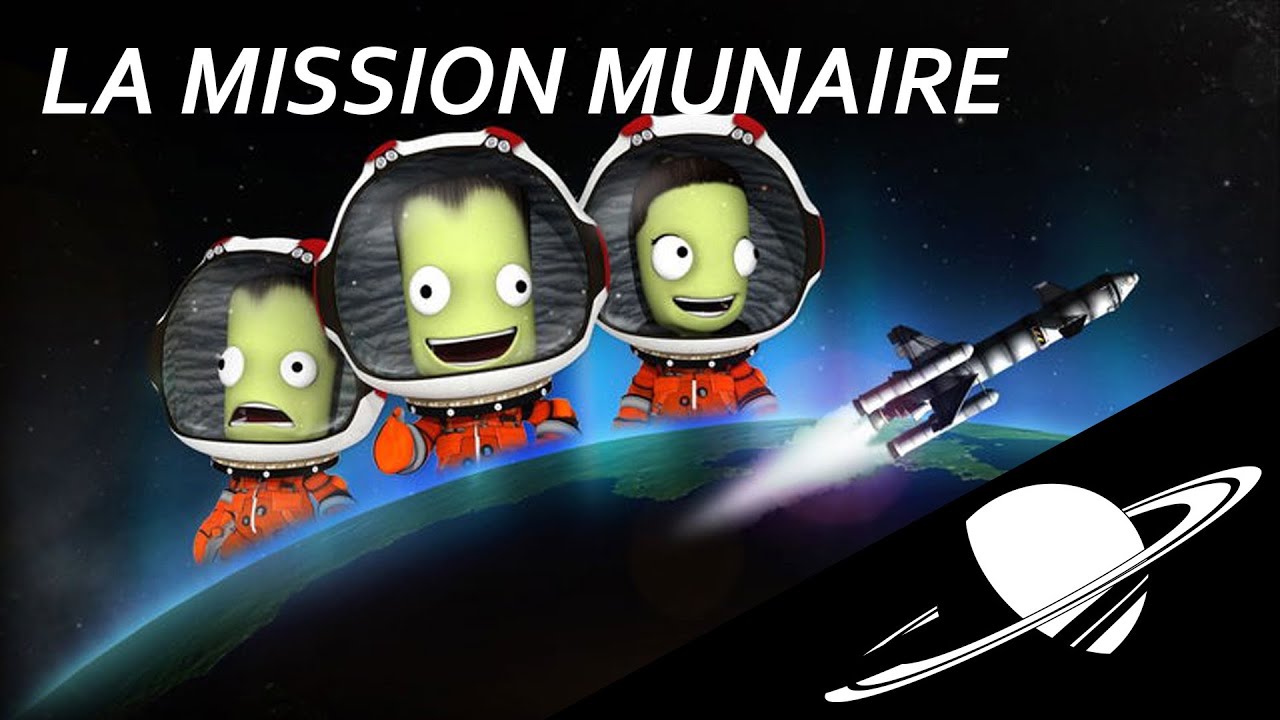
KSP partie 5 - La Mission munaire
Keywords
Summary
157 words
Critical Evaluation
The video provides a solid introduction to orbital mechanics and mission planning within the context of Kerbal Space Program. The creator’s explanations are accurate and align with real-world physics, albeit simplified for gameplay. The use of a whiteboard to illustrate concepts like the Hohmann transfer is effective, though the lack of animation may make some concepts harder to grasp for visual learners. The tutorial is well-structured, progressing from basic controls to complex maneuvers, and includes practical tips such as using the map view and maneuver nodes. The scientific accuracy is high for a game tutorial; the creator correctly explains the need to burn at the right point to change orbit altitude and the concept of sphere of influence. However, the video assumes prior knowledge from previous parts, which might confuse newcomers. The production quality is decent, with clear narration and on-screen demonstrations. The video does not cite external sources, but it references other parts of the series for further context. Overall, the content is valuable for KSP players seeking to understand orbital mechanics and execute a lunar mission, and it serves as a good educational resource for basic spaceflight concepts.
190 words
Title / Content Match
The title accurately reflects the content, which focuses on executing a lunar mission in KSP.
Quality & Reliability
8/10
The video provides a clear and accurate explanation of orbital mechanics and mission planning in Kerbal Space Program, with practical demonstrations. The scientific principles are correctly presented, and the tutorial is well-structured. The content is based on the game's physics model, which is a simplified but valid representation of real orbital mechanics.
Key Moments
Markers derived by PSI from the transcript: the creator did not define chapters.
- Introduction and recap of previous episodes
- Explanation of the three axes of rotation (roll, pitch, yaw)
- Concept of free fall and orbit explained with whiteboard
- Two-step process to achieve orbit: burn to apogee, then circularize
- Hohmann transfer maneuver to reach the Mun
- Launch and ascent profile, staging, and fuel management
- Using map view and maneuver nodes to plan orbit
- Executing the burn and achieving orbit
- Planning the transfer to the Mun and intercepting it
- Spacewalk for science and quicksave tip
- Lunar approach, capture burn, and landing
- Return to Kerbin and reentry
- Conclusion and mods mention
Cited Sources
- KSP Partie 1 – l’Histoire du jeu — First part of the series, providing historical context.
- KSP Partie 2 - Gameplay général — General gameplay mechanics.
- KSP partie 3 - les pièces — Overview of parts.
- KSP partie 4 - Concevoir un vaisseau munaire — Designing a lunar vessel.
- KSP partie 6 - modder le jeu — Modding the game.
Concurring Sources
- Hohmann transfer orbit — The maneuver described in the video is a Hohmann transfer, a standard orbital mechanics concept.
- Orbital mechanics — The video's explanations align with fundamental principles of orbital mechanics.
External References
Contribution & Novelties
This video provides a clear, step-by-step tutorial on executing a lunar mission in Kerbal Space Program, emphasizing the underlying orbital mechanics. It explains concepts like the Hohmann transfer and sphere of influence in an accessible way, making it a valuable educational resource for understanding basic spaceflight.
Pour aller plus loin :
- Hohmann transfer orbit — The maneuver used to transfer between orbits, central to the video’s explanation.
- Sphere of influence (astrodynamics) — The concept of a body’s gravitational dominance, mentioned in the video.
- Kerbal Space Program — The game itself, which simulates orbital mechanics.
94 words
Radar Profile
The radar profile shows high scores in information quantity and quality, with a slightly lower technical level, indicating the video is informative and accurate but not overly technical. The overall reliability is high, making it a trustworthy tutorial.