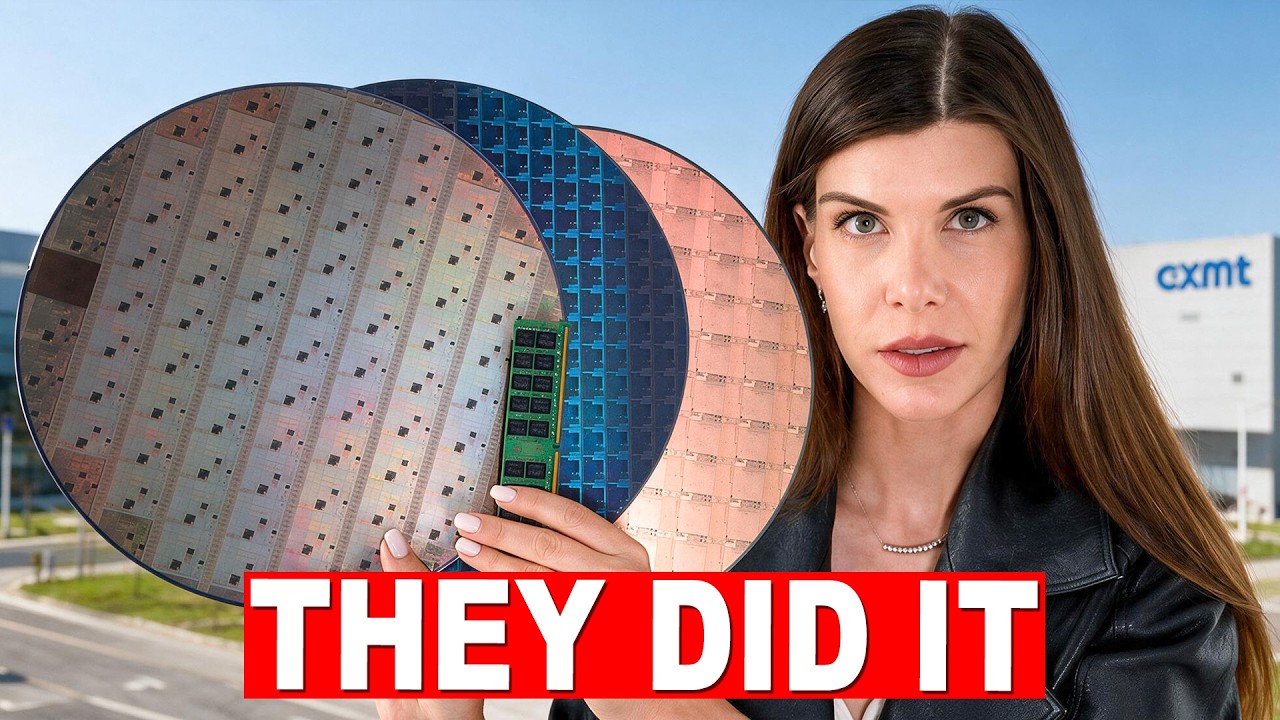
This Could End The RAM Crisis
Keywords
Summary
140 words
Critical Evaluation
Value of the Information & Strength of the Argument
The video provides valuable insights into the memory industry’s current state, with specific details on manufacturing processes and company strategies. The argumentation is coherent, contrasting SK Hynix’s focus on HBM with CXMT’s focus on volume. The presenter supports claims with concrete examples, such as the cost of TC bonders and the scale of clean rooms. However, the analysis is largely based on the presenter’s expertise and lacks direct citations to primary sources, which weakens the overall rigor.
Scientific Rigor, Source Quality, Title Accuracy
The video demonstrates a good understanding of the technical aspects of memory manufacturing, but it does not cite specific sources for its claims. The title is somewhat clickbait but accurately reflects the content. The description includes links to the presenter’s newsletter and podcast, but these are not direct sources for the video’s claims. The video would benefit from referencing industry reports or official company statements to enhance credibility.
160 words
Title / Content Match
The title is somewhat sensational but accurately reflects the video's focus on potential solutions to the RAM shortage, particularly through the expansion strategies of SK Hynix and CXMT.
Quality & Reliability
7/10
The video provides a well-structured analysis of the memory industry, with specific data points and references to major companies. However, it lacks direct citations to primary sources, and the presenter's background is not independently verified. The content is largely opinion-based, though grounded in industry knowledge.
Key Moments
Markers derived by PSI from the transcript: the creator did not define chapters.
- Introduction to the memory industry and the two companies SK Hynix and CXMT.
- Explanation of the DRAM industry's boom-bust cycle and consolidation to three players.
- Impact of AI on memory demand, with examples of GPU memory sizes.
- Technical challenges of HBM manufacturing, including stacking and bonding.
- SK Hynix's massive factory expansion, including M15X and other projects.
- Sponsorship segment for Genspark SecondBrain Note.
- CXMT's strategy of scaling conventional DRAM production in Hefei.
- Comparison of SK Hynix's and CXMT's philosophies and market strategies.
- CXMT's IPO and potential impact on the memory market.
- Conclusion and giveaway announcement.
Cited Sources
- Anastasi In Tech Newsletter — Mentioned as a resource for further information.
- Deep in Tech Podcast (Apple) — Mentioned as a related podcast.
- Deep in Tech Podcast (Spotify) — Mentioned as a related podcast.
- Anastasi In Tech LinkedIn — Mentioned for connecting with the presenter.
Concurring Sources
- SK Hynix official website — Official company information on HBM products and manufacturing.
- CXMT official website — Official company information on DRAM products and expansion plans.
Contribution & Novelties
The video provides a clear comparison of two contrasting strategies in the memory industry, highlighting the trade-offs between HBM and conventional DRAM. It offers a unique perspective on CXMT’s rapid expansion and its potential to disrupt the market. The presenter’s background in chip design adds credibility to the technical explanations.
Pour aller plus loin :
- High Bandwidth Memory (HBM) — Wikipedia article explaining HBM technology and its applications.
- DRAM — Wikipedia article on dynamic random-access memory, covering its history and technology.
- Semiconductor industry — Wikipedia article on the semiconductor industry, including market dynamics and major players.
96 words
Radar Profile
The radar profile shows high scores in quantity of information and technical level, indicating a content-rich video with detailed explanations. However, the lower score in global reliability suggests that the lack of direct citations and the opinion-based nature of the content may reduce its overall trustworthiness.