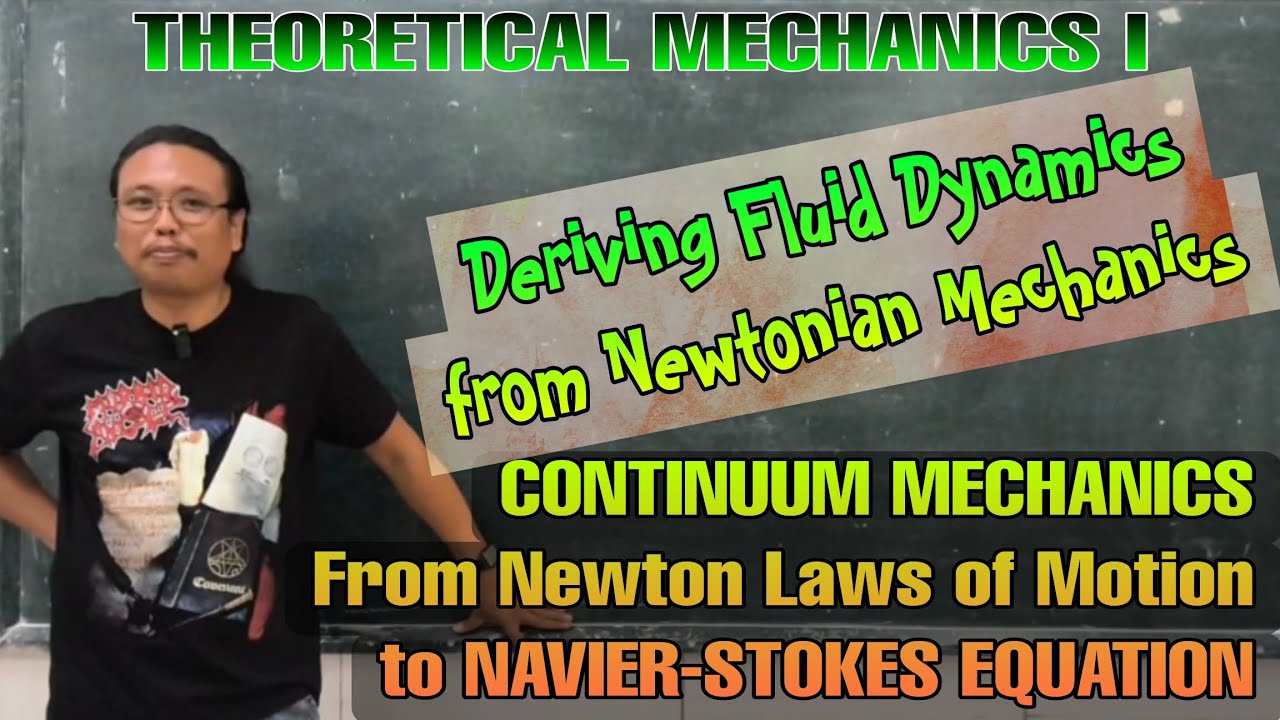
TheoMech-15: Open Systems and the Dynamics of Flow and Continuum
Keywords
Summary
172 words
Critical Evaluation
Value of the Information & Strength of the Argument
The lecture provides a solid derivation of the Reynolds transport theorem, which is a fundamental tool in fluid mechanics and continuum mechanics. The instructor carefully explains each step, from the definition of an extensive quantity to the application of the divergence theorem. The argumentation is logical and builds on previous material, making the derivation accessible to students with a background in calculus and mechanics. The application to the chain problem demonstrates the practical utility of the theorem. However, the presentation is sometimes disjointed due to classroom interruptions and informal language, which may hinder clarity for some viewers.
Scientific Rigor, Source Quality, Title Accuracy
The scientific rigor is high: the derivation follows standard mathematical procedures and is consistent with established physics. The instructor does not cite specific sources, but the content aligns with classical mechanics textbooks. The title accurately reflects the content, focusing on open systems and flow dynamics. The lecture is part of a structured course, and the instructor references previous lectures, indicating a coherent curriculum.
175 words
Title / Content Match
The title accurately reflects the content: the lecture focuses on open systems and the dynamics of flow, deriving the Reynolds transport theorem and applying it to continuum mechanics.
Quality & Reliability
8/10
The lecture is a formal derivation of the Reynolds transport theorem and its application to Newton's second law for open systems. The instructor demonstrates a rigorous mathematical approach, using Taylor series, surface integrals, and the divergence theorem. The content is consistent with standard classical mechanics textbooks. However, the lecture is a classroom recording with some informal digressions and technical interruptions, and the instructor's explanations are sometimes unclear due to language mixing and incomplete sentences.
Key Moments
Markers derived by PSI from the transcript: the creator did not define chapters.
- Introduction and review of closed systems
- Definition of open systems and control volume
- Derivation of Reynolds transport theorem
- Application to Newton's second law for open systems
- Reduction to one dimension and chain problem
- Introduction of stress tensor and momentum flux tensor
- Derivation of differential momentum equation
Cited Sources
- Theoretical Mechanics 1 Course Playlist — Full course playlist referenced in the video description.
Concurring Sources
- Reynolds transport theorem — Standard reference for the theorem derived in the lecture.
Contribution & Novelties
The lecture provides a clear pedagogical derivation of the Reynolds transport theorem and its application to Newton’s second law for open systems, which is a cornerstone of continuum mechanics. The instructor’s approach of starting from systems of particles and extending to continuous media helps bridge the gap between discrete and continuum descriptions. The application to the chain problem illustrates the theorem’s utility in solving classic mechanics problems.
Pour aller plus loin :
- Reynolds transport theorem — A comprehensive overview of the theorem and its applications.
- Cauchy momentum equation — The differential form of the momentum equation derived in the lecture.
- Stress tensor — The concept of stress tensor introduced in the lecture.
112 words
Radar Profile
The radar profile shows high scores across all dimensions, indicating a technically rigorous and informative lecture. The balance between quantity and quality of information is strong, with a high level of technical detail. The overall reliability is high, reflecting the formal derivation and standard content.