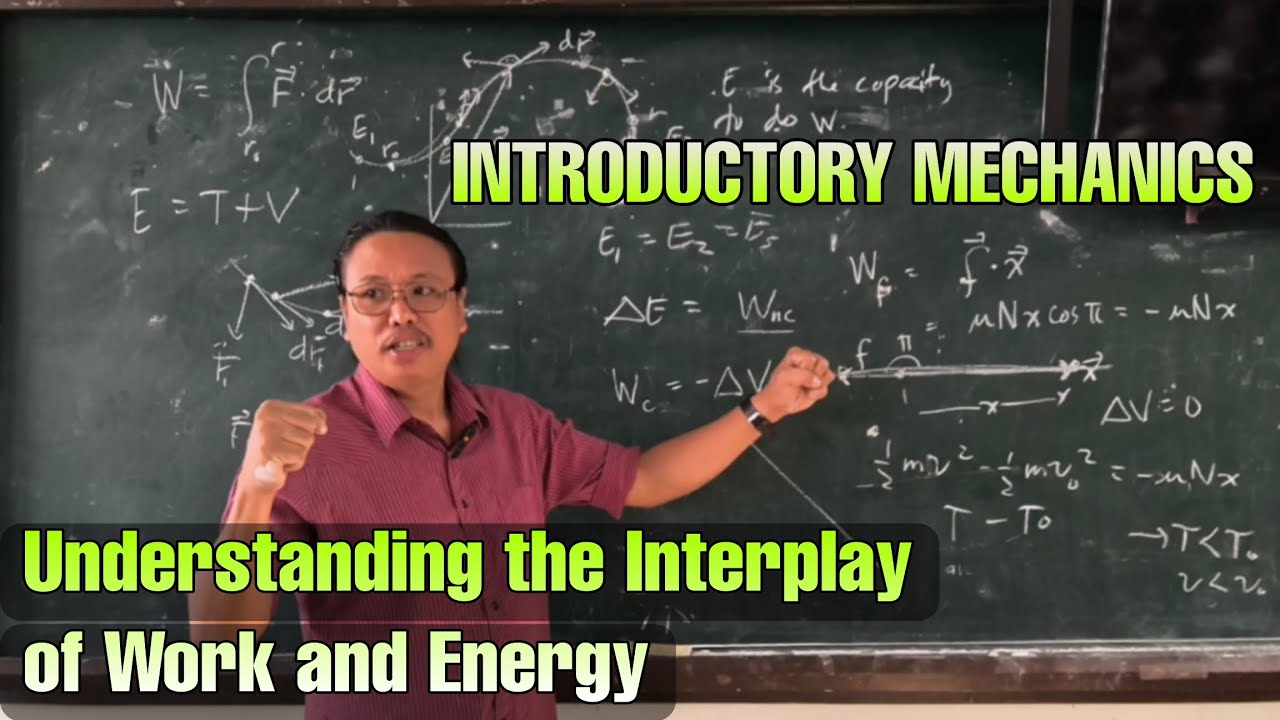
Lec 10 (Introductory Mechanics): Work and Energy Transformation
Keywords
Summary
193 words
Critical Evaluation
Value of the Information & Strength of the Argument
The lecture provides a solid foundation in work and energy concepts, with clear derivations and practical examples. The argumentation is logical and builds from basic definitions to applications. The instructor effectively uses diagrams and step-by-step problem-solving to illustrate principles. However, the presentation is somewhat informal, with occasional digressions and motivational comments that may distract from the core content. The value lies in its pedagogical approach, making complex ideas accessible, but it lacks depth in discussing edge cases or advanced applications.
89 words
Title / Content Match
The title accurately reflects the content, which focuses on work and energy transformation in introductory mechanics.
Quality & Reliability
7/10
The lecture provides a clear and correct explanation of work and energy concepts, with derivations and examples. However, it lacks citations to external sources and contains some informal digressions.
Key Moments
Markers derived by PSI from the transcript: the creator did not define chapters.
- Introduction and recap of work definition as line integral.
- Explanation of work as sum of dot products and relation to energy.
- Discussion on conservative forces and potential energy.
- Example of friction doing negative work and energy transformation to heat.
- Introduction of energy units (joule, calorie) and conversion.
- Problem: block sliding down incline, velocity independent of angle.
- Problem: particle on track, calculating velocities at different heights.
- Discussion on maximum height and energy conservation with no friction.
- Emphasis on energy conservation and transformation, including body metabolism.
- Final problem solving and assignment for students to verify energy conservation.
Contribution & Novelties
The lecture provides a clear and accessible introduction to work and energy, with a focus on conceptual understanding and problem-solving. It emphasizes the transformation of energy and the role of friction, which is often understated in introductory texts. The instructor’s approach of using multiple examples and encouraging self-checking is pedagogically valuable.
Pour aller plus loin :
- Work (physics) — Provides a comprehensive overview of work in physics.
- Conservation of energy — Explains the principle of energy conservation.
- Kinetic energy — Details the concept of kinetic energy.
- Potential energy — Discusses potential energy in various contexts.
- Friction — Explains friction and its role in energy dissipation.
105 words
Radar Profile
The radar profile shows a balanced performance across all dimensions, with slightly higher scores in quality of information and technical level, indicating a solid educational content. The lower score in quantity of information suggests the lecture could benefit from more examples or deeper exploration.