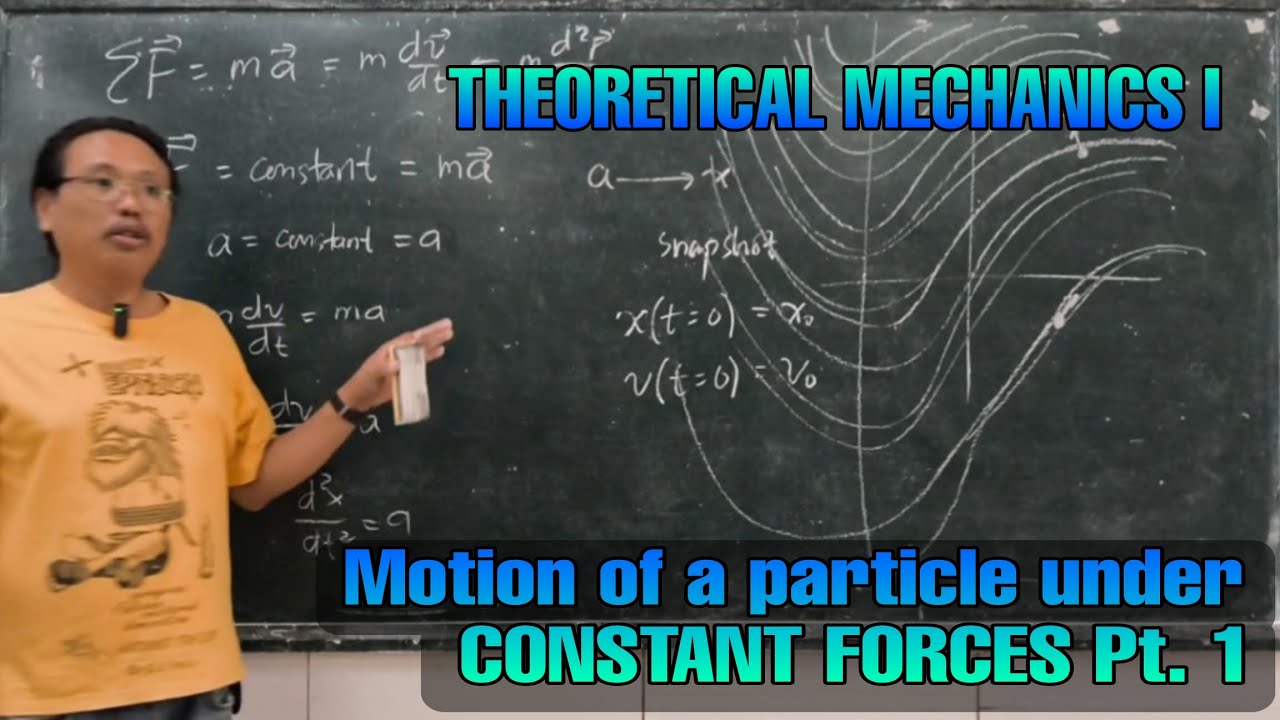
TheoMech-03: Particles under Constant Forces
Keywords
Summary
155 words
Critical Evaluation
Value of the Information & Strength of the Argument
The lecture provides a solid conceptual foundation for theoretical mechanics, emphasizing the derivation of kinematics from Newton’s laws rather than treating them as separate topics. The argumentation is logical and builds step-by-step, connecting physics to mathematics. The instructor uses examples, like different parametrizations of a circle, to illustrate that the same path can have different dynamics. He also explains the importance of initial conditions in solving differential equations, linking to the concept of snapshots. The value lies in clarifying common misconceptions and deepening understanding of fundamental principles.
Scientific Rigor, Source Quality, Title Accuracy
The lecture is scientifically rigorous, with derivations based on Newton’s laws and calculus. The instructor references his own previous videos for foundational concepts, but no external sources are cited. The title accurately reflects the content. The presentation is informal but pedagogically effective, with a focus on conceptual clarity. The lack of external citations is typical for a lecture, but the content aligns with standard physics textbooks.
168 words
Title / Content Match
The title accurately reflects the content: the lecture focuses on particles under constant forces, deriving kinematic equations from Newton's laws.
Quality & Reliability
8/10
The lecture is a rigorous derivation of kinematics from Newton's laws, emphasizing conceptual understanding and mathematical foundations. The instructor is a physics educator, and the content aligns with standard theoretical mechanics curriculum. However, it is a single lecture without external citations, and the presentation is informal with some asides.
Key Moments
Markers derived by PSI from the transcript: the creator did not define chapters.
- Introduction: Newton's laws as central principle, kinematics as consequence.
- Review of parametrization: different parametrizations of same curve, different physics.
- Derivation of kinematic equations from constant force: v = v0 + at, x = x0 + v0t + 1/2at^2.
- Discussion of initial conditions and uniqueness of solutions to differential equations.
- Derivation of third kinematic equation using average velocity.
- Derivation of fourth equation v^2 = v0^2 + 2a(x - x0) via implicit differentiation.
Cited Sources
- Full Course Playlist — Playlist for the full theoretical mechanics course.
Concurring Sources
- Classical Mechanics (Goldstein) — Standard textbook covering Newtonian mechanics and kinematics.
Contribution & Novelties
The lecture’s originality lies in its pedagogical approach, emphasizing the derivation of kinematics from Newton’s laws and the conceptual importance of initial conditions. It bridges the gap between mathematics and physics by explaining the physical meaning of derivatives and the role of parametrization. The lecture also touches on advanced topics like Lie theory and manifolds, providing a glimpse into deeper mathematical structures.
Pour aller plus loin :
- Newton’s laws of motion — Foundational principles discussed.
- Ordinary differential equation — The role of initial conditions in solving ODEs.
- Parametric equation — Parametrization of curves and its physical implications.
- Lie group — Mentioned in the context of symmetries of differential equations.
109 words
Radar Profile
The radar profile shows high scores in information quantity, quality, and reliability, with a slightly lower technical level. This indicates a lecture that is rich in content, well-structured, and trustworthy, but may not require advanced mathematical background from the viewer.