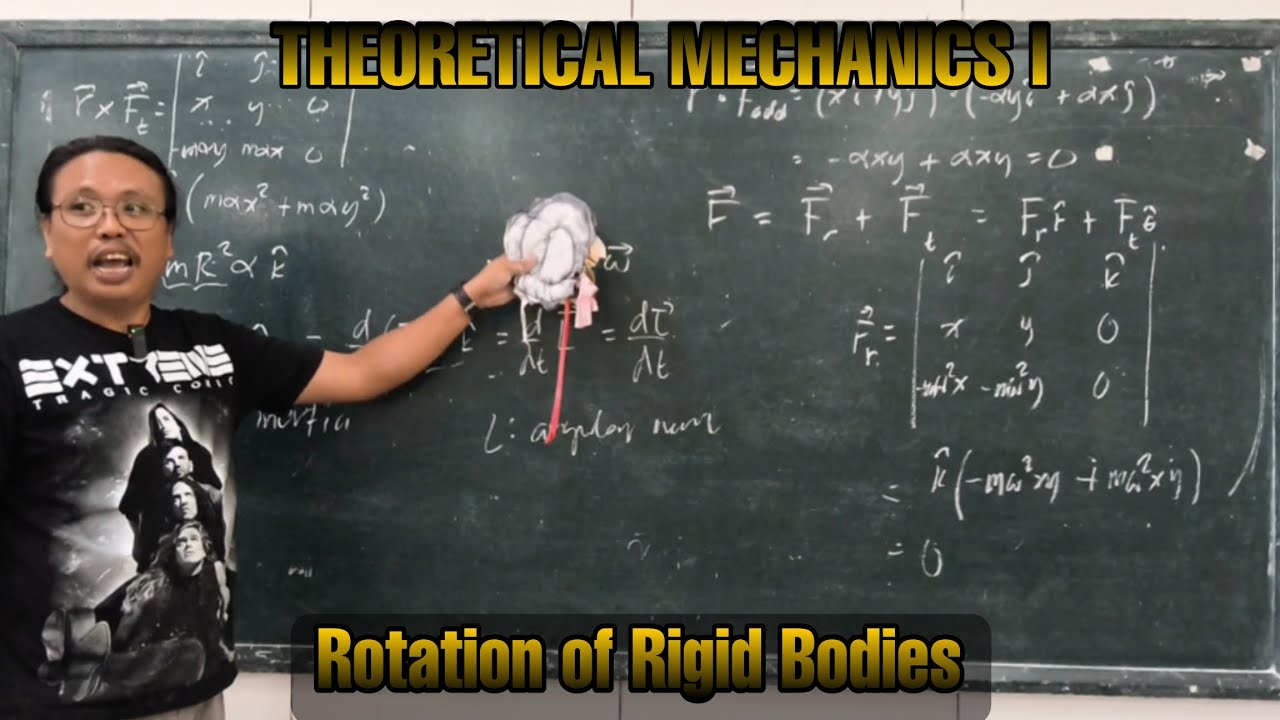
TheoMech-12: Rotation of Rigid Bodies - An Introduction
Keywords
Summary
224 words
Critical Evaluation
Value of the Information & Strength of the Argument
The lecture provides a solid foundation for understanding rigid body rotation. The instructor derives all key equations from first principles, using clear mathematical steps and physical reasoning. He effectively connects the new concepts to previously covered material, such as harmonic oscillators and Newton’s laws. The argumentation is logical and thorough, with careful attention to the assumptions and limitations of each derivation. For example, he explicitly notes that the derived torque equation is a special case for a fixed pivot and will be generalized later. The distinction between centripetal and centrifugal forces is well explained, clarifying a common point of confusion. The value of the information is high for students seeking a rigorous introduction to the topic.
Scientific Rigor, Source Quality, Title Accuracy
The lecture is scientifically rigorous, with derivations that are mathematically sound. The instructor demonstrates a deep understanding of the subject and presents the material in a coherent manner. However, the video does not cite any external sources or references, which is typical for a lecture but limits its utility for further verification. The title accurately reflects the content, as the lecture is indeed an introduction to the rotation of rigid bodies. The instructor’s teaching style is clear, though he occasionally makes minor errors (e.g., forgetting the mass term) that he corrects, which does not detract from the overall quality. No comments were provided for analysis.
236 words
Title / Content Match
The title accurately reflects the content: an introductory lecture on the rotation of rigid bodies, covering kinematics, dynamics, and the concept of torque.
Quality & Reliability
8/10
The lecture is a formal physics course presentation, deriving concepts from first principles with mathematical rigor. The instructor demonstrates a clear pedagogical approach, building on previous material and providing derivations. The content aligns with standard theoretical mechanics curriculum. However, the video is a single lecture without external citations or references, and the instructor occasionally makes minor slips (e.g., forgetting the mass term) that are corrected. Overall, the presentation is reliable for educational purposes.
Key Moments
Markers derived by PSI from the transcript: the creator did not define chapters.
- Introduction and review of convolution integral; mention of Laplace transform as next topic.
- Start of rotation topic: rolling wheel, relation between translational and rotational variables (x = rθ, v = rω, a = rα).
- Analysis of particle in uniform circular motion: position, velocity, acceleration vectors; identification of centripetal force.
- Discussion of centrifugal force as a fictitious force in non-inertial frames.
- Extension to non-uniform circular motion: derivation of total force with radial and tangential components.
- Introduction of torque via cross product; definition of moment of inertia and rotational analog of Newton's second law (τ = Iα).
- Introduction of angular momentum L = Iω and torque as dL/dt; conditions for equilibrium (sum of forces and torques zero).
Cited Sources
- Full Course Playlist — Playlist of the full Theoretical Mechanics course, providing context for this lecture.
Contribution & Novelties
This lecture provides a clear and rigorous introduction to rigid body rotation, deriving key concepts such as torque and angular momentum from first principles. It bridges the gap between translational and rotational dynamics, emphasizing the vector nature of these quantities. The instructor’s pedagogical approach, building on previous material and explicitly stating assumptions, is valuable for students.
Pour aller plus loin :
- Moment of inertia — Provides a comprehensive overview of moment of inertia, including its calculation for various bodies.
- Angular momentum — Detailed explanation of angular momentum, its conservation, and applications.
- Torque — Wikipedia article on torque, including its definition, calculation, and relation to rotational motion.
106 words
Radar Profile
The radar profile shows high scores across all dimensions, indicating a well-balanced and reliable educational resource. The lecture is technically rigorous, provides substantial information, and is presented in a clear manner, making it suitable for students seeking a solid understanding of rigid body rotation.