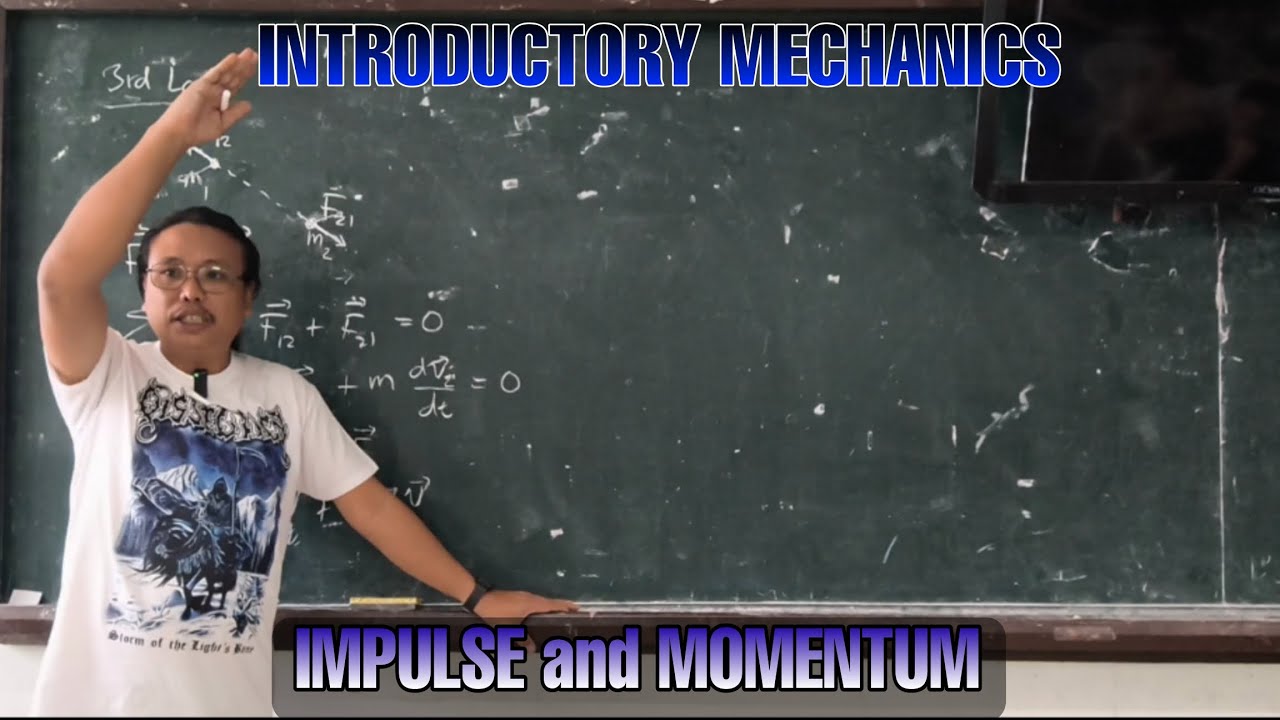
Lec 13 (Introductory Mechanics): Impulse and Momentum
Keywords
Summary
200 words
Critical Evaluation
Value of the Information & Strength of the Argument
The lecture provides a solid conceptual foundation for momentum and impulse. It correctly derives conservation of momentum from Newton’s third law and clearly explains the distinction between F=ma and F=dp/dt, which is often overlooked in introductory courses. The argumentation is logical and step-by-step, with numerical examples that illustrate the application of the concepts. The instructor’s correction of a calculation error during the session adds credibility and demonstrates a rigorous approach. The discussion of why momentum is a vector quantity and its importance in collisions is well-articulated. The physical interpretation of impulse as the effect of a force over time is effectively conveyed through a comparative example.
Scientific Rigor, Source Quality, Title Accuracy
The lecture is scientifically rigorous, with correct mathematical derivations and clear explanations. However, it does not cite any external sources, which is typical for a tutorial but limits its utility for further verification. The title accurately reflects the content, focusing on impulse and momentum. The instructor’s informal style and occasional tangents do not detract from the scientific accuracy. No comments were provided for analysis.
185 words
Title / Content Match
The title accurately reflects the content, which focuses on impulse and momentum in introductory mechanics.
Quality & Reliability
8/10
The lecture is mathematically rigorous, correctly derives conservation of momentum from Newton's third law, and explicitly distinguishes between F=ma and F=dp/dt. The instructor corrects a calculation error during the session, demonstrating intellectual honesty. However, the presentation is informal and lacks citations to external sources.
Key Moments
Markers derived by PSI from the transcript: the creator did not define chapters.
- Introduction and review of Newton's laws as starting point.
- Derivation of conservation of momentum from Newton's third law.
- Discussion of F=dp/dt as the original form of Newton's second law, with mass variation.
- Definition of linear momentum and its vector nature.
- Application of conservation of momentum to collision problems.
- Example calculation of final velocity in a collision, with correction of vector sign error.
- Introduction to perfectly elastic and perfectly inelastic collisions.
- Numerical example of perfectly elastic collision and verification of kinetic energy conservation.
- Numerical example of perfectly inelastic collision and calculation of final velocity.
- Introduction of impulse-momentum theorem and physical interpretation of impulse.
- Comparative example illustrating the effect of force application time on momentum change.
Contribution & Novelties
The lecture provides a clear and rigorous introduction to momentum and impulse, emphasizing the fundamental nature of F=dp/dt and the vector nature of momentum. It effectively connects Newton’s third law to the conservation of momentum and illustrates the difference between elastic and inelastic collisions with worked examples. The instructor’s correction of a calculation error highlights the importance of vector signs in physics problems.
Pour aller plus loin :
- Momentum — Wikipedia article providing a comprehensive overview of momentum in physics.
- Impulse (physics) — Wikipedia article on impulse and the impulse-momentum theorem.
- Newton’s laws of motion — Wikipedia article detailing Newton’s laws, including the original formulation of the second law.
109 words
Radar Profile
The radar profile shows high scores in information quantity, quality, and reliability, with a slightly lower technical level. This indicates a lecture that is informative and accurate, but accessible to an introductory audience.