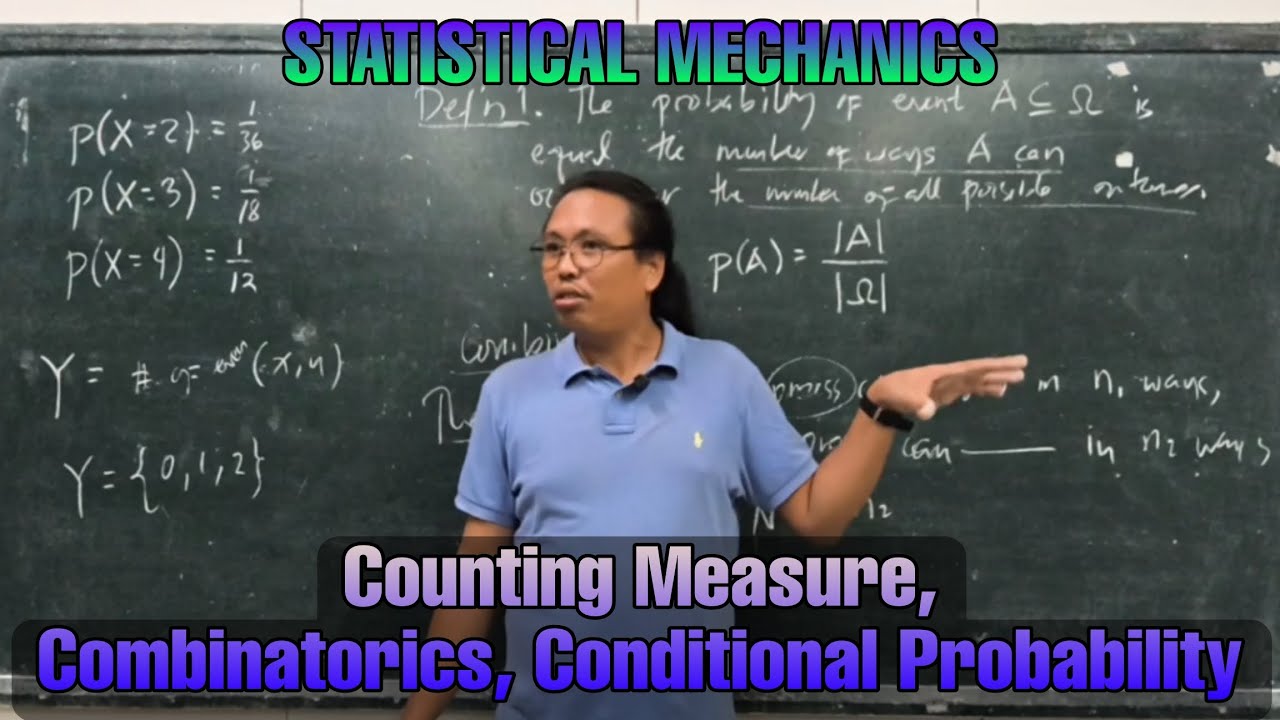
StatMech-04: Probability, Common Sense, and Combinatorics
Keywords
Summary
129 words
Critical Evaluation
Value of the Information & Strength of the Argument
The lecture provides a solid conceptual foundation, connecting abstract measure theory to practical combinatorics. The instructor’s approach of starting from first principles and building up is valuable for understanding the ‘why’ behind probability formulas. The argumentation is clear, with step-by-step derivations and concrete examples that illustrate abstract concepts. However, the presentation is informal, with some digressions and a conversational tone that may not suit all learners. The value lies in the intuitive explanations and the emphasis on the measure-theoretic basis, which is often glossed over in introductory courses.
Scientific Rigor, Source Quality, Title Accuracy
The lecture is mathematically rigorous, with careful definitions and derivations. However, it does not cite specific sources, relying instead on standard textbook knowledge. The title accurately reflects the content, which covers probability and combinatorics within a statistical mechanics context. The lack of formal citations is a minor weakness, but the content itself is sound and aligns with established mathematical principles.
163 words
Title / Content Match
The title accurately reflects the content, which covers probability foundations and combinatorics within a statistical mechanics course.
Quality & Reliability
7/10
The lecture is mathematically rigorous, building probability from measure theory and combinatorics, with clear derivations and examples. However, it lacks formal citations and the presentation is informal with some digressions.
Key Moments
Markers derived by PSI from the transcript: the creator did not define chapters.
- Introduction and review of measure-theoretic probability, sigma algebras, and CDF.
- Example of random variable with dice tosses, defining sample space and probability mass function.
- Definition of probability as counting measure and introduction to combinatorics.
- Multiplication principle and factorial arrangements.
- Combinations and permutations, with examples involving gender categories.
- Problem solving: arranging boys and girls with constraints, using combinatorial principles.
Cited Sources
- Full Course Playlist — The playlist for the full statistical mechanics course, providing context for this lecture.
Concurring Sources
- Measure (mathematics) - Wikipedia — Provides background on measure theory, which the lecture builds upon.
- Combinatorics - Wikipedia — Covers the combinatorial principles used in the lecture.
Contribution & Novelties
This lecture offers a unique perspective by grounding statistical mechanics in measure theory and combinatorics, which is often not emphasized in standard treatments. It bridges abstract probability concepts with practical counting techniques, providing a solid foundation for understanding equilibrium statistical mechanics. The instructor’s emphasis on first principles and intuition is valuable for students seeking a deeper understanding.
Pour aller plus loin :
- Measure theory — Foundational for the probability framework discussed.
- Combinatorics — The mathematics of counting, central to the lecture.
- Statistical mechanics — The broader context of the course.
90 words
Radar Profile
The radar profile shows high scores in quantity of information, technical level, and reliability, indicating a dense, rigorous lecture. The quality of information is also high, but the presentation style may be less polished, which is reflected in the slightly lower quality score.