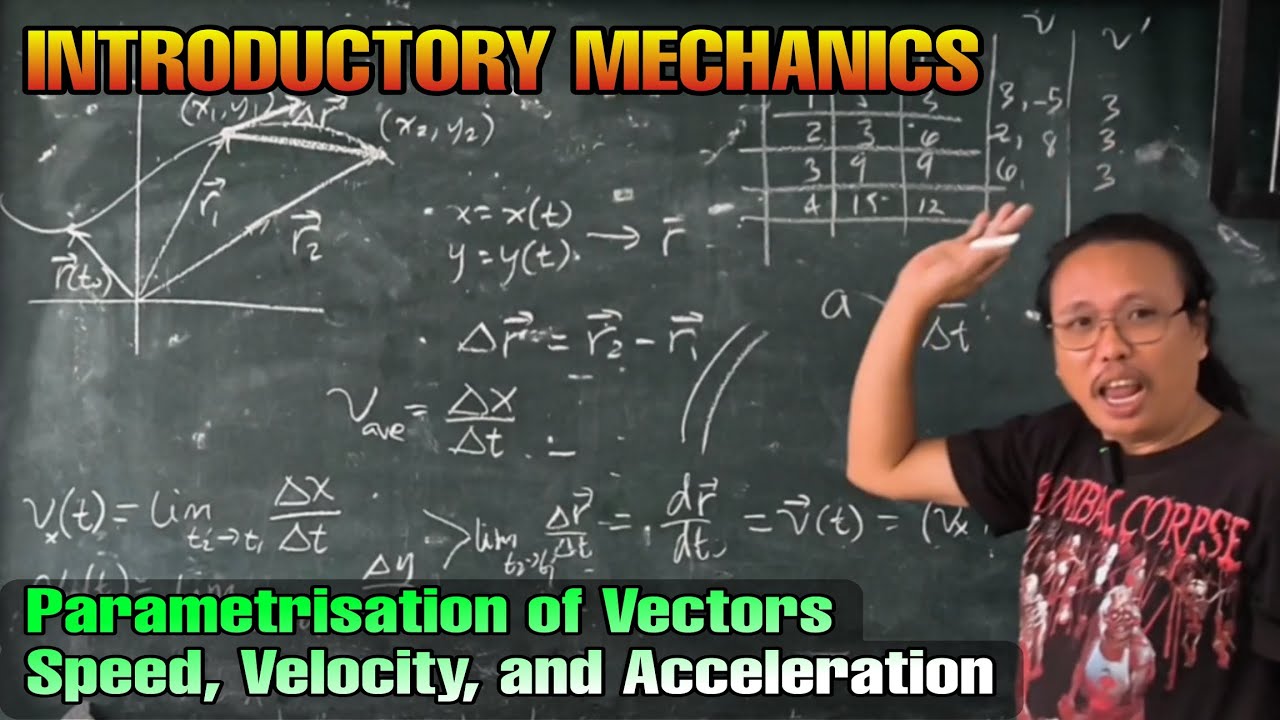
Lec 04 (Introductory Mechanics): From Vectors to Curves to Kinematics
Keywords
Summary
138 words
Critical Evaluation
Value of the Information & Strength of the Argument
The lecture provides a solid conceptual foundation for kinematics, bridging vectors and calculus. The instructor uses intuitive examples and diagrams to explain abstract ideas, such as the difference between average and instantaneous velocity, and the meaning of negative acceleration. The argumentation is clear and logically structured, building from simple one-dimensional motion to parametric curves. However, the presentation is informal and sometimes digresses, which may reduce focus. The mathematical derivations are correct but not fully rigorous, as the instructor often skips steps, stating ’this is not a calculus class.’ Overall, the content is valuable for beginners, but it lacks depth for advanced students.
Scientific Rigor, Source Quality, Title Accuracy
The scientific rigor is adequate for an introductory lecture: the concepts are standard and correctly presented. However, no external sources are cited, and the instructor relies on his own explanations. The title accurately reflects the content, as the lecture indeed covers vectors, curves, and kinematics. The teaching style is engaging but occasionally rambling, which might affect clarity. The absence of citations is not a major issue for a tutorial, but it limits the ability to verify claims independently.
195 words
Title / Content Match
The title accurately reflects the content: the lecture transitions from vector basics to parametric curves and then to kinematics (velocity, acceleration).
Quality & Reliability
7/10
The lecture is a clear and pedagogically sound introduction to kinematics, using vector calculus and parametric curves. The explanations are mathematically correct, though the presentation is informal and lacks rigorous derivations. The instructor demonstrates concepts with examples and emphasizes physical intuition. No external sources are cited, but the content is standard and reliable.
Key Moments
Markers derived by PSI from the transcript: the creator did not define chapters.
- Introduction to position vector and parametrization of curves
- Definition of average velocity and its interpretation
- Explanation of instantaneous velocity as a limit
- Discussion on acceleration and its sign
- Comparison of average velocity and average speed
- Example of constant acceleration and arithmetic progression
- Introduction to parametrization of a circle and speed calculation
Contribution & Novelties
The lecture offers a clear pedagogical approach to connecting vectors, curves, and kinematics, which is valuable for introductory physics students. It emphasizes the geometric interpretation of velocity as tangent to the curve and clarifies common misconceptions about acceleration and speed. The use of parametric curves to illustrate different speeds is particularly instructive.
Pour aller plus loin :
- Parametric equation — Provides background on parametrization of curves.
- Kinematics — Overview of the branch of mechanics dealing with motion.
- Derivative — Essential calculus concept used throughout the lecture.
86 words
Radar Profile
The radar profile shows a balanced performance across all dimensions, with slightly higher scores in information quality and technical level, indicating a solid educational resource. The lower score in quantity of information suggests the lecture could benefit from more examples or depth.