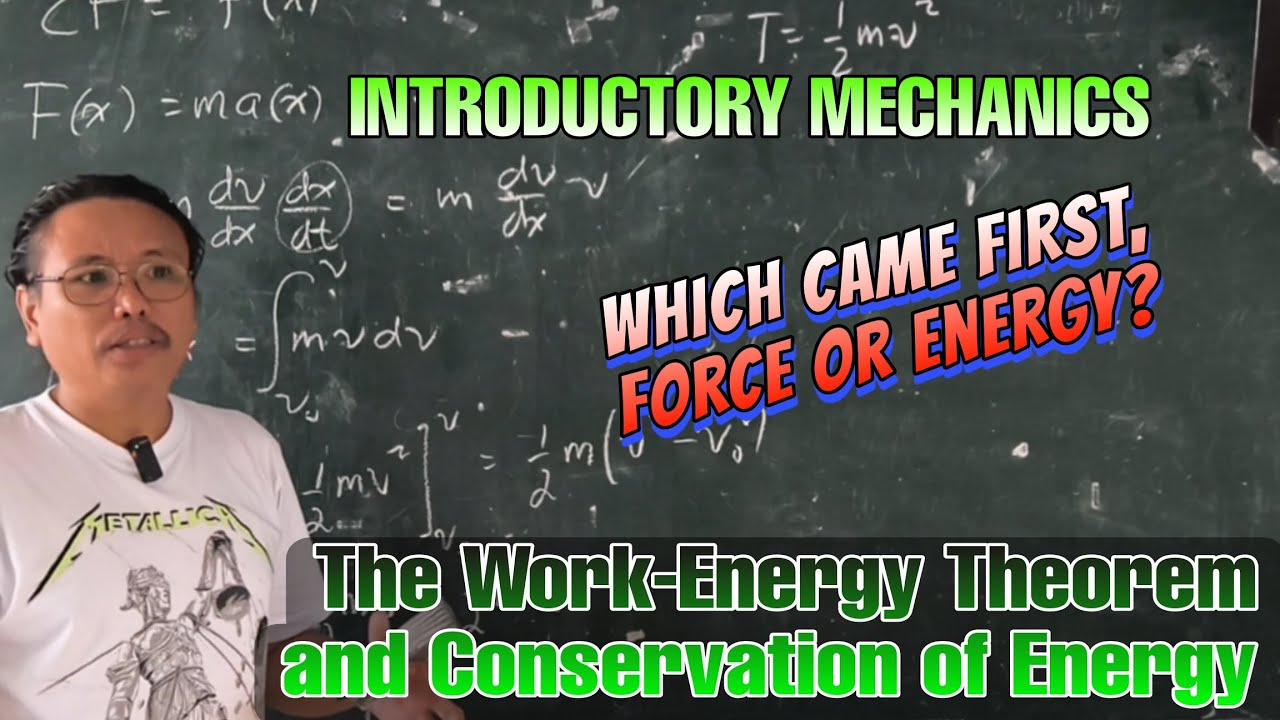
Lec 09 (Introductory Mechanics): Work, Energy, and Conservation
Keywords
Summary
179 words
Critical Evaluation
Value of the Information & Strength of the Argument
The lecture provides a clear and rigorous derivation of the work-energy theorem and conservation of energy from Newton’s laws, which is valuable for students. The argumentation is logical and step-by-step, using calculus appropriately. The instructor emphasizes the physical meaning of each quantity, such as kinetic energy as energy of motion and potential energy as energy of position. He also clarifies the distinction between conservative and non-conservative forces, which is crucial for understanding when energy is conserved. The use of analogies (e.g., money) helps intuition, though sometimes it may distract. Overall, the content is accurate and well-structured.
Scientific Rigor, Source Quality, Title Accuracy
The lecture is scientifically rigorous in its derivations, but it lacks explicit citations to sources. The instructor does not reference textbooks or papers, which is typical for a lecture but limits verifiability. The title accurately describes the content. The video is part of a series, so it assumes prior knowledge from previous lectures. No comments were provided for analysis.
170 words
Title / Content Match
The title accurately reflects the content: a lecture on work, energy, and conservation in introductory mechanics.
Quality & Reliability
7/10
The lecture is a formal physics instruction, deriving the work-energy theorem and conservation of energy from Newton's laws. The reasoning is mathematically sound and follows standard derivations. However, the presentation is informal and lacks citations, and the video quality is low (audio issues, tangents).
Key Moments
Markers derived by PSI from the transcript: the creator did not define chapters.
- Introduction: recap of previous topics, moving to non-constant forces.
- Derivation of work-energy theorem: F dx = m v dv, leading to kinetic energy.
- Definition of work as integral of force over displacement, discussion of positive and negative work.
- Introduction of conservative and non-conservative forces, definition of potential energy.
- Derivation of conservation of mechanical energy: ΔT + ΔV = W_nc.
- Example of gravitational potential energy and conservation of energy equation.
- Preview of next lecture: example with incline and no friction.
Contribution & Novelties
This lecture provides a clear and rigorous derivation of the work-energy theorem and conservation of energy from Newton’s laws, which is a fundamental topic in mechanics. The instructor’s approach emphasizes the mathematical derivation and physical interpretation, making it suitable for students. The lecture also clarifies the distinction between conservative and non-conservative forces, which is essential for understanding energy conservation.
Pour aller plus loin :
- Work (physics) — Overview of work in physics.
- Kinetic energy — Detailed explanation of kinetic energy.
- Potential energy — Overview of potential energy.
- Conservation of energy — General principle of energy conservation.
96 words
Radar Profile
The radar profile shows high scores in information quality and reliability, with moderate scores in quantity and technical level. This indicates a lecture that is accurate and well-explained, but may not cover an extensive amount of material or require advanced mathematical background.