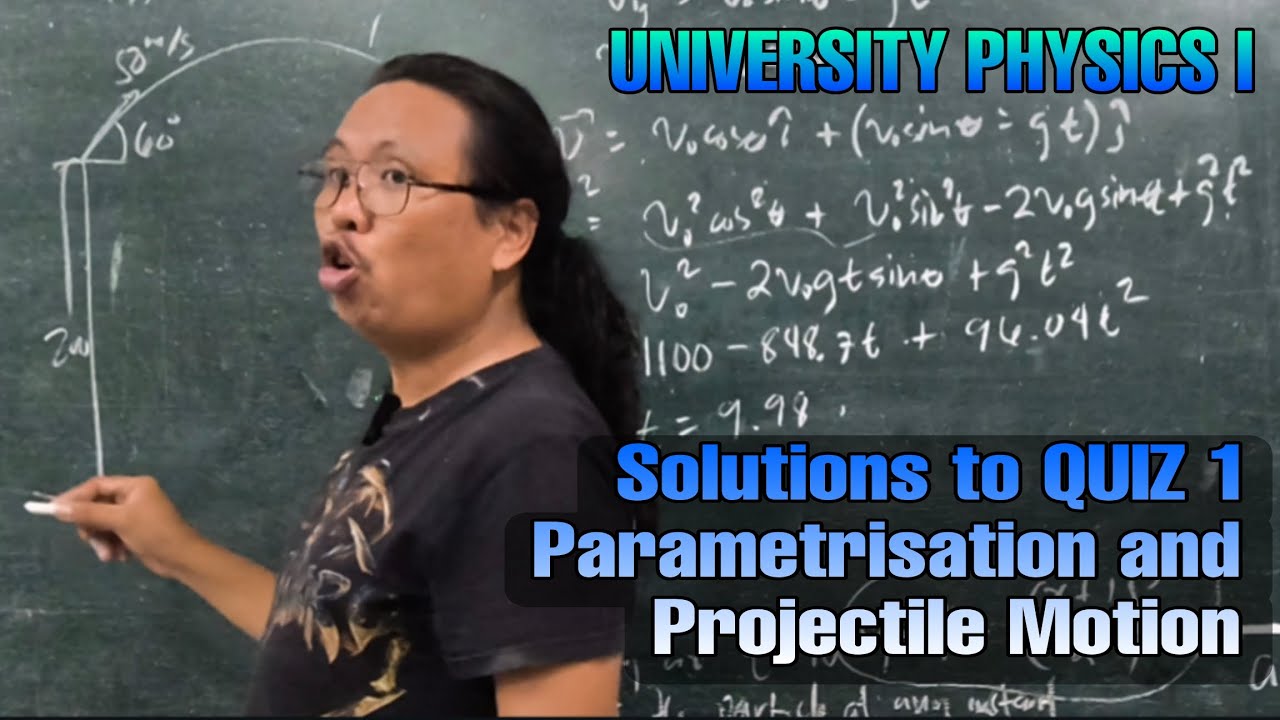
Lec 04 Physics for Engineers || Solved Problems for Kinematics and Projectile
Keywords
Summary
164 words
Critical Evaluation
Value of the Information & Strength of the Argument
The video provides valuable instructional content for students learning kinematics and projectile motion. The instructor demonstrates a systematic method for solving problems, starting from given parametric equations and deriving velocity, speed, and trajectory equations. The argumentation is logical and follows standard physics principles. The step-by-step derivations are clear, and the numerical calculations are shown in detail, which helps in understanding the process. The interactive format, with questions to the audience, reinforces the learning. However, the presentation is informal and lacks rigorous proof or derivation of the underlying formulas, but this is acceptable for a tutorial aimed at engineering students.
Scientific Rigor, Source Quality, Title Accuracy
The scientific rigor is adequate for a tutorial: the physics principles applied are correct, and the calculations are accurate. The video does not cite any external sources, which is typical for a problem-solving session. The title accurately describes the content, and the lecture is well-structured. The instructor’s explanations are clear, though the informal language and occasional digressions may reduce precision. Overall, the content is reliable for educational purposes.
182 words
Title / Content Match
The title accurately reflects the content: a lecture on kinematics and projectile motion with solved problems.
Quality & Reliability
7/10
The video is a straightforward physics tutorial with step-by-step derivations and numerical solutions. The methodology is standard and correct, though the presentation is informal and lacks citations. The content is reliable for educational purposes.
Key Moments
Markers derived by PSI from the transcript: the creator did not define chapters.
- Introduction to the first problem: given parametric position vector, find velocity and speed.
- Derivation of velocity vector from position vector.
- Calculation of speed function and evaluation at t=10.
- Finding the algebraic equation of the trajectory by eliminating the parameter.
- Start of the second problem: projectile launched from height with initial velocity and angle.
- Derivation of the velocity vector for projectile motion.
- Setting the magnitude of velocity to 60 m/s and solving for time.
- Discussion of negative time and its physical meaning.
- Calculation of velocity vector at the found time.
- Follow-up question about height when speed is 60 m/s, solution cut off.
Contribution & Novelties
The video provides a clear, step-by-step tutorial on solving kinematics and projectile motion problems, which is valuable for engineering students. It demonstrates the process of deriving velocity and speed from parametric equations and solving for time when speed is given. The interactive format engages students and reinforces understanding.
Pour aller plus loin :
- Projectile motion — Overview of projectile motion equations and concepts.
- Kinematics — Fundamental concepts of kinematics.
- Parametric equations — Explanation of parametric representation of curves.
78 words
Radar Profile
The radar profile shows a balanced performance across all dimensions, with slightly higher scores in quality of information and technical level, indicating a solid educational resource. The lower score in quantity of information reflects the short duration and limited scope, but the content is well-presented.