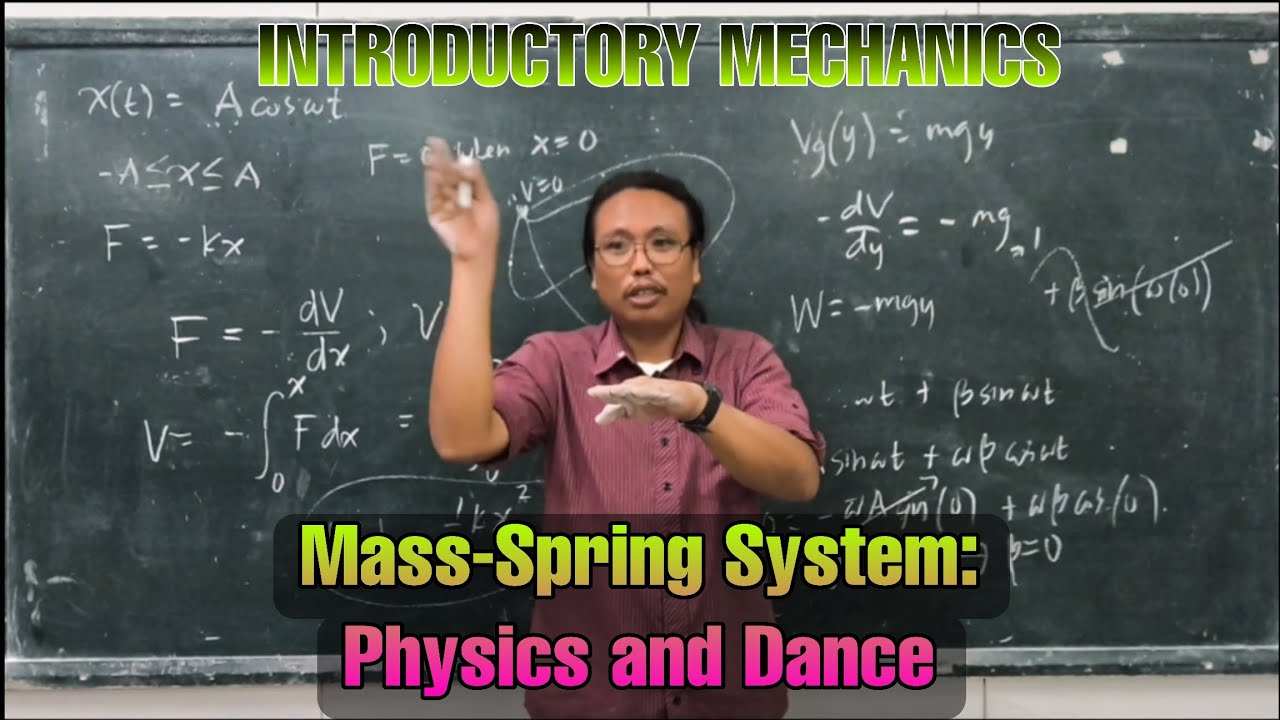
Lec 11 (Introductory Mechanics): The Simple Harmonic Oscillator
Keywords
Summary
158 words
Critical Evaluation
Value of the Information & Strength of the Argument
The lecture provides a solid introduction to the simple harmonic oscillator, emphasizing the derivation from fundamental principles. The argumentation is logical and step-by-step, making it accessible to students with a basic calculus background. The instructor explains the reasoning behind the solution of the differential equation, including the concept of superposition and the role of initial conditions. The discussion of potential energy and its comparison with gravitational potential energy adds depth. However, the lecture could be strengthened by explicitly proving the conservative nature of the force and discussing the limitations of the linear spring model.
Scientific Rigor, Source Quality, Title Accuracy
The lecture is scientifically rigorous, with clear mathematical derivations. The instructor does not cite external sources, but the content is standard physics. The title accurately reflects the content. The lecture is well-structured and internally consistent, though it assumes prior knowledge of calculus and Newton’s laws.
154 words
Title / Content Match
The title accurately reflects the content, which is a lecture on the simple harmonic oscillator.
Quality & Reliability
8/10
The lecture provides a rigorous derivation of the simple harmonic oscillator from Newton's laws, including the solution of the differential equation and energy analysis. The reasoning is clear and mathematically sound, though it relies on assumptions (linear spring, conservative force) that are stated but not fully proven. The presentation is pedagogical and internally consistent.
Key Moments
Markers derived by PSI from the transcript: the creator did not define chapters.
- Introduction to the mass-spring system and assumptions of linearity.
- Derivation of Hooke's law and definition of spring constant.
- Setting up the differential equation from Newton's second law.
- Solving the differential equation by inspection and introducing sine and cosine solutions.
- Applying initial conditions to find the specific solution.
- Discussion of the conservative nature of the force and derivation of potential energy.
- Comparison of elastic potential energy with gravitational potential energy.
- Analysis of total energy and maximum potential energy at turning points.
Contribution & Novelties
The lecture provides a clear and pedagogical introduction to the simple harmonic oscillator, emphasizing the derivation from Newton’s laws and the solution of the differential equation. It offers a solid foundation for understanding oscillatory motion.
Pour aller plus loin :
- Hooke’s law — Fundamental principle behind the spring force.
- Simple harmonic motion — General concept and applications.
- Differential equation — Mathematical background for solving the oscillator equation.
67 words
Radar Profile
The radar profile shows high scores in information quantity, quality, and reliability, with a slightly lower technical level. This indicates a lecture that is comprehensive and trustworthy, but may require some background knowledge to fully appreciate.