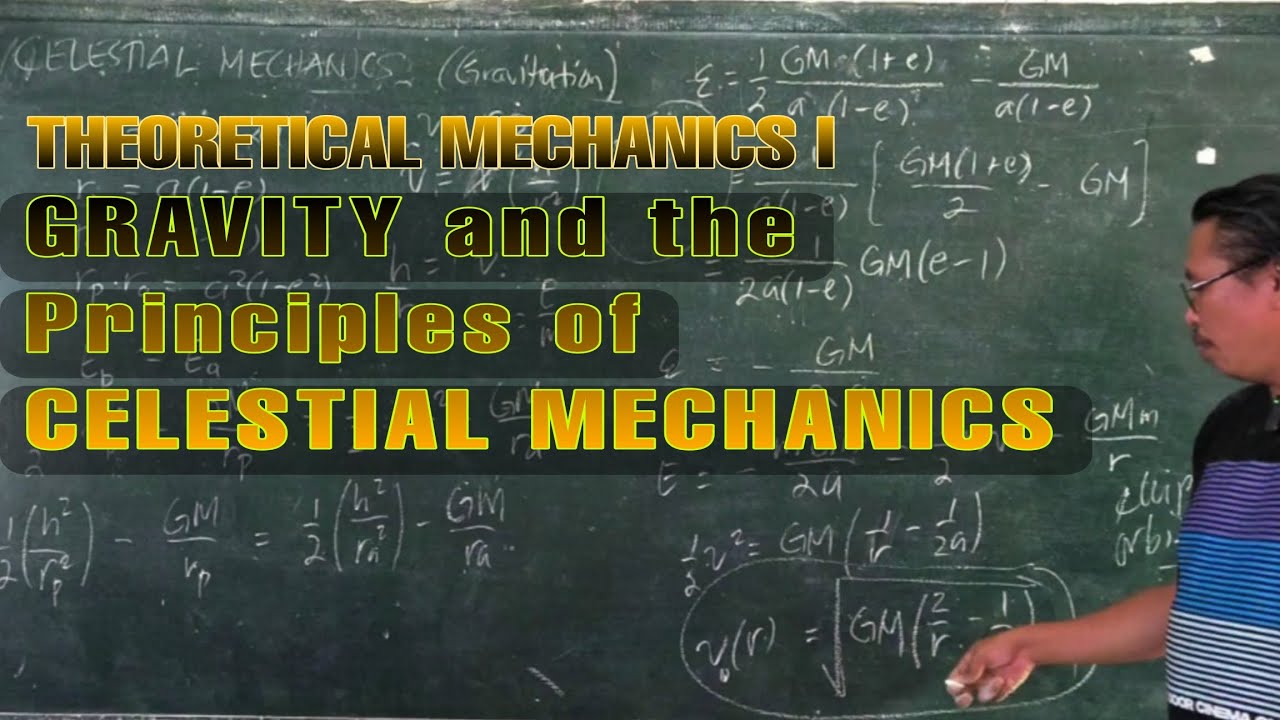
TheoMech-18: Celestial Mechanics and Gravitation
Keywords
Summary
152 words
Critical Evaluation
Value of the Information & Strength of the Argument
The lecture provides a solid derivation of Newton’s law of gravitation from Kepler’s empirical laws, which is a valuable pedagogical approach. The argumentation is logical and step-by-step, starting from the geometry of ellipses, then using Kepler’s second law to establish the central nature of the force, and finally applying the Binet formula to show the inverse-square dependence. The use of Kepler’s third law to determine the constant of proportionality is elegant. The instructor also connects the derived law to practical applications, such as calculating the gravitational field at Earth’s surface. However, the presentation is somewhat informal, with occasional asides and a few minor numerical inaccuracies (e.g., Earth’s radius), but these do not undermine the core physics.
Scientific Rigor, Source Quality, Title Accuracy
The lecture is scientifically rigorous in its derivations, relying on established principles of Newtonian mechanics and Kepler’s laws. The instructor does not cite external sources but builds the content from fundamental physics, which is appropriate for a course lecture. The title accurately reflects the content, which is focused on celestial mechanics and gravitation. The video is part of a structured course playlist, indicating a systematic approach. The presentation is clear, though informal, and the mathematical steps are well-explained. No external sources are cited, but the derivations are self-contained and based on well-known physics.
224 words
Title / Content Match
The title accurately reflects the content, which focuses on celestial mechanics and gravitation within a theoretical mechanics course.
Quality & Reliability
7/10
The lecture is a formal physics derivation, based on established Newtonian mechanics and Kepler's laws. The instructor demonstrates a clear logical progression from Kepler's empirical laws to Newton's law of gravitation, using mathematical derivations. However, the presentation is informal, with some asides and potential minor errors in constants (e.g., Earth's radius), but the core physics is correct. The video is part of a structured course, suggesting pedagogical reliability.
Key Moments
Markers derived by PSI from the transcript: the creator did not define chapters.
- Introduction to celestial mechanics and the two major theories of gravity: Newton's and Einstein's.
- Review of Kepler's three laws of planetary motion and the historical context with Tycho Brahe's data.
- Geometry of ellipses: definition, eccentricity, latus rectum, and perihelion/aphelion.
- Derivation of Kepler's second law: equal areas in equal times, leading to the constancy of angular momentum.
- Derivation of the Binet formula for central force motion.
- Application of Kepler's first law to show the force is proportional to 1/r^2.
- Use of Kepler's third law to determine the constant of proportionality, leading to Newton's law of gravitation.
- Vector form of Newton's law of gravitation.
- Calculation of the gravitational field at Earth's surface, yielding g ≈ 9.8 m/s².
- Introduction to gravitational potential energy and its relation to work.
Cited Sources
- Full Course Playlist: Theoretical Mechanics 1 — The playlist for the full course, providing context for this lecture.
Concurring Sources
- Kepler's laws of planetary motion — The lecture's discussion of Kepler's laws aligns with standard physics textbooks.
- Newton's law of universal gravitation — The derivation and final form of the law match established physics.
Contribution & Novelties
The lecture provides a clear and systematic derivation of Newton’s law of gravitation from Kepler’s laws, which is a classic but valuable pedagogical approach. It emphasizes the logical progression from empirical observations to a fundamental force law. The use of the Binet formula is a standard technique but is well-explained. The lecture also connects the derived law to practical applications, such as calculating g at Earth’s surface. Overall, it reinforces the foundational concepts of celestial mechanics.
Pour aller plus loin :
- Kepler’s laws of planetary motion — Overview of Kepler’s laws and their historical context.
- Newton’s law of universal gravitation — Detailed explanation of the law and its derivation.
- Binet equation — The differential equation used to derive the force law from orbital shape.
124 words
Radar Profile
The radar profile shows high scores in quantity and quality of information, reflecting the lecture's comprehensive coverage and accurate physics. The technical level is also high, indicating a rigorous mathematical treatment. The overall reliability is strong, with no major errors detected. This suggests a well-structured and informative lecture for students of theoretical mechanics.