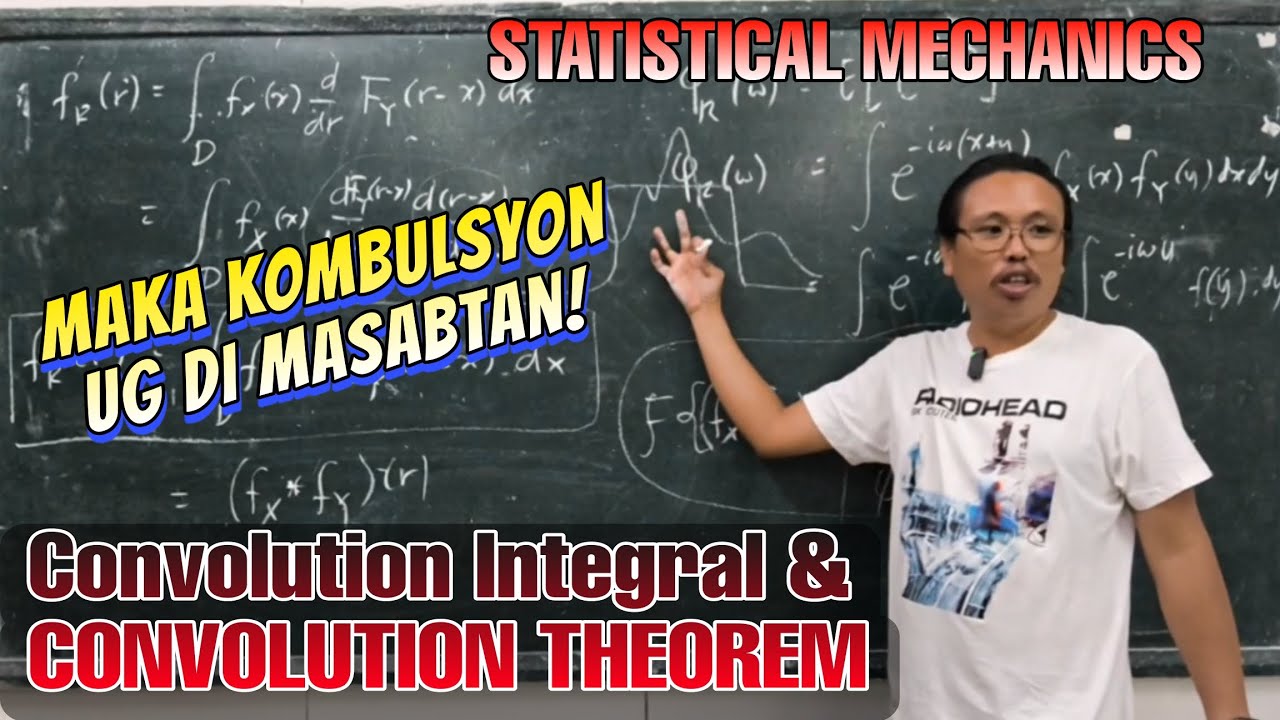
StatMech-09: Convolution Integral and the Convolution Theorem
Keywords
Summary
153 words
Critical Evaluation
Value of the Information & Strength of the Argument
The lecture provides a solid mathematical foundation for the convolution integral and theorem, deriving them from first principles. The argumentation is clear and logical, building on previous concepts such as probability density functions and Jacobian transformations. The instructor effectively demonstrates the application of these concepts through worked examples, which enhances understanding. The discussion of applications in quantum mechanics and signal processing adds value by showing the relevance of the material. However, the presentation is somewhat informal, with occasional digressions and asides that may detract from the focus.
Scientific Rigor, Source Quality, Title Accuracy
The lecture is mathematically rigorous, with derivations based on measure theory and differential geometry. The instructor does not cite external sources, but the content is presented as a self-contained derivation. The title accurately reflects the content, which is focused on the convolution integral and theorem. The lecture is part of a larger course playlist, which provides context. The presentation is informal, but the mathematical content is sound.
169 words
Title / Content Match
The title accurately reflects the content, which focuses on the convolution integral and the convolution theorem in the context of statistical mechanics.
Quality & Reliability
7/10
The lecture is mathematically rigorous, deriving the convolution integral from first principles using measure theory and differential geometry. The instructor demonstrates a clear understanding of the material, but the presentation is informal and includes some digressions and asides that may distract from the core content.
Key Moments
Markers derived by PSI from the transcript: the creator did not define chapters.
Cited Sources
- Full Course Playlist — Playlist containing the full course on statistical and thermal physics
Contribution & Novelties
The lecture provides a rigorous derivation of the convolution integral and theorem within the context of statistical mechanics, emphasizing the mathematical foundations. It connects the concept to applications in quantum mechanics and signal processing, highlighting its broad utility.
Pour aller plus loin :
- Convolution — Wikipedia article providing a comprehensive overview of convolution.
- Fourier transform — Wikipedia article on the Fourier transform, essential for understanding the convolution theorem.
- Probability density function — Wikipedia article on probability density functions, relevant to the examples in the lecture.
85 words
Radar Profile
The radar profile shows high scores in quantity and quality of information, and technical level, indicating a dense and rigorous lecture. The reliability score is slightly lower, reflecting the informal presentation style and lack of external citations.