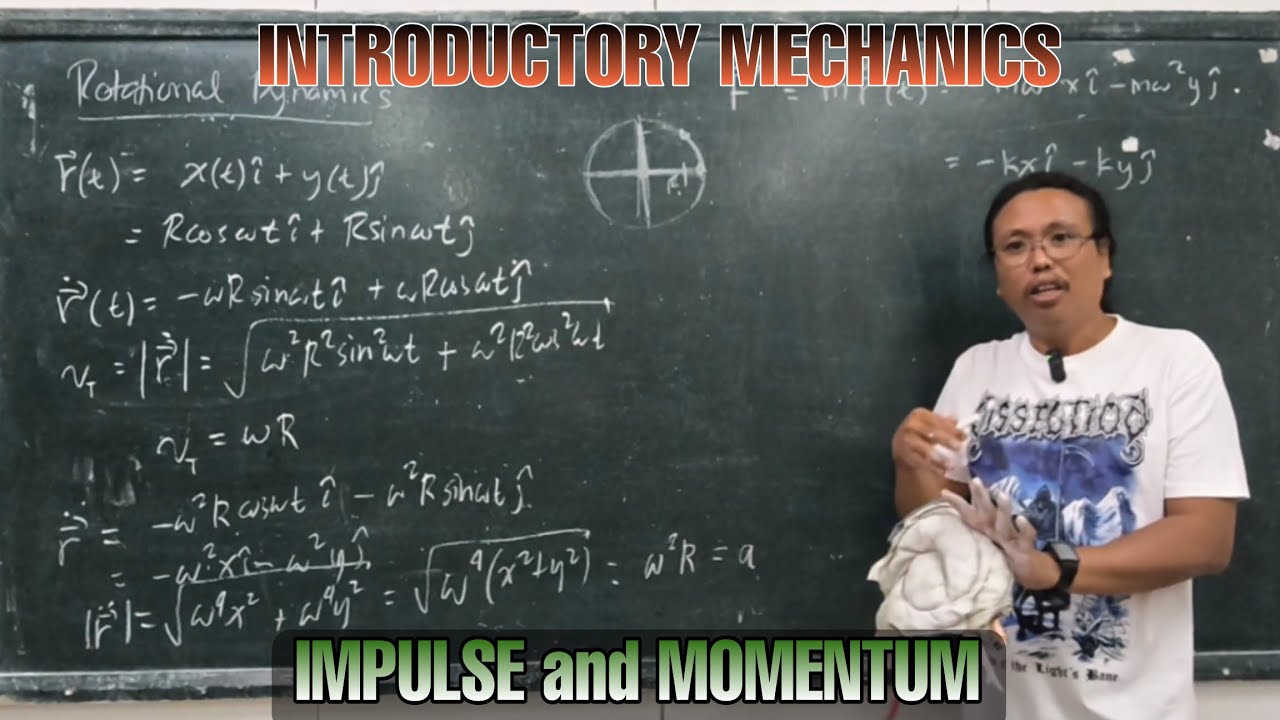
Lec 14 (Introductory Mechanics): Torque and Rotational Dynamics
Keywords
Summary
154 words
Critical Evaluation
Value of the Information & Strength of the Argument
The lecture provides a solid, mathematically rigorous derivation of rotational kinematics and dynamics. The instructor carefully builds from the rolling without slipping condition to derive the relationships between linear and angular quantities. The use of vector calculus to derive centripetal acceleration and force is particularly valuable, as it goes beyond a simple formula presentation. The argumentation is logical and step-by-step, with clear explanations of the physical meaning of each quantity. However, the presentation is informal and sometimes digresses, which may hinder clarity for some viewers. The value lies in the thorough derivation and the connection between translational and rotational concepts, which is essential for understanding rigid body dynamics.
Scientific Rigor, Source Quality, Title Accuracy
The lecture is scientifically rigorous, with accurate derivations and correct physics. The instructor does not cite external sources, but the content is standard introductory mechanics. The title accurately reflects the content, as the lecture covers torque and rotational dynamics, though the focus is more on kinematics and centripetal force before introducing torque. The informal style and occasional digressions do not detract from the scientific accuracy. No comments were provided for analysis.
194 words
Title / Content Match
The title accurately reflects the content, which covers torque and rotational dynamics, though the lecture focuses more on kinematics and centripetal force before introducing torque.
Quality & Reliability
7/10
The lecture provides a rigorous derivation of rotational kinematics and dynamics from first principles, with clear mathematical steps. The content is accurate, though the presentation is informal and occasionally digresses. The lack of citations and the informal style slightly reduce the score.
Key Moments
Markers derived by PSI from the transcript: the creator did not define chapters.
- Introduction to rotational motion and rolling without slipping
- Derivation of s = rθ and relation between linear and angular velocity
- Introduction of angular velocity and angular acceleration, units of radians
- Derivation of rotational kinematic equations for constant acceleration
- Analysis of uniform circular motion, parametrization of position vector
- Derivation of velocity and acceleration vectors, magnitude of acceleration
- Introduction of centripetal force, direction and magnitude
- Extension to non-uniform circular motion, introduction of tangential acceleration
- Decomposition of total force into radial and tangential components
- Summary and transition to torque and rotational dynamics
Contribution & Novelties
The lecture provides a clear and rigorous derivation of rotational kinematics and dynamics from first principles, emphasizing the connection between translational and rotational motion. It goes beyond typical textbook treatments by explicitly deriving the vector forms of velocity and acceleration for circular motion, and by showing how the total force decomposes into radial and tangential components. This approach helps build a strong conceptual foundation for understanding torque and angular momentum.
Pour aller plus loin :
- Rotational motion — Wikipedia article on rotation around a fixed axis, covering key concepts.
- Centripetal force — Wikipedia article on centripetal force, with derivations and examples.
- Torque — Wikipedia article on torque, including its definition and relation to angular acceleration.
115 words
Radar Profile
The radar profile shows a balanced lecture with high scores in information quantity and technical level, indicating a content-rich and technically sound presentation. The quality and reliability scores are slightly lower, reflecting the informal style and lack of citations, but the overall profile suggests a solid educational resource.