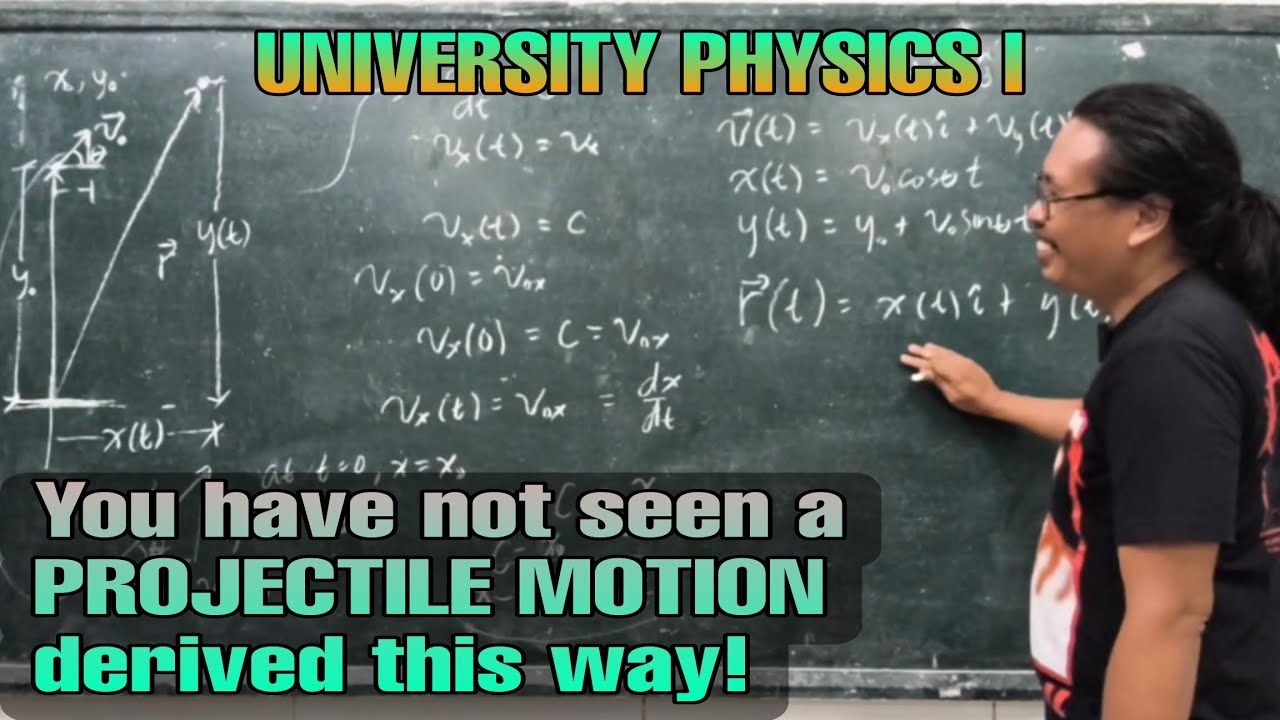
Lec 03 Physics for Engineers || Projectile Motion
Keywords
Summary
168 words
Critical Evaluation
Value of the Information & Strength of the Argument
The video provides a solid, step-by-step derivation of projectile motion equations from Newton’s second law, which is valuable for engineering students. The argumentation is logical and thorough, with clear explanations of each step. The instructor emphasizes the physical meaning behind the mathematics, such as why the mass cancels out and the interpretation of negative time solutions. He also derives the trajectory equation and maximum height using two methods (analytic geometry and physics), reinforcing understanding. The examples are worked out in detail, and the instructor encourages active participation by asking students to use calculators. The presentation is rigorous and pedagogically effective.
Scientific Rigor, Source Quality, Title Accuracy
The scientific rigor is high: the derivations are mathematically correct and physically sound. The instructor uses first principles, starting from F=ma, and does not rely on memorized formulas. However, no external sources are cited, and the video is based on the instructor’s own teaching materials. The title accurately reflects the content, which is a lecture on projectile motion. The video is self-contained and does not reference textbooks or papers, which is typical for a tutorial. The lack of citations does not detract from the accuracy of the content, but it limits the ability to verify claims independently.
212 words
Title / Content Match
The title accurately reflects the content: a lecture on projectile motion for engineering physics, covering derivation, examples, and analysis.
Quality & Reliability
7/10
The video provides a rigorous derivation of projectile motion equations from Newton's second law, with clear mathematical steps and physical interpretation. The instructor demonstrates a first-principles approach, deriving the trajectory equation and maximum height both analytically and physically. The content is accurate and pedagogically sound, though it lacks formal citations and external references.
Key Moments
Markers derived by PSI from the transcript: the creator did not define chapters.
- Introduction: review of constant force in 1D, extension to 2D with constant force in y and zero in x.
- Derivation of kinematic equations for y with constant acceleration -g.
- Derivation of uniform motion in x: vx constant, x = v0x t.
- Introduction of initial velocity components in terms of angle: v0x = v0 cosθ, v0y = v0 sinθ.
- Example problem: particle fired from 200 m building with v0=50 m/s at 60°.
- Solving for height after 5 seconds: y-y0 = 94 m.
- Solving for time to return to launch level: t = 8.84 s.
- Solving for times to reach 30 m above and below launch level.
- Solving for time to hit the ground: t = 12.19 s.
- Derivation of trajectory equation: y = y0 + x tanθ - (g/(2 v0^2 cos^2θ)) x^2.
- Finding maximum height using vertex of parabola and physics (vy=0).
Contribution & Novelties
The video offers a first-principles derivation of projectile motion, starting from Newton’s second law, which is not commonly found in textbooks. It emphasizes the physical interpretation of equations, such as the independence of mass and the meaning of negative time solutions. The instructor also derives the maximum height using both analytic geometry and physics, providing a deeper understanding. The teaching style is interactive and encourages critical thinking.
Pour aller plus loin :
- Projectile motion — Comprehensive overview of projectile motion, including equations and examples.
- Kinematics — Background on the study of motion without considering forces.
- Newton’s laws of motion — Foundational principles used in the derivation.
106 words
Radar Profile
The radar profile shows high scores in quantity and quality of information, moderate technical level, and good reliability. This indicates a well-structured tutorial that provides substantial content with accurate physics, suitable for engineering students.