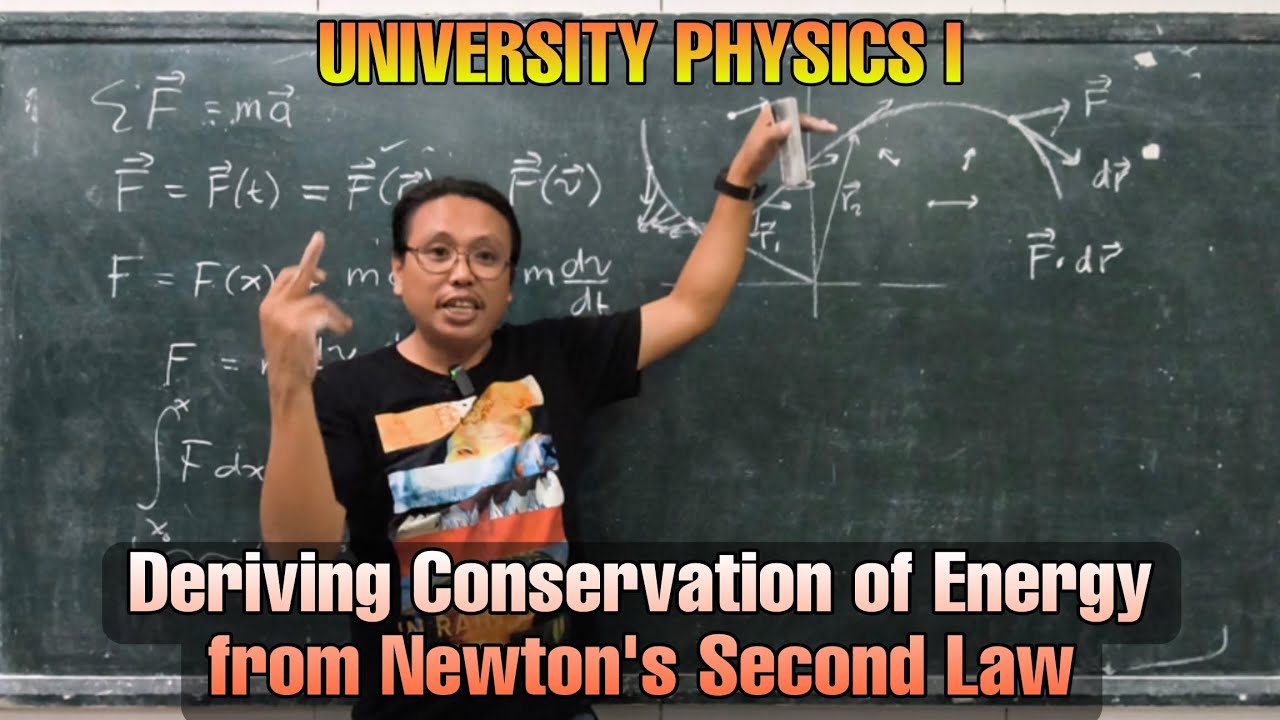
Lec 04 (University Physics I): Work-Energy Theorem derived from Newton's Second Law
Keywords
Summary
149 words
Critical Evaluation
Value of the Information & Strength of the Argument
The lecture provides a clear and rigorous derivation of the work-energy theorem, which is a fundamental result in classical mechanics. The argumentation is logical and step-by-step, starting from Newton’s second law and using calculus to arrive at the theorem. The instructor takes care to explain the physical meaning of each mathematical step, such as the dot product in the work integral and the interpretation of kinetic and potential energy. The value of the information is high for students seeking a deeper understanding of the theorem’s origin, as it goes beyond a mere statement and shows the derivation. The argumentation is solid, with no apparent logical gaps. The use of intuitive analogies (e.g., wind, water flow) helps to illustrate abstract concepts, though it may sometimes be verbose.
Scientific Rigor, Source Quality, Title Accuracy
The lecture is scientifically rigorous, with correct mathematical derivations and physical interpretations. The instructor does not cite external sources, but this is typical for a lecture that derives fundamental principles. The title accurately reflects the content, as the lecture indeed derives the work-energy theorem from Newton’s second law. The presentation is informal, with some digressions and asides, but the core content is accurate. The lack of citations is not a major issue for a lecture, but it means that the content is not directly linked to specific references. Overall, the scientific rigor is good, and the title is appropriate.
240 words
Title / Content Match
The title accurately reflects the content: the lecture derives the work-energy theorem from Newton's second law, with a focus on the one-dimensional case.
Quality & Reliability
7/10
The lecture provides a rigorous derivation of the work-energy theorem from Newton's second law, using calculus and vector concepts. The reasoning is sound and the mathematical steps are correct, though the presentation is informal and includes some digressions.
Key Moments
Markers derived by PSI from the transcript: the creator did not define chapters.
- Introduction: review of constant force case and motivation for variable forces.
- Discussion of vector fields and force as a function of position, time, and velocity.
- Derivation of work-energy theorem in one dimension using chain rule.
- Interpretation of the dot product in the work integral.
- Introduction of conservative and non-conservative forces, gradient of a scalar field.
- Derivation of conservation of mechanical energy from the work-energy theorem.
- Discussion of the physical meaning of kinetic and potential energy.
- Summary and conclusion: energy conservation derived from Newton's second law.
Contribution & Novelties
The lecture provides a clear and rigorous derivation of the work-energy theorem from Newton’s second law, emphasizing the mathematical steps and physical interpretations. It is particularly valuable for students who want to understand the origin of the theorem rather than just memorize it. The explanation of conservative forces as gradients of a scalar field is a nice touch that connects to more advanced topics.
Pour aller plus loin :
- Work-energy theorem — Wikipedia article on work and the work-energy theorem.
- Conservative force — Wikipedia article on conservative forces and their relation to potential energy.
- Gradient — Wikipedia article on the gradient of a scalar field.
- Kinetic energy — Wikipedia article on kinetic energy.
- Potential energy — Wikipedia article on potential energy.
121 words
Radar Profile
The radar profile shows a balanced lecture with high scores in information quantity and quality, and a moderate technical level. The reliability is also high, reflecting the accurate derivation. The lecture is strong in content but may not be as accessible to beginners due to the use of calculus and vector concepts.