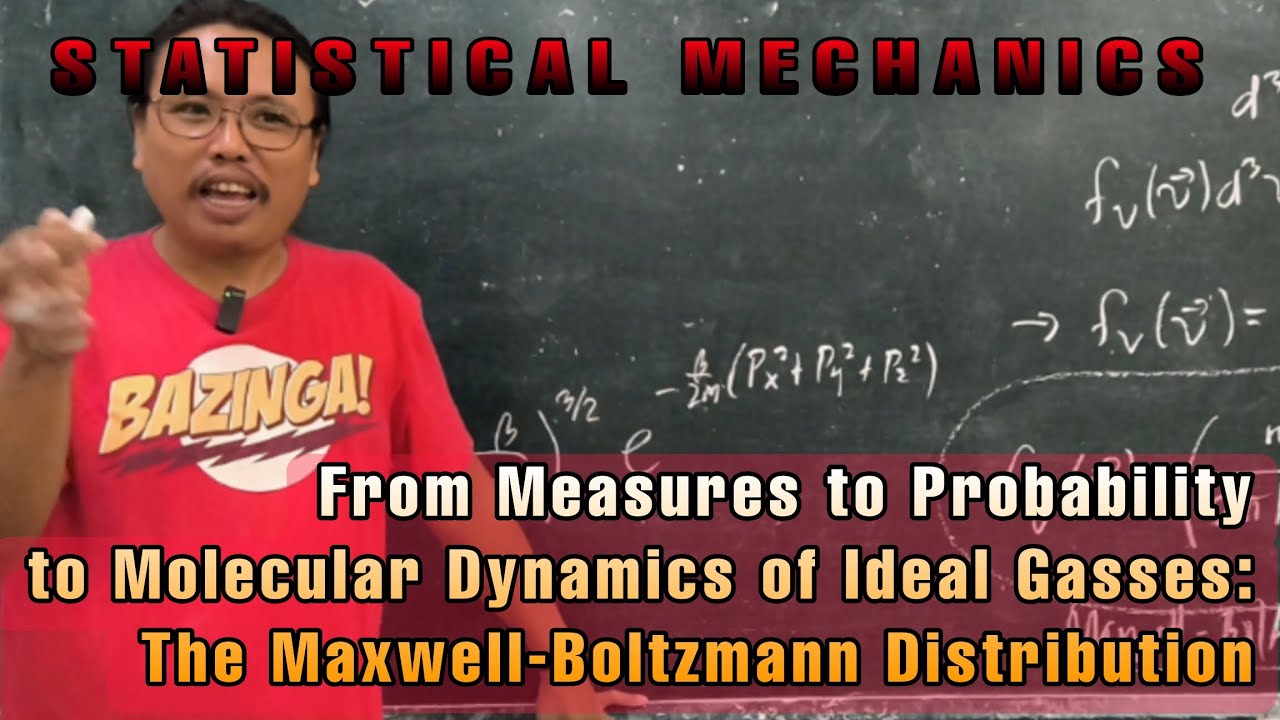
StatMech-13: The Maxwell-Boltzmann Distribution and Dynamics of Ideal Gas
Keywords
Summary
131 words
Critical Evaluation
Value of the Information & Strength of the Argument
The lecture provides a rigorous derivation of the Maxwell-Boltzmann distribution from the principles of statistical mechanics, using measure theory and differential geometry. The argumentation is solid, building step-by-step from the microcanonical ensemble to the canonical ensemble and then to the ideal gas. The instructor carefully explains the mathematical steps, including the use of delta functions and the change of variables. The derivation of the ideal gas law and the equipartition theorem from the distribution is convincing and demonstrates the power of the formalism. The value of the information is high for advanced students or researchers seeking a deeper understanding of statistical mechanics.
Scientific Rigor, Source Quality, Title Accuracy
The lecture is scientifically rigorous, with a clear mathematical framework. However, no external sources are cited; the content is based on the instructor’s own derivation. The title accurately reflects the content. The description mentions a full course playlist, which is the only source provided. The lecture is part of a series, so the rigor is consistent with a university-level course. The lack of citations is typical for a lecture, but it means the content is not peer-reviewed. The title is appropriate and does not overpromise.
202 words
Title / Content Match
The title accurately reflects the content: the lecture derives the Maxwell-Boltzmann distribution and applies it to ideal gas dynamics, including pressure and heat capacity.
Quality & Reliability
8/10
The lecture is mathematically rigorous, deriving the Maxwell-Boltzmann distribution from first principles using measure theory and differential geometry. The presentation is coherent and builds on previous lectures. However, the video is a single lecture without external citations or peer review, and the informal style with occasional language mixing may reduce clarity for some viewers.
Key Moments
Markers derived by PSI from the transcript: the creator did not define chapters.
- Introduction and review of phase space and microcanonical ensemble.
- Definition of the density function and normalization.
- Derivation of the canonical ensemble from the microcanonical ensemble.
- Derivation of the Boltzmann factor and partition function.
- Specialization to a free particle and derivation of the momentum distribution.
- Derivation of the Maxwell-Boltzmann velocity distribution.
- Calculation of expectation values and the equipartition theorem.
- Derivation of the ideal gas law from the distribution.
- Definition of heat capacity and enthalpy.
Cited Sources
- Full Course Playlist — The description provides a link to the full course playlist, which contains all lectures in this series.
Concurring Sources
- Maxwell–Boltzmann distribution — The Wikipedia article provides a standard derivation and properties of the distribution, consistent with the lecture's content.
- Ideal gas law — The ideal gas law is derived in the lecture and is a fundamental result in thermodynamics.
Contribution & Novelties
This lecture provides a rigorous derivation of the Maxwell-Boltzmann distribution from first principles, using measure theory and differential geometry. It emphasizes the geometric foundations of statistical mechanics, which is not common in typical treatments. The derivation of the ideal gas law and equipartition theorem from the distribution is clear and insightful.
Pour aller plus loin :
- Maxwell–Boltzmann distribution — Overview of the distribution and its applications.
- Statistical mechanics — General background on the field.
- Equipartition theorem — Related theorem for energy distribution.
82 words
Radar Profile
The radar profile shows high scores in technical level and information quality, indicating a mathematically rigorous and informative lecture. The lower score in information quantity suggests the lecture is focused and does not cover a broad range of topics, but it is deep in the covered material.