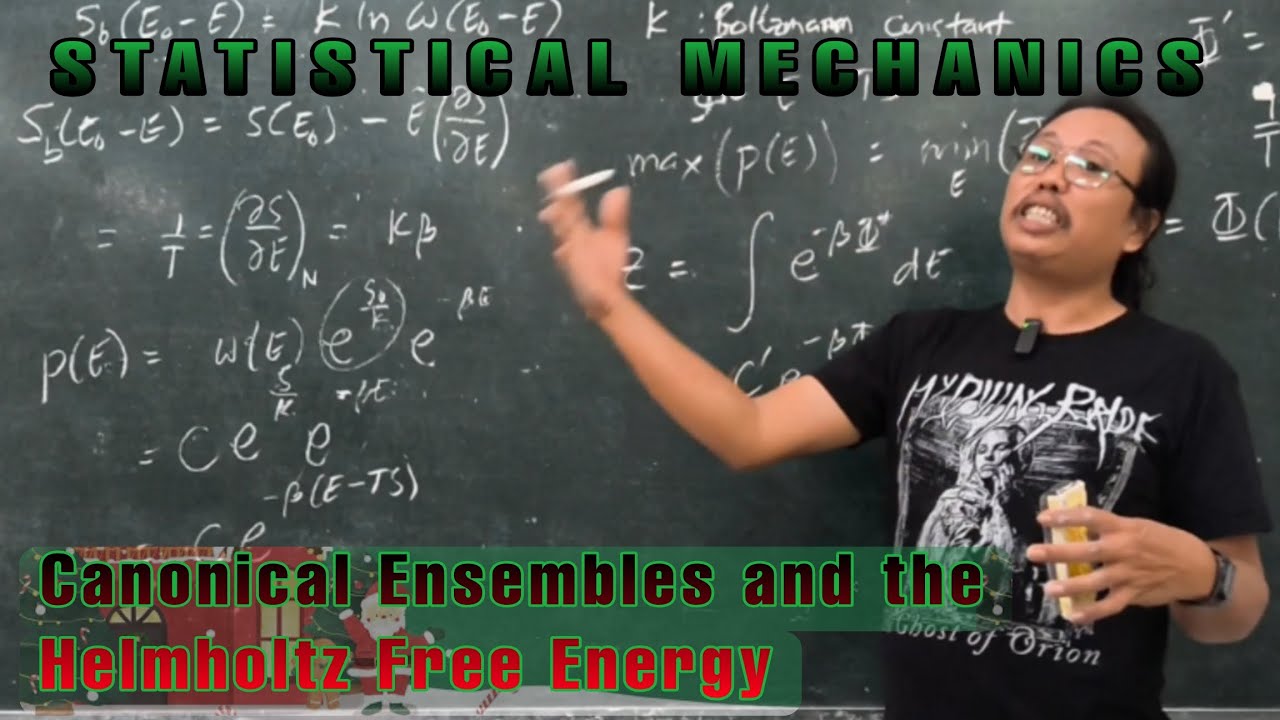
StatMech-14: Canonical Ensembles and Helmholtz Free Energy
Keywords
Summary
174 words
Critical Evaluation
Value of the Information & Strength of the Argument
The lecture provides a high-value, first-principles derivation of the canonical ensemble, using measure theory and differential geometry to establish the mathematical foundations. The argumentation is solid, with careful steps linking the microstate counting to the macroscopic free energy. The instructor’s approach of maximizing the probability distribution and minimizing the free energy is logically sound and well-explained. The use of Taylor expansion and the neglect of higher-order terms is justified, and the connection to the Shannon entropy is clearly demonstrated. The lecture also introduces the grand canonical ensemble as a natural extension, showing the versatility of the formalism.
Scientific Rigor, Source Quality, Title Accuracy
The lecture is scientifically rigorous, with a clear mathematical structure. The instructor does not cite external sources, but the content is based on standard statistical mechanics, and the playlist link in the description provides access to the full course. The title accurately reflects the content, and the lecture stays on topic. The informal style and occasional digressions do not detract from the scientific accuracy.
176 words
Title / Content Match
The title accurately reflects the content, which focuses on canonical ensembles and the Helmholtz free energy.
Quality & Reliability
8/10
The lecture is mathematically rigorous, building on measure theory and differential geometry, and derives the canonical ensemble and Helmholtz free energy from first principles. The reasoning is clear and consistent, though the presentation style is informal and occasionally digresses.
Key Moments
Markers derived by PSI from the transcript: the creator did not define chapters.
- Introduction and review of previous concepts: phase volume, density of states, and probability density.
- Derivation of entropy from density of states and definition of temperature.
- Taylor expansion of bath entropy and introduction of Helmholtz free energy.
- Maximization of probability distribution and minimization of free energy.
- Definition of partition function and relation F = -kT ln Z.
- Redefinition of entropy in terms of probabilities, leading to Shannon entropy.
- Derivation of macroscopic relation F = U - TS.
- Extension to open systems and introduction of grand canonical ensemble.
Cited Sources
- Full Course Playlist — The playlist for the full course in statistical and thermal physics, providing context for this lecture.
Concurring Sources
- Canonical ensemble — The lecture's derivation of the canonical ensemble aligns with standard treatments.
- Helmholtz free energy — The definition and properties of Helmholtz free energy are consistent with the lecture.
Contribution & Novelties
This lecture offers a unique perspective by grounding statistical mechanics in measure theory and differential geometry, which is not common in typical treatments. It provides a rigorous derivation of the canonical ensemble and Helmholtz free energy from first principles, emphasizing the mathematical structure. The connection between the Shannon entropy and the thermodynamic entropy is clearly demonstrated, and the extension to the grand canonical ensemble is presented as a natural generalization.
Pour aller plus loin :
- Canonical ensemble — Provides a standard overview of the canonical ensemble and its properties.
- Helmholtz free energy — Detailed explanation of the Helmholtz free energy and its role in thermodynamics.
- Measure theory — Foundational concepts of measure theory used in the lecture.
- Shannon entropy — Information-theoretic entropy, which is related to the thermodynamic entropy.
129 words
Radar Profile
The radar profile shows high scores in technical level and information quality, indicating a mathematically rigorous and informative lecture. The lower score in information quantity suggests that the lecture is focused and does not cover a broad range of topics, but rather delves deeply into the specific subject.