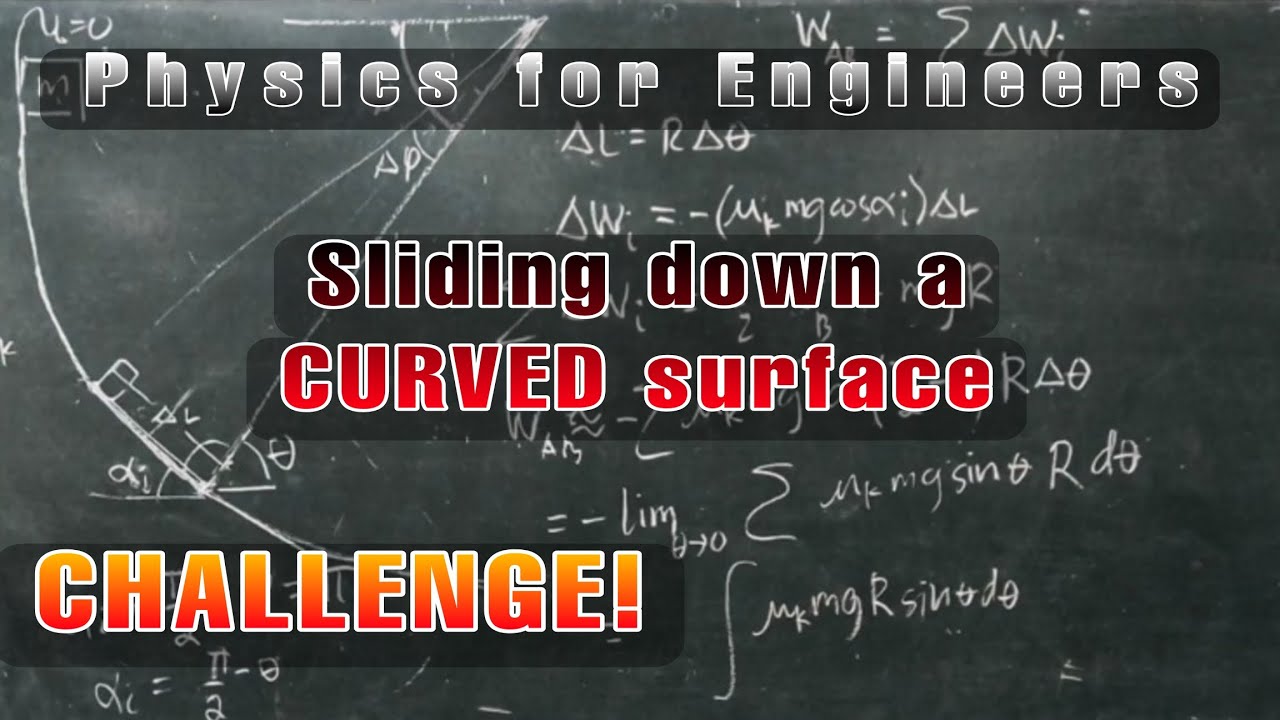
Lec 11 Physics for Engineers || Sliding on a Curved Surface with FRICTION: Solved Problem
Keywords
Summary
137 words
Critical Evaluation
Value of the Information & Strength of the Argument
The video provides a clear step-by-step derivation of the work done by friction on a curved path, using the limit of a polygon to transition from a sum to an integral. This is a valuable pedagogical approach that illustrates the connection between discrete and continuous analysis. The argumentation is logical and the mathematics is mostly correct, with the key result for the velocity being correct and recovering the frictionless limit. However, the second part, concerning the stopping height, contains an error that is not resolved, which undermines the completeness of the argument. The instructor’s informal style and reliance on external tools for trigonometric identities may detract from the rigor, but the core physics is sound.
Scientific Rigor, Source Quality, Title Accuracy
The video is a tutorial with no external sources cited. The derivation is self-contained, but the lack of references means there is no verification of the results against standard textbooks. The title accurately reflects the content, which is a solved problem on sliding with friction on a curved surface. The presentation is informal and includes some tangential remarks, but the main topic is consistently addressed. The unresolved error in the stopping height formula is a significant flaw in the scientific rigor of the video.
214 words
Title / Content Match
The title accurately describes the content: a solved problem on sliding with friction on a curved surface.
Quality & Reliability
7/10
The derivation is mathematically sound and recovers the frictionless limit, but the presentation is informal and contains a notable error in the final stopping height formula that is not fully resolved.
Key Moments
Markers derived by PSI from the transcript: the creator did not define chapters.
- Introduction of the problem: mass sliding on a semicircular track with friction.
- Setup of the work-energy theorem for non-conservative systems.
- Approximation of the curved path by a polygon and definition of delta L.
- Derivation of the work done by friction on a small segment.
- Integration over the path to find total work done by friction.
- Solution for the velocity at the bottom and recovery of frictionless case.
- Introduction of the second problem: finding the stopping height.
- Setting up the energy equation for the stopping condition.
- Solving the trigonometric equation for the stopping angle.
- Derivation of the stopping height formula and identification of an inconsistency.
Contribution & Novelties
The video provides a pedagogical derivation of the work done by friction on a curved path, illustrating the transition from a discrete sum to an integral. It also presents a general formula for the stopping height, though with an error that is not resolved. The approach of using a polygon approximation is a useful teaching tool.
Pour aller plus loin :
- Work (physics) — Provides background on work and energy.
- Friction — Overview of friction and its role in mechanics.
- Work-energy theorem — Explanation of the theorem used in the video.
91 words
Radar Profile
The radar profile shows high scores in technical level and information quantity, but lower in reliability due to the unresolved error. The video is technically dense but may not be fully reliable for learners.