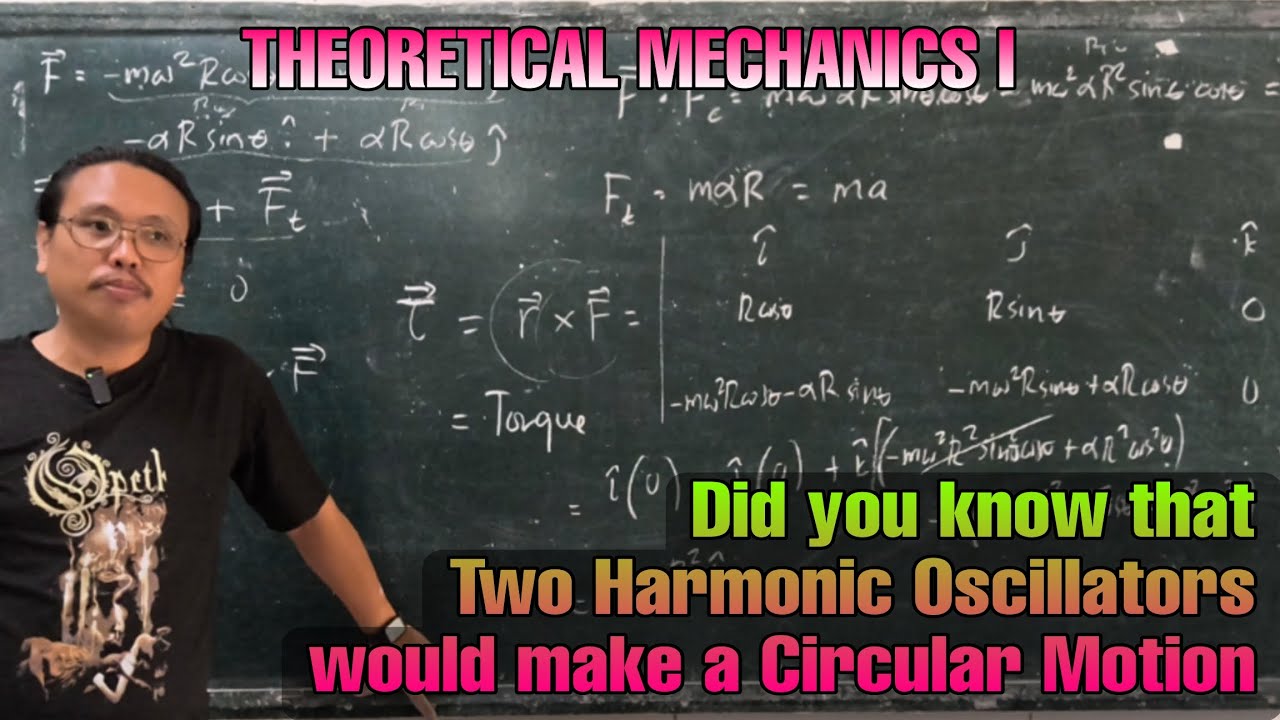
TheoMech-07: How Harmonic Oscillation leads to Rotational Dynamics
Keywords
Summary
161 words
Critical Evaluation
Value of the Information & Strength of the Argument
The lecture provides a clear and logical derivation of circular motion from harmonic oscillations, which is a fundamental concept in physics. The argumentation is solid, building from the Taylor series expansion to the solution of differential equations and the geometric interpretation of the resulting motion. The instructor effectively uses diagrams and analogies, such as the scotch tape example, to illustrate the relationship between translational and rotational motion. The value lies in its pedagogical approach, making complex concepts accessible to students. The argumentation is rigorous, though it relies on known results without external citations.
Scientific Rigor, Source Quality, Title Accuracy
The scientific rigor is high for a lecture: the mathematical derivations are correct and clearly presented. However, the lecture does not cite any external sources or references, which limits its scholarly depth. The title accurately reflects the content, as the lecture indeed shows how harmonic oscillation leads to rotational dynamics. The description mentions a full course playlist, which serves as a source for further learning. No comments were provided for analysis.
179 words
Title / Content Match
The title accurately reflects the content: the lecture demonstrates how harmonic oscillation, when applied to two perpendicular directions, leads to circular motion and rotational dynamics.
Quality & Reliability
7/10
The lecture is a formal physics course presentation, mathematically rigorous in its derivations, but lacks citations and references to external sources. The instructor's explanations are clear and logically structured, but the content is not peer-reviewed and may contain minor pedagogical simplifications.
Key Moments
Markers derived by PSI from the transcript: the creator did not define chapters.
- Introduction and review of Taylor series expansion of potential function.
- Discussion of potential well and qualitative motion of a particle.
- Example of Lennard-Jones potential and molecular vibrations.
- Derivation of circular motion from two perpendicular harmonic oscillations.
- Solution of differential equations for x and y motion.
- Interpretation of circular motion as projections of oscillatory motion.
- Relating translational and rotational motion via arc length.
- Derivation of angular velocity and acceleration from translational motion.
- Derivation of centripetal force and its magnitude.
- Discussion of uniformly accelerated motion and its effect on angular motion.
Cited Sources
- Theoretical Mechanics 1 Full Course Playlist — The playlist containing this lecture and other related lectures in the course.
Concurring Sources
- Harmonic oscillator — The lecture's treatment of harmonic oscillation aligns with standard physics textbooks.
- Circular motion — The derivation of circular motion from harmonic oscillations is consistent with standard kinematics.
Contribution & Novelties
The lecture provides a clear pedagogical derivation of circular motion from harmonic oscillations, which is a fundamental concept in classical mechanics. It bridges the gap between oscillatory motion and rotational dynamics, offering a fresh perspective for students. The use of the Taylor series to justify the harmonic approximation and the subsequent derivation of circular motion is particularly insightful.
Pour aller plus loin :
- Harmonic oscillator — Provides a comprehensive overview of the harmonic oscillator in classical and quantum mechanics.
- Circular motion — Explains the kinematics and dynamics of circular motion, including centripetal force.
- Taylor series — Mathematical background on Taylor series expansion.
- Lennard-Jones potential — Details on the potential used to model molecular interactions.
114 words
Radar Profile
The radar profile shows high scores in quantity and technical level, indicating a dense and mathematically rigorous lecture. The quality and reliability scores are slightly lower, reflecting the lack of external citations and the informal presentation style. Overall, the lecture is strong in content but could benefit from more rigorous sourcing.