Quantum Machine Learning workshop - Day 2 (12.04.2026)
Keywords
Summary
162 words
Critical Evaluation
Value of the Information & Strength of the Argument
The video provides valuable practical guidance on implementing quantum machine learning classification models using PennyLane and PyTorch. It covers important topics like class imbalance and threshold tuning, which are often overlooked in introductory materials. The argumentation is clear and logical, with step-by-step explanations of code and concepts. However, the presentation is informal and lacks rigorous theoretical justification for some claims, such as the potential advantages of quantum models. The instructor acknowledges that the classical model was not tuned, which weakens the comparison. Overall, the content is informative for practitioners but not deeply analytical.
Scientific Rigor, Source Quality, Title Accuracy
The video is a tutorial, so it does not cite formal sources. The only source provided is the workshop website, which contains additional resources. The title accurately reflects the content. The scientific rigor is moderate: the instructor explains concepts clearly but does not provide references to research papers or textbooks. The lack of citations reduces the overall reliability, but the practical demonstrations and code examples add value. The audience comments are not provided, so no analysis of public reception is possible.
189 words
Title / Content Match
The title accurately reflects the content: a workshop on quantum machine learning, specifically day 2, covering classification and integration with PyTorch.
Quality & Reliability
7/10
The workshop provides a structured tutorial on quantum machine learning classification, integrating PennyLane with PyTorch. It covers relevant topics such as class imbalance, grid search, and threshold adjustment. The content is technically sound, but the presentation is informal and lacks formal citations. The video is part of a workshop series by a foundation, suggesting a certain level of expertise, but the lack of peer-reviewed references and the informal delivery limit its scientific rigor.
Key Moments
Markers derived by PSI from the transcript: the creator did not define chapters.
- Introduction and overview of day 2 topics: classification, class imbalance, grid search, threshold adjustment.
- Explanation of classification concepts and models available in quantum machine learning.
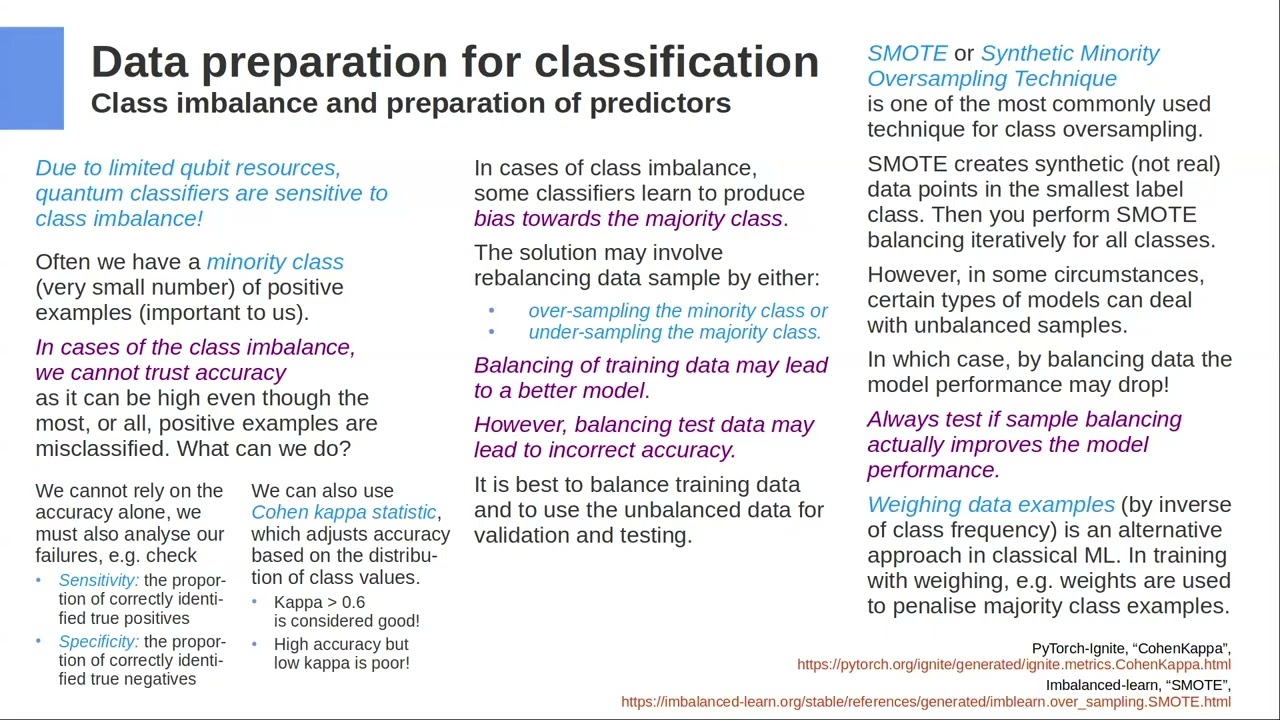
- Discussion on data preparation and class imbalance, including techniques like SMOTE.
- Explanation of priors and how to rescale balanced results to population.
- Introduction to integrating PennyLane with PyTorch for hybrid models.
- Detailed walkthrough of the PyTorch training loop and quantum layer definition.
- Discussion on hyperparameter tuning using grid search and random search.
- Comparison of classical and quantum model performance, with warning about fair comparison.
- Explanation of ROC curves and threshold adjustment to improve accuracy.
- Conclusion and mention of the quiz and feedback form.
Cited Sources
- Workshop website — Official workshop page with additional resources and information.
Concurring Sources
- PennyLane documentation — Official PennyLane documentation, which supports the integration with PyTorch as demonstrated in the video.
Contribution & Novelties
The video offers a practical, hands-on introduction to quantum machine learning classification, specifically demonstrating how to integrate PennyLane with PyTorch. It covers important practical issues like class imbalance and threshold tuning, which are often not addressed in introductory quantum ML tutorials. The comparison between classical and quantum models, while not rigorously tuned, provides a starting point for understanding potential differences in training dynamics.
Pour aller plus loin :
- PennyLane documentation — Official documentation for PennyLane, including tutorials on quantum machine learning.
- PyTorch documentation — Official PyTorch documentation for building neural networks.
- SMOTE: Synthetic Minority Over-sampling Technique — Original paper on SMOTE, a technique for handling class imbalance.
- Quantum Machine Learning — A review paper on quantum machine learning by Biamonte et al., providing a broad overview.
126 words
Radar Profile
The radar profile shows high scores in quantity of information, technical level, and global reliability, indicating a content-rich and technically advanced tutorial. The quality of information is slightly lower, possibly due to the informal presentation and lack of formal citations. The overall balance suggests a valuable practical resource for those already familiar with basic quantum computing concepts.