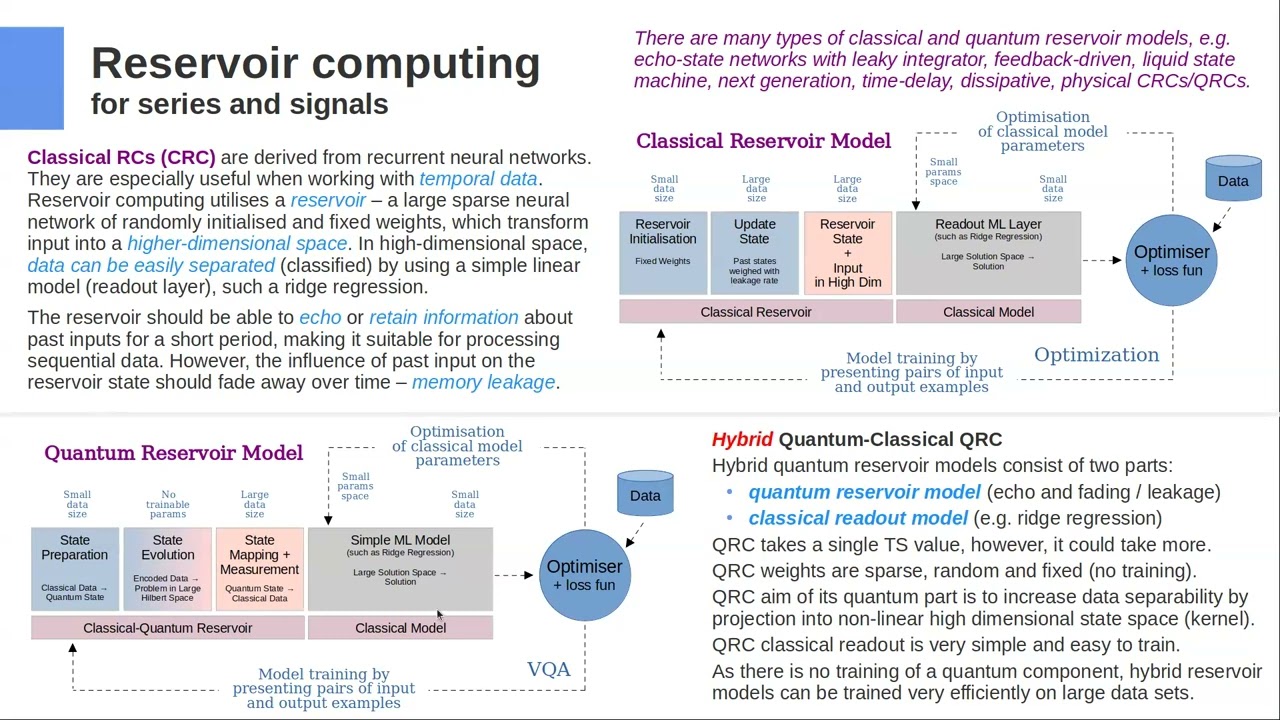
WQCG meetup - Episode LXXIX, 11.07.2026, Jacob Cybulski, "Quantum Reservoir Computing"
Keywords
Summary
199 words
Critical Evaluation
Value of the Information & Strength of the Argument
The talk provides a valuable overview of quantum reservoir computing, with a clear explanation of the concepts and a specific implementation. The argumentation is solid, as the speaker justifies design choices (e.g., ZZ feature map over angle encoding) based on theoretical reasoning and experimental observations. He also acknowledges limitations and open questions, which adds credibility. The presentation is well-structured, moving from classical to quantum, and includes references to key literature.
Scientific Rigor, Source Quality, Title Accuracy
The speaker demonstrates scientific rigor by referencing foundational works (e.g., Jaeger’s echo state networks, Maass’s liquid state machines, Appeltant’s delay-based reservoirs, Gauthier’s next-generation reservoir computing) and explaining how they influence his approach. He also mentions his own project and acknowledges collaborators. The title accurately reflects the content, and the talk is consistent with the advertised topic. No comments were provided for analysis.
147 words
Title / Content Match
The title accurately reflects the content, which focuses on quantum reservoir computing, including a specific dual-memory approach.
Quality & Reliability
7/10
The talk is given by an expert in the field, with references to established literature and a clear methodology. However, it is a presentation of ongoing research without peer-reviewed publication details, and the speaker acknowledges limitations and open questions.
Key Moments
Markers derived by PSI from the transcript: the creator did not define chapters.
- Introduction and announcements by the host, Pavo.
- Speaker introduction and access to slides.
- Introduction to reservoir computing and its applications.
- Explanation of classical reservoir computing and echo state property.
- Transition to quantum reservoir computing and its potential advantages.
- Presentation of the dual-memory quantum reservoir model.
- Discussion of quantum feature maps and encoding schemes.
- Details on the quantum circuit structure and hyperparameters.
- Review of related work and literature.
- Justification for using quantum reservoirs and comparison with classical neural networks.
Cited Sources
- Jacob Cybulski's website — Speaker's website where slides are available.
- Enquanted — Speaker's startup company.
Concurring Sources
- Quantum reservoir computing — General reference for quantum reservoir computing.
- Echo state networks — Foundational work by Jaeger.
Contribution & Novelties
The talk presents a novel ‘dual-memory’ quantum reservoir computing model that combines a classical leaky echo state network with a quantum feature map. This approach aims to leverage both short-term and long-term memory in time series prediction. The speaker discusses the importance of encoding schemes and hyperparameter scaling, and provides insights into the sensitivity of the model. The work is positioned within the broader context of quantum reservoir computing, and the speaker highlights potential advantages in terms of geometry and distance measures.
Pour aller plus loin :
- Quantum reservoir computing — Overview of the field.
- Echo state network — Foundational concept for reservoir computing.
- Liquid state machine — Another type of reservoir computing.
- Next generation reservoir computing — Recent approach that avoids neural networks.
- ZZ feature map — Specific encoding used in the talk.
134 words
Radar Profile
The radar profile shows high scores in technical level and information quality, indicating a technically deep and informative talk. The moderate scores in quantity and reliability suggest that while the talk is rich in content, it is based on ongoing research without peer-reviewed publication, and the speaker acknowledges limitations.