QSilver36 - Quantum Computing and Programming Workshop organized by QPoland - Day 5 (6.03.2026)
Keywords
Summary
195 words
Critical Evaluation
Value of the Information & Strength of the Argument
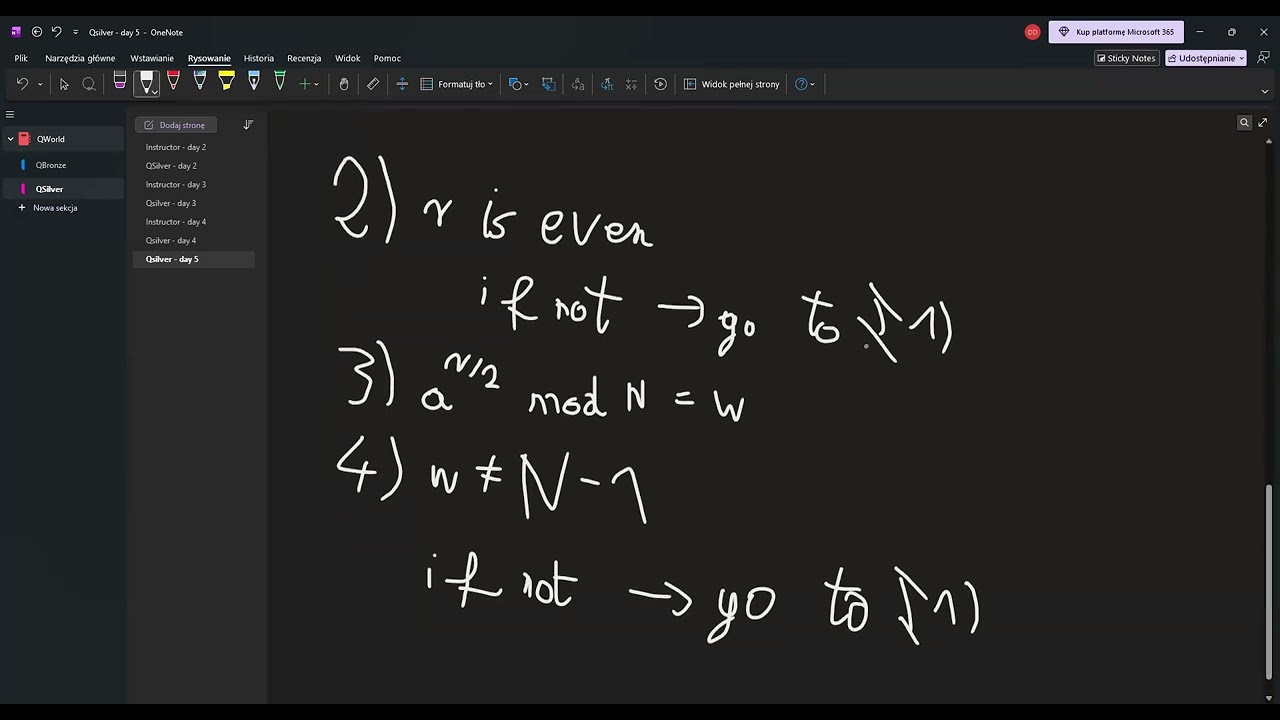
The video provides a solid, step-by-step explanation of Shor’s algorithm, from the mathematical foundations to the practical implementation. The presenter carefully justifies each step, such as why R must be even and why the condition A^(R/2) ≠ -1 mod N is necessary. The argumentation is logical and builds on previous sessions, making it accessible to those who have followed the workshop. The use of a concrete example (N=15) and a coding demonstration reinforces the theoretical concepts. However, the presentation is somewhat informal and occasionally lacks precision (e.g., ‘short algorithm’ instead of ‘Shor’s algorithm’), and the video is a recording of a live session with potential distractions. Overall, the value of the information is high for learners seeking a practical understanding of Shor’s algorithm.
Scientific Rigor, Source Quality, Title Accuracy
The scientific rigor is generally good, with accurate explanations of the algorithm and its mathematical basis. The presenter correctly describes the classical complexity and the quantum advantage. The sources are limited to the workshop page, which provides context but no external references. The title accurately reflects the content, and the video is well-structured. The lack of formal citations is a minor weakness, but the content itself is reliable and consistent with established quantum computing literature. The presenter also correctly notes the current limitations of quantum computers and the existence of post-quantum cryptography.
230 words
Title / Content Match
The title accurately describes the content: a workshop session on quantum computing and programming, specifically focusing on Shor's algorithm on the final day.
Quality & Reliability
8/10
The video provides a clear and structured explanation of Shor's algorithm, including the mathematical derivation and a practical coding example. The content is technically accurate and consistent with established quantum computing principles. However, the video is a workshop recording with limited production quality, and the presenter occasionally makes minor slips (e.g., 'short algorithm' instead of 'Shor's algorithm'). The sources are limited to the workshop page, but the content itself is reliable.
Key Moments
Markers derived by PSI from the transcript: the creator did not define chapters.
- Introduction and overview of the session.
- Explanation of RSA encryption and the factoring problem.
- Classical complexity of factoring and introduction to Shor's algorithm.
- Step-by-step procedure of Shor's algorithm: picking A, gcd check, order finding.
- Post-processing: ensuring R is even and A^(R/2) ≠ -1 mod N.
- Derivation of the factorization using gcd and the three possible cases.
- Worked example with N=15, using a spreadsheet to find the period.
- Discussion of post-quantum cryptography and current limitations.
- Coding demonstration in Jupyter notebook: factoring 21 with Qiskit.
- Conclusion and wrap-up of the workshop.
Cited Sources
- QSilver36 Workshop Page — Official page for the QSilver36 workshop, providing details about the sessions and materials.
Concurring Sources
- Shor's algorithm - Wikipedia — Provides a comprehensive overview of Shor's algorithm, confirming the steps and mathematical basis presented in the video.
Contribution & Novelties
This video provides a comprehensive and practical walkthrough of Shor’s algorithm, combining theoretical explanation with a live coding example. It is particularly valuable for learners who want to understand both the mathematical underpinnings and the implementation details. The presenter’s step-by-step approach, including the worked example and the use of Qiskit, makes the algorithm more accessible. The discussion of post-quantum cryptography adds contemporary relevance.
Pour aller plus loin :
- Shor’s algorithm - Wikipedia — Provides a detailed overview of the algorithm, its history, and its implications.
- Quantum Phase Estimation - Wikipedia — A key component of the order-finding step in Shor’s algorithm.
- Post-Quantum Cryptography - NIST — Information on cryptographic algorithms designed to resist quantum attacks.
115 words
Radar Profile
The radar profile shows high scores across all dimensions, indicating a well-rounded and reliable educational resource. The video excels in providing both theoretical depth and practical implementation, making it suitable for learners with some background in quantum computing.