QNickel26 - workshop on oracular quantum algorithms, Day 2 (26.05.2026)
Keywords
Summary
198 words
Critical Evaluation
Value of the Information & Strength of the Argument
The value of the information is high for learners of quantum computing, as it provides a clear, step-by-step derivation of two fundamental quantum algorithms. The argumentation is solid: the instructor carefully derives the quantum states at each step, using mathematical notation and explaining the reasoning behind each transformation. The use of examples and the interactive Q&A strengthen the pedagogical value. The instructor also addresses practical considerations, such as the cost of measurements and the difference between query complexity and overall resource usage, which adds depth to the discussion. The argumentation is rigorous, with no logical gaps in the derivations presented.
Scientific Rigor, Source Quality, Title Accuracy
The scientific rigor is high: the mathematical derivations are correct and align with standard quantum computing literature. The instructor does not cite external sources, but the content is based on well-established algorithms (Deutsch-Jozsa and Bernstein-Vazirani) that are widely documented. The title accurately reflects the content, as it is indeed a workshop on oracular quantum algorithms. The lack of formal citations is typical for a tutorial, but the material is presented with sufficient detail to be verifiable. The session includes interactive discussions that clarify potential misconceptions, further enhancing its rigor.
204 words
Title / Content Match
The title accurately describes the content: a workshop on oracular quantum algorithms, specifically Day 2, covering Deutsch-Jozsa and Bernstein-Vazirani algorithms.
Quality & Reliability
8/10
The workshop is led by an instructor with clear expertise in quantum algorithms, providing rigorous mathematical derivations and addressing participant questions. The content aligns with established quantum computing theory, though it lacks formal citations and is a tutorial rather than peer-reviewed research.
Key Moments
Markers derived by PSI from the transcript: the creator did not define chapters.
- Introduction and welcome to Day 2 of the workshop.
- Lydia begins the session, introducing the plan to cover three quantum algorithms.
- Review of Deutsch's algorithm and introduction to Deutsch-Jozsa problem.
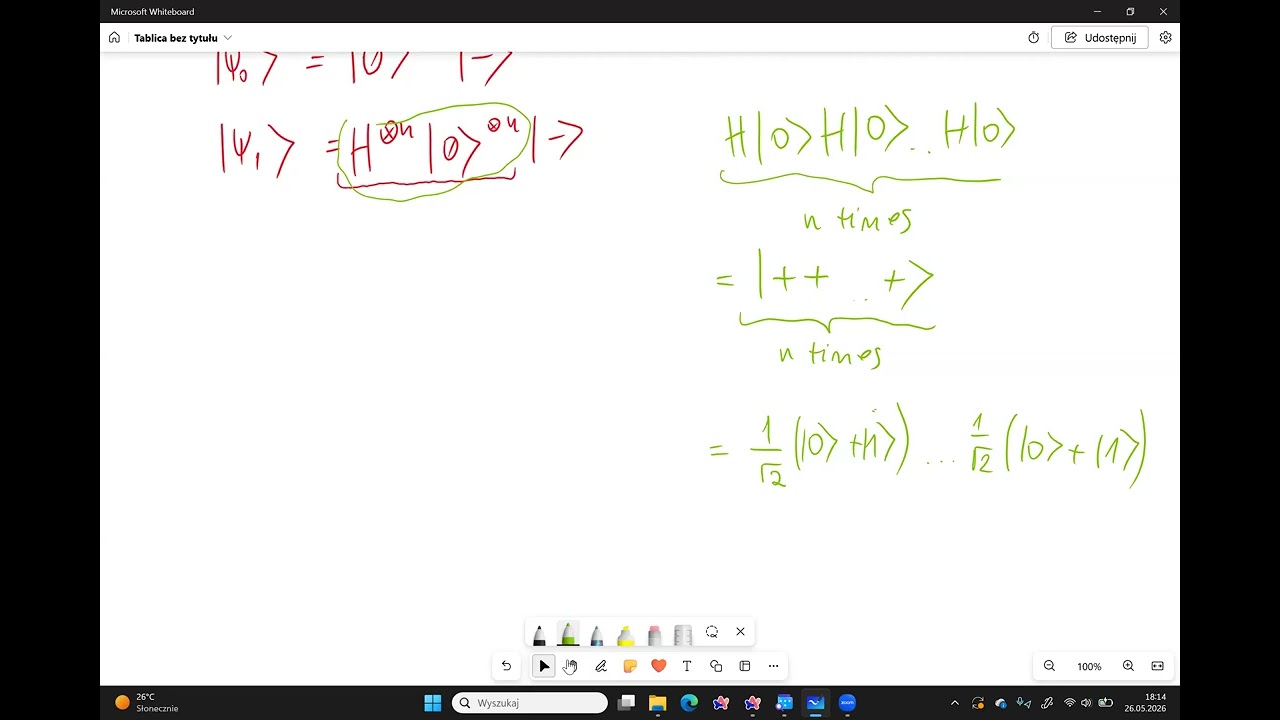
- Derivation of the Deutsch-Jozsa circuit and the use of Hadamard gates.
- Explanation of the amplitude calculation for the all-zeros state.
- Conclusion of Deutsch-Jozsa: constant vs balanced detection.
- Q&A session addressing measurement and query complexity.
- Introduction to Bernstein-Vazirani algorithm and problem definition.
- Derivation of Bernstein-Vazirani circuit and probability of measuring s.
- Implementation guidance and break announcement.
Contribution & Novelties
The video provides a clear pedagogical exposition of two foundational quantum algorithms, emphasizing the reuse of building blocks like the Hadamard transform and phase kickback. It offers a step-by-step derivation that is accessible to learners with basic quantum computing knowledge. The interactive Q&A adds value by addressing common misconceptions.
Pour aller plus loin :
- Deutsch–Jozsa algorithm - Wikipedia — Overview and formal definition.
- Bernstein–Vazirani algorithm - Wikipedia — Detailed explanation of the algorithm.
- Quantum computing - Wikipedia — Background on quantum computing principles.
83 words
Radar Profile
The radar profile shows high scores across all dimensions, indicating a well-rounded and reliable tutorial. The strengths are in the quantity and quality of information, as well as the technical depth and overall reliability.
💬 No comments were provided for analysis.