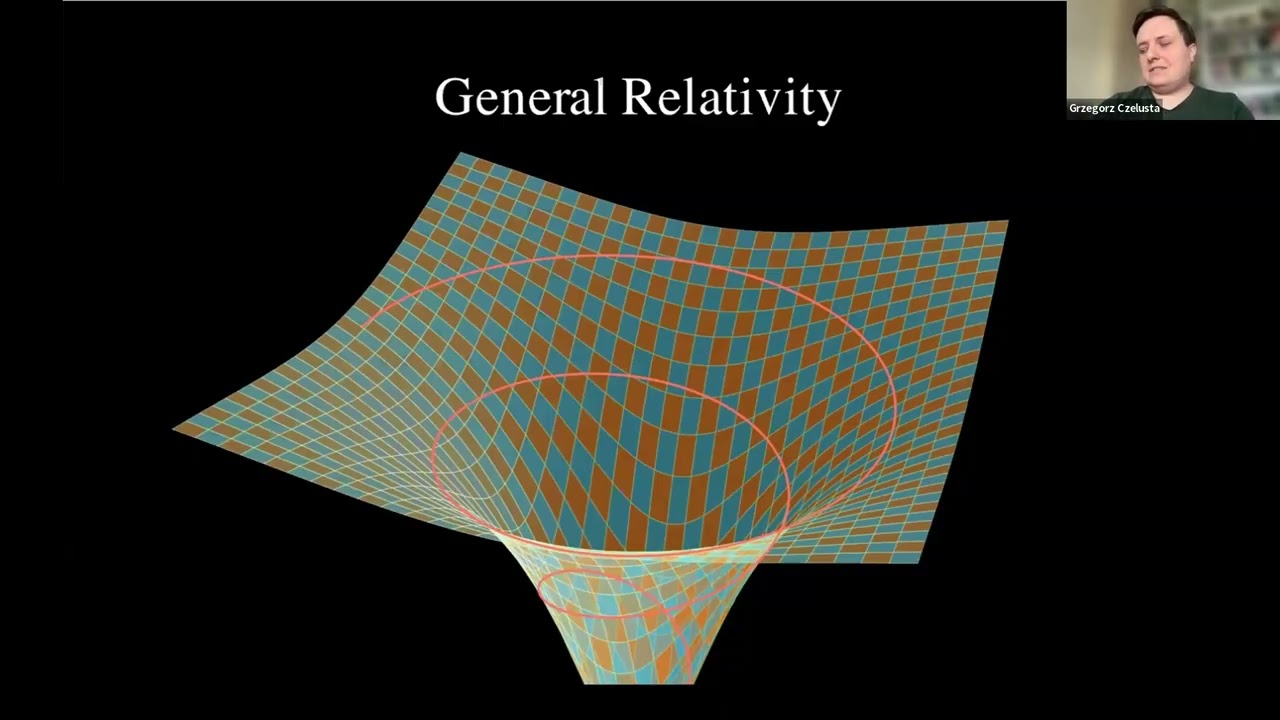
WQCG meetup - Episode 77 (Grzegorz Czelusta, "Quantum Computing for Quantum Gravity")
Keywords
Summary
158 words
Critical Evaluation
Value of the Information & Strength of the Argument
The talk provides valuable insights into the intersection of quantum gravity and quantum computing, offering a clear explanation of spin networks and their potential for quantum simulation. The argumentation is solid, building from fundamental concepts to specific implementations. The speaker demonstrates a strong understanding of both the theoretical framework and the practical challenges of quantum simulation. The presentation is well-structured, with logical progression from motivation to technical details. However, the talk is primarily an overview and does not delve into the deeper conceptual issues of LQG, such as the Hamiltonian constraint, which limits its depth.
Scientific Rigor, Source Quality, Title Accuracy
The talk demonstrates scientific rigor in its presentation of established concepts in LQG and quantum computing. The speaker references key figures and works, such as Matvei Bronstein and the Ashtekar-Lewandowski construction, but does not provide explicit citations or references. The description contains no links to papers or resources, so the sources cited are limited to those mentioned verbally. The title accurately reflects the content, and the talk is well-aligned with the stated topic. The speaker’s expertise is evident, but the lack of formal references reduces the overall rigor.
198 words
Title / Content Match
The title accurately reflects the content: the talk focuses on quantum computing applications to quantum gravity, specifically spin networks.
Quality & Reliability
8/10
The talk is given by a PhD candidate with a clear technical command of the subject, presenting a coherent and well-structured overview of spin networks and their quantum simulation. The content is consistent with established literature in loop quantum gravity and quantum computing, though it is not peer-reviewed and lacks detailed citations.
Key Moments
Markers derived by PSI from the transcript: the creator did not define chapters.
- Introduction and motivation for quantum gravity
- Explanation of general relativity and its problems
- Introduction to loop quantum gravity and spin networks
- Derivation of spin networks from Ashtekar-Barbero variables
- Geometric interpretation of spin networks
- Quantum circuit representation of spin networks
- Comparison of simulation methods
- Experimental results on IBM processor
- Discussion of limitations and future work
- Q&A session
Cited Sources
- Paper on quantum circuits for spin networks — Referenced during the talk as the source for the projector circuit and tensor network construction.
Concurring Sources
- Loop Quantum Gravity — Provides background on the theory and its key concepts.
- Spin network — Explains the mathematical structure and role in quantum gravity.
Contribution & Novelties
The talk presents a novel approach to simulating spin networks on quantum computers, particularly the tensor network-inspired method that reduces qubit overhead. This is a valuable contribution to the field of quantum gravity simulation. The speaker also provides experimental results on real hardware, demonstrating the feasibility of the approach.
Pour aller plus loin :
- Loop quantum gravity — Overview of the theoretical framework.
- Spin network — Definition and applications.
- Quantum circuit — Basic concepts for quantum computing.
77 words
Radar Profile
The radar profile shows high scores in information quantity, quality, and technical level, with a slightly lower reliability score due to lack of formal citations. This indicates a technically rich and informative talk, but with room for improvement in source transparency.
💬 No comments were provided for analysis.