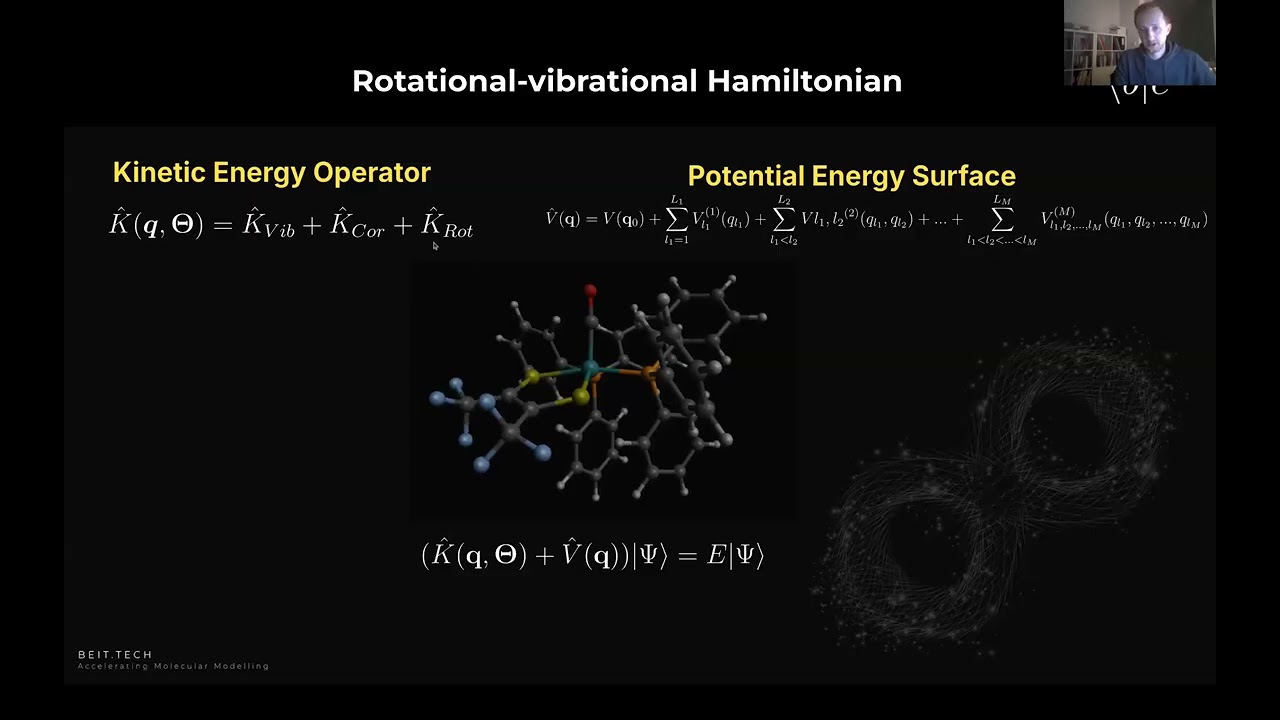
Simulating high-accuracy nuclear motion Hamiltonians in discrete variable representation using Walsh-Hadamard QROM with fault-tolerant quantum computers
Keywords
Summary
149 words
Critical Evaluation
Value of the Information & Strength of the Argument
The talk provides a clear and well-structured argument for using quantum computers to simulate nuclear motion Hamiltonians, highlighting the exponential scaling of classical methods and the potential for quantum advantage. The speaker explains the DVR transformation and its benefits, and outlines a concrete quantum algorithm using block encoding and LCU. The argumentation is logical and grounded in established quantum chemistry and quantum computing techniques. The talk is valuable for researchers in quantum chemistry and quantum algorithms, offering a specific approach to a challenging problem.
Scientific Rigor, Source Quality, Title Accuracy
The talk references the speaker’s own paper for details on the DVR encoding, but no external sources are explicitly cited in the video. The title accurately describes the content. The presentation is rigorous in its technical explanations, but the lack of citations to external literature limits the ability to verify claims independently. The speaker mentions a recent discovery of a molecule in space, but does not provide a specific reference.
169 words
Title / Content Match
The title accurately reflects the content, focusing on simulating nuclear motion Hamiltonians with DVR and Walsh-Hadamard QROM for fault-tolerant quantum computers.
Quality & Reliability
8/10
The talk presents a technical approach to quantum simulation of nuclear motion Hamiltonians, grounded in established quantum chemistry and quantum computing principles. The speaker is a physicist at a quantum startup, and the content aligns with published research. However, the talk is a presentation of ongoing work without peer-reviewed details or external validation in the video.
Key Moments
Markers derived by PSI from the transcript: the creator did not define chapters.
- Introduction and announcements by the host.
- Emil Żak introduces himself and the company Bait.
- Overview of Bait's R&D areas, including quantum algorithms for chemistry.
- Motivation: accurate spectra for drug discovery, astrophysics, and biochemistry.
- Computational model: variational basis representation (VBR) and discrete variable representation (DVR).
- Explanation of DVR transformation and its advantages.
- Quantum algorithm: encoding DVR transformations and block encoding.
- Discussion of quantum volume and resource reduction.
- Example of SO2 molecule and potential energy surface.
- Conclusion and Q&A session begins.
Cited Sources
- Paper on DVR encoding (referenced by speaker) — The speaker references his own paper for details on the DVR encoding circuit, but does not provide a URL.
Concurring Sources
- Quantum algorithms for quantum chemistry — General review of quantum algorithms for chemistry, supporting the feasibility of quantum simulation.
Contribution & Novelties
The talk presents a specific quantum algorithm for simulating nuclear motion Hamiltonians using DVR and block encoding, with an emphasis on reducing quantum volume. The approach leverages the structure of DVR transformations to efficiently encode the Hamiltonian, potentially making fault-tolerant simulations of larger molecules feasible. The talk contributes to the growing body of work on quantum algorithms for quantum chemistry.
Pour aller plus loin :
- Quantum computing for chemistry — Overview of quantum computing applications in chemistry.
- Discrete variable representation — Explanation of DVR method.
- Block encoding — Foundational paper on block encoding techniques.
94 words
Radar Profile
The radar profile shows high scores in information quantity, quality, technical level, and reliability, indicating a well-rounded and technically sound presentation. The talk is dense with information and demonstrates expertise, though it may be challenging for a general audience.
💬 No comments were provided for analysis.