Warsaw Quantum Computing Group - Episode LXXIII (Dr Julien Baglio)
Keywords
Summary
211 words
Critical Evaluation
Value of the Information & Strength of the Argument
The talk provides valuable insights into the application of quantum GANs to real-world problems, supported by references to multiple publications and actual hardware experiments. The argumentation is solid, as the speaker systematically addresses challenges and potential advantages, and presents comparative results (e.g., style-based vs. vanilla QGAN). The discussion of barren plateaus and the use of a nonlinear function to restrict angles shows a nuanced understanding of practical issues. The speaker also connects the work to broader literature on quantum machine learning generalization.
Scientific Rigor, Source Quality, Title Accuracy
The speaker cites several publications, though specific references are not listed in the description. The talk is based on original research, and the speaker mentions a forthcoming publication. The title accurately reflects the content. The description provides a link to the organization’s contact page, which is not a direct source but a general resource. The talk appears scientifically rigorous, with careful attention to metrics and validation. The speaker acknowledges limitations and future work, which enhances credibility.
173 words
Title / Content Match
The title accurately reflects the content: a talk on quantum generative adversarial networks for healthcare and life sciences.
Quality & Reliability
8/10
The talk presents original research results from multiple publications, including real quantum hardware sampling, and discusses known challenges like barren plateaus. The speaker is a researcher from the University of Basel, and the content is consistent with current literature. However, the presentation is a summary and not a peer-reviewed source itself.
Key Moments
Markers derived by PSI from the transcript: the creator did not define chapters.
- Introduction and overview of the talk's structure.
- Problem statement: drug discovery challenges and costs.
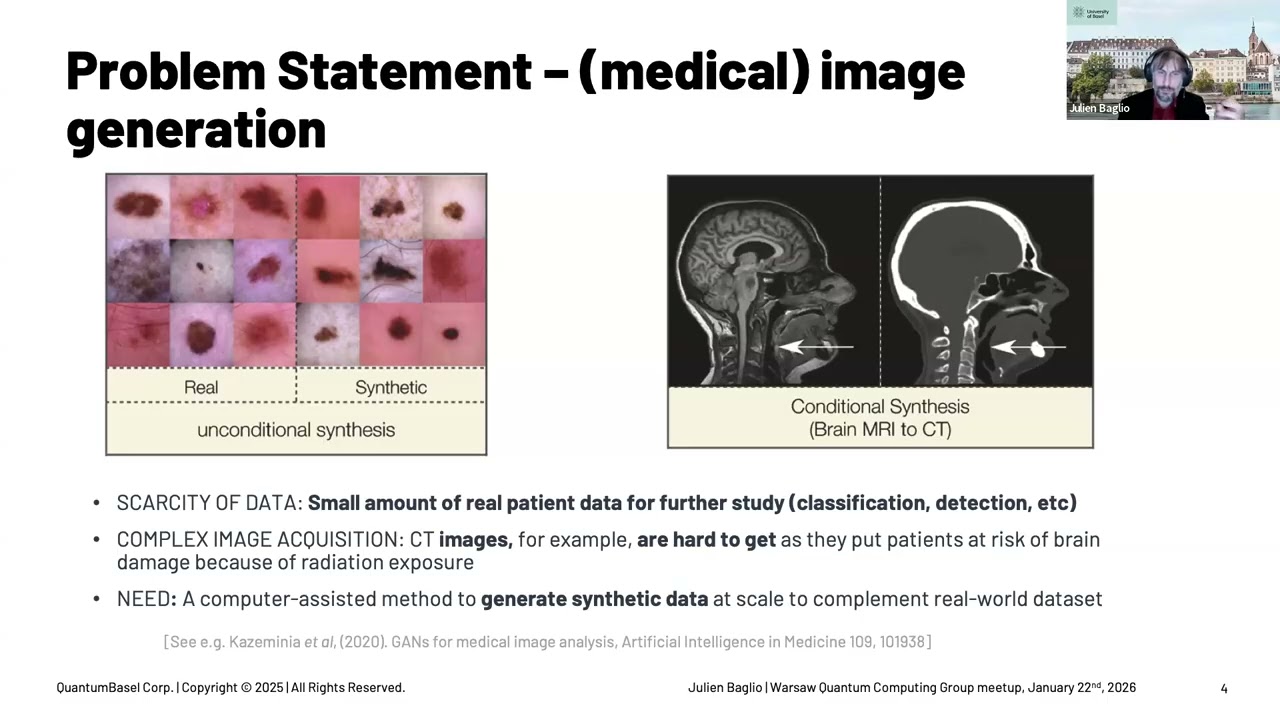
- Problem statement: medical image generation and data scarcity.
- Explanation of GANs and the art forger analogy.
- Classical GAN challenges: mode collapse, training instability, barren plateaus.
- Introduction of hybrid quantum GAN architecture.
- Style-based approach and data re-uploading.
- Potential advantages of QGANs: fewer parameters, better generalization.
- Pipeline for drug discovery using VAE and QGAN.
- Discussion of MOSES dataset and experimental setup.
- Results on real quantum hardware and hints of quantum advantage.
- Challenges and future directions.
Cited Sources
- Fundacja Quantum AI contact page — Provided in the video description as a contact resource for the organizing group.
Concurring Sources
- Quantum machine learning — General reference for quantum machine learning concepts discussed.
- Generative adversarial network — Background on GANs.
Contribution & Novelties
The talk presents a novel style-based quantum GAN architecture applied to drug discovery and medical imaging, with promising results on real quantum hardware. It suggests a potential quantum exponential advantage in trainable parameters, which is a significant claim. The use of a latent space approach to handle complex molecular data is a practical contribution.
Pour aller plus loin :
- Quantum machine learning — Overview of quantum machine learning concepts.
- Generative adversarial network — Background on GANs.
- Barren plateaus — Key paper on barren plateaus in quantum variational circuits.
88 words
Radar Profile
The radar profile shows high scores across all dimensions, indicating a well-rounded and reliable presentation. The talk is technically detailed, provides substantial information, and is based on credible research, though it is not a peer-reviewed publication itself.
💬 No comments were provided for analysis.