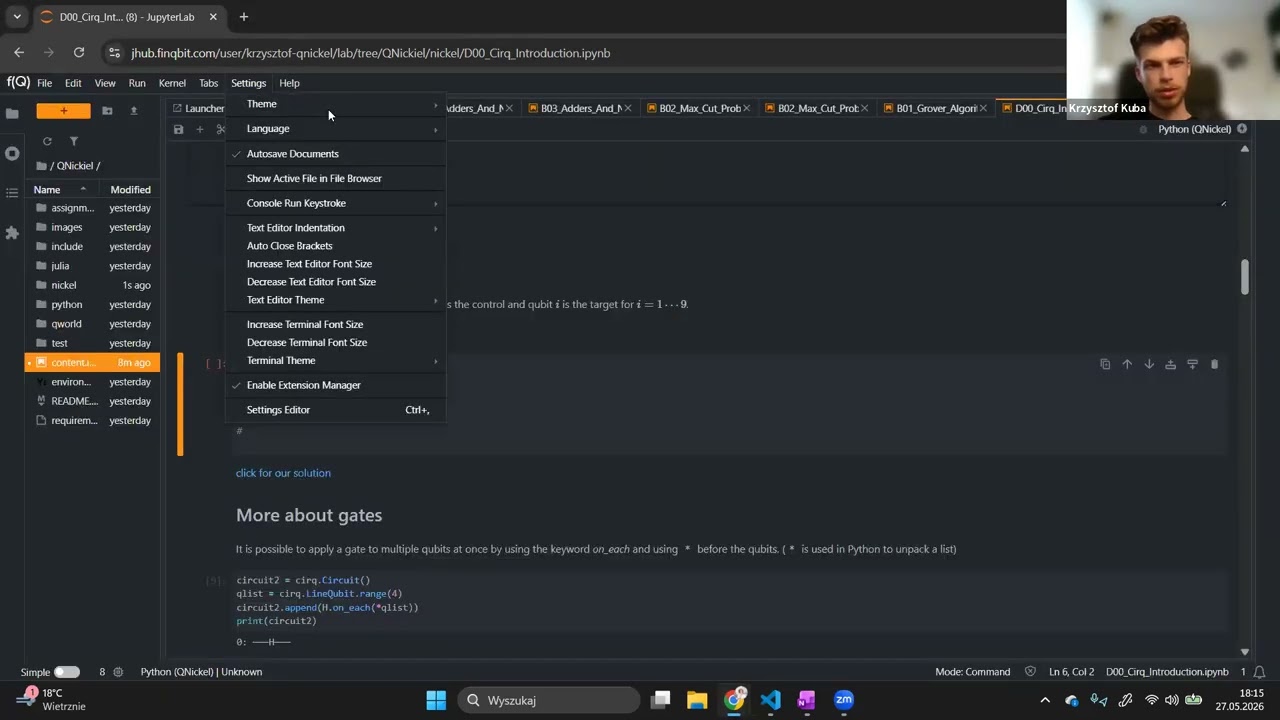
QNickel26 - workshop on oracular quantum algorithms, Day 3 (27.05.2026)
Keywords
Summary
167 words
Critical Evaluation
Value of the Information & Strength of the Argument
The value of the information is high for participants seeking practical knowledge in quantum programming. The instructor provides clear, step-by-step explanations of Cirq syntax and concepts, supported by live coding examples and interactive tasks. The argumentation is solid, as the instructor logically builds from basic circuit construction to more complex operations, and connects the material to Grover’s algorithm, which is a fundamental quantum algorithm. The reasoning is coherent and well-structured, making it accessible for learners with some prior exposure to quantum computing.
Scientific Rigor, Source Quality, Title Accuracy
The scientific rigor is good: the instructor demonstrates a solid understanding of the subject, and the code examples are accurate. The sources are primarily the workshop materials and the Cirq documentation, which are reliable. The title accurately reflects the content, as it is indeed a workshop on oracular quantum algorithms, specifically focusing on Cirq and Grover’s algorithm. The instructor also addresses questions from participants, clarifying potential misunderstandings, which enhances the reliability of the content.
171 words
Title / Content Match
The title accurately describes the content: a workshop on oracular quantum algorithms, specifically Day 3, focusing on Cirq and Grover's algorithm.
Quality & Reliability
8/10
The content is a technical workshop led by an expert, providing accurate and practical instruction on quantum programming with Cirq and Grover's algorithm. The explanations are clear and the code examples are correct. Minor uncertainties about hardware specifics are acknowledged, but overall the information is reliable.
Key Moments
Markers derived by PSI from the transcript: the creator did not define chapters.
- Introduction and overview of the workshop day, including plans for Cirq and Grover's algorithm.
- Introduction to Cirq: qubit creation, circuit construction, and basic gates.
- Explanation of different ways to apply gates in Cirq, including 'on_each' and 'controlled_by'.
- Task 1: Create a circuit with 10 qubits, apply Hadamard and CNOT gates.
- Task 2: Create a circuit with 10 qubits, apply Hadamard to all, CNOT from 0 to 9, and Hadamard again.
- How to run a circuit, measure qubits, and interpret results.
- Task 3: Implement circuit from task 1, measure all qubits, and simulate 1000 times.
- Debugging circuits and retrieving state vectors without measurement.
- Task 4: Create a 4-qubit circuit with Hadamard and controlled-Z, observe negative sign in state vector.
- Introduction to Grover's algorithm: classical search problem and expected speedup.
Cited Sources
- Cirq documentation — The instructor references Cirq as the quantum programming language used in the workshop, and the documentation is the primary source for syntax and features.
Concurring Sources
- Cirq documentation — The instructor's explanations align with the official Cirq documentation, which is a reliable source for the framework's syntax and features.
Contribution & Novelties
The workshop provides a hands-on introduction to Cirq, a quantum programming framework, and demonstrates its application to Grover’s algorithm. The novelty lies in the practical, interactive approach, allowing participants to implement and test quantum circuits in real-time. The session bridges theoretical concepts with concrete coding examples, which is valuable for learners.
Pour aller plus loin :
- Grover’s algorithm - Wikipedia — Provides a comprehensive overview of the algorithm, its complexity, and applications.
- Quantum Computing - IBM Quantum — Offers resources and tutorials on quantum computing, including Qiskit, which is compared to Cirq in the workshop.
- Cirq on GitHub — The official repository for Cirq, containing source code, examples, and documentation.
110 words
Radar Profile
The radar profile shows high scores in all dimensions, indicating a well-rounded and reliable tutorial. The quantity and quality of information are strong, and the technical level is appropriate for the target audience. The overall reliability is high, reflecting the instructor's expertise and the accuracy of the content.
💬 Sur les 0 commentaires analysés, aucune tendance n'est disponible.