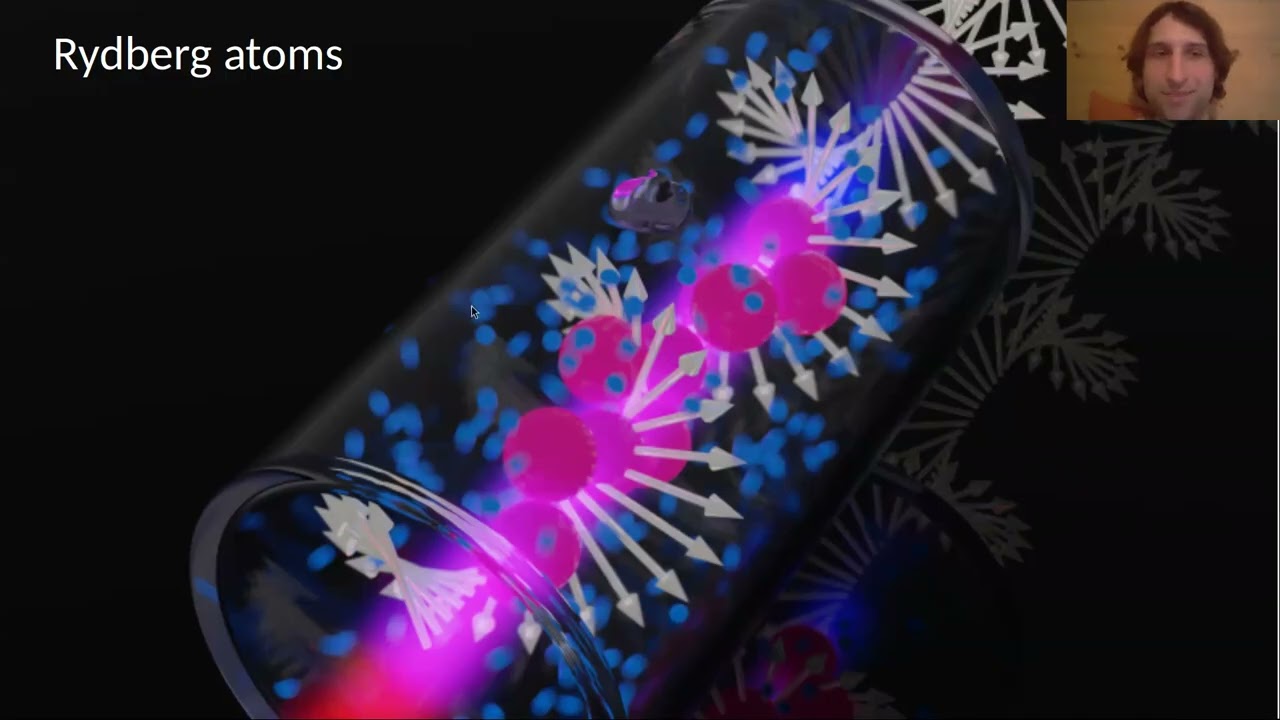
WQCG, Episode LXXV, Michał Parniak, "Rydberg atoms: between quantum sensing and quantum computing"
Keywords
Summary
125 words
Critical Evaluation
Value of the Information & Strength of the Argument
The talk provides valuable insights into the practical applications of Rydberg atoms for quantum sensing, with a clear argumentation for their advantages over classical methods. Parniak presents experimental results that demonstrate the sensitivity and versatility of these sensors, and he argues for the strong connection between quantum sensing and computing, as both require precise control and isolation from perturbations. The argumentation is solid, supported by experimental evidence and references to published work.
Scientific Rigor, Source Quality, Title Accuracy
The talk demonstrates scientific rigor, with detailed explanations of experimental setups and results. Parniak references several publications, including papers in Physical Review Applied and Optica, and mentions collaborations with the European Space Agency. The title accurately reflects the content, focusing on Rydberg atoms and their dual role in sensing and computing. The presentation is well-structured and technically sound.
145 words
Title / Content Match
The title accurately reflects the content, focusing on Rydberg atoms and their applications in quantum sensing and computing.
Quality & Reliability
8/10
The talk is given by an expert researcher in quantum optics, presenting original research results and methods. The content is technically detailed and appears scientifically sound, with references to published work and ongoing projects. However, as a seminar, it lacks peer review and some claims are presented without full experimental details.
Key Moments
Markers derived by PSI from the transcript: the creator did not define chapters.
- Introduction to the talk and overview of Rydberg atoms.
- Explanation of Rydberg atoms' properties and their coupling to optical and microwave fields.
- Discussion of electromagnetically induced transparency (EIT) and its use in sensing.
- Presentation of microwave-to-optical transduction and its advantages.
- Results on thermal radiation detection and radiometer development.
- Phase-sensitive sensing without local oscillator using FPGA-based noise cancellation.
- Future plans for cavity-enhanced sensing and quantum backaction studies.
Cited Sources
- Physical Review Applied paper on automotive radar chip calibration — Mentioned as a publication in Physical Review Applied regarding calibration of an automotive radar chip at 131 GHz.
- Optica paper on multi-frequency detection — Mentioned as a publication in Optica demonstrating detection of multiple frequencies using a terahertz frequency comb.
Concurring Sources
- Rydberg atom - Wikipedia — General reference for Rydberg atoms.
- Electromagnetically induced transparency - Wikipedia — General reference for EIT.
Contribution & Novelties
The talk presents original research on Rydberg atom-based sensors, including a radiometer operating at the thermal noise limit and a phase-sensitive sensor without a local oscillator. These are significant contributions to the field of quantum sensing. The speaker also discusses the connection between sensing and computing, offering a perspective on how advances in sensing can benefit quantum computing.
Pour aller plus loin :
- Rydberg atom — Overview of Rydberg atoms and their properties.
- Electromagnetically induced transparency — Explanation of EIT and its applications.
- Quantum backaction — Concept of quantum backaction in measurements.
92 words
Radar Profile
The radar profile shows high scores across all dimensions, indicating a well-rounded and reliable presentation. The talk is technically detailed, scientifically rigorous, and provides valuable information on quantum sensing with Rydberg atoms.