Warsaw Quantum Computing Group - Episode LXX (30.10.2025)
Keywords
Summary
204 words
Critical Evaluation
Value of the Information & Strength of the Argument
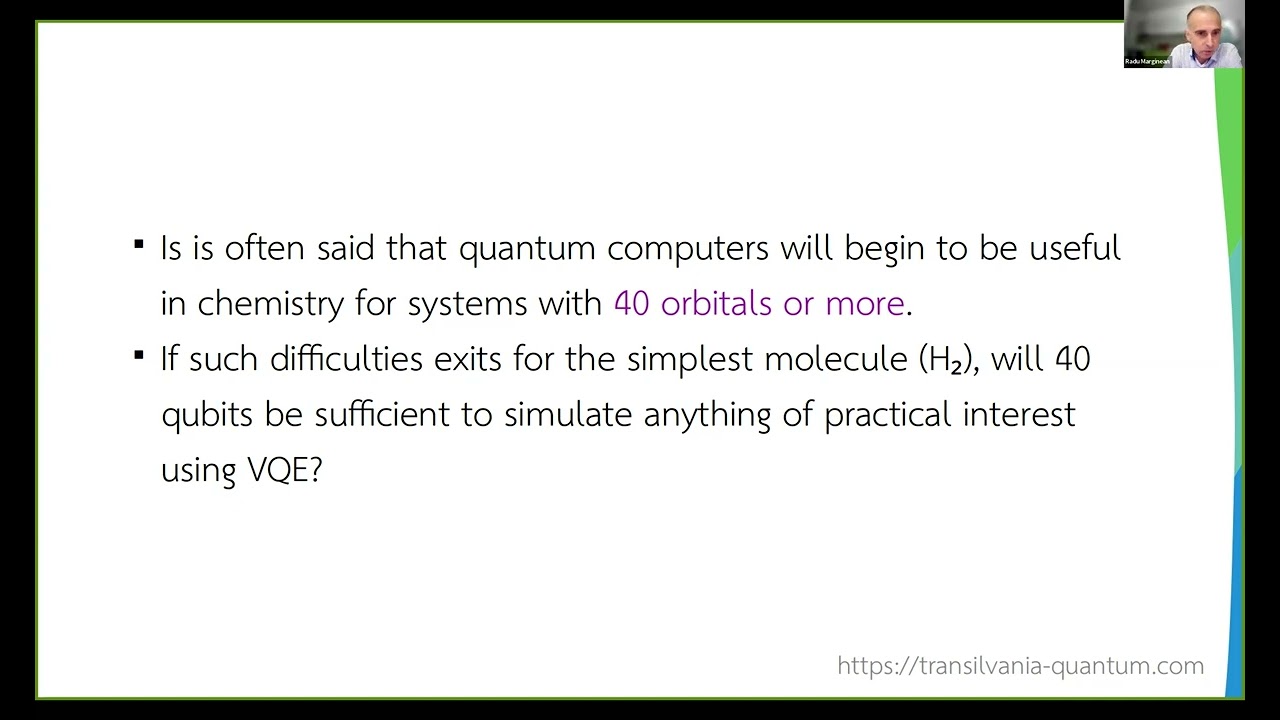
The talk provides valuable insights into the practical challenges of quantum computing, particularly for quantum chemistry. The speakers argue convincingly that current quantum devices and algorithms are not yet ready for practical applications, citing specific examples like the discrepancy between VQE results and experimental values for hydrogen. They also highlight the issue of barren plateaus and the scaling problem of VQE. The argumentation is coherent and based on personal experience, but it lacks rigorous citations to external studies. The presentation of the tools is clear and demonstrates their functionality, but the claims about their utility are not backed by comparative benchmarks or independent evaluations.
Scientific Rigor, Source Quality, Title Accuracy
The talk is primarily an expert opinion and demonstration of new tools. The speakers do not cite specific external sources, but they reference general concepts like VQE, QAOA, and quantum phase estimation. The title accurately reflects the content, as it is indeed a meetup episode presenting two new tools. The adéquation between title and content is good. The scientific rigor is moderate: the speakers present their own tools without independent validation, and the discussion of challenges is based on anecdotal evidence rather than systematic review. The lack of references to literature weakens the scientific credibility.
214 words
Title / Content Match
The title accurately reflects the content: a meetup episode presenting two new tools for quantum computing.
Quality & Reliability
6/10
The talk presents practical tools and discusses limitations of current quantum computing approaches, but it is largely based on personal experience and opinions, with limited references to external sources.
Key Moments
Markers derived by PSI from the transcript: the creator did not define chapters.
Contribution & Novelties
The talk presents two new tools: Quantum Flows, a platform for running quantum computing workflows, and a browser-based IDE for Qiskit. These tools aim to lower the barrier for experimentation in quantum computing. The speakers also provide a critical perspective on the current state of quantum computing, highlighting practical limitations. However, the novelty is limited as similar tools exist, and the presentation does not provide a detailed comparison with existing solutions.
Pour aller plus loin :
- Qiskit — Official Qiskit documentation.
- Variational Quantum Eigensolver — Overview of VQE.
- Barren plateaus — Explanation of the phenomenon.
95 words
Radar Profile
The radar profile shows moderate scores across all dimensions, indicating a balanced but not exceptional presentation. The highest score is in technical level, reflecting the detailed discussion of quantum computing concepts, while the lowest is in reliability, due to the lack of external sources.
💬 No comments were provided for analysis.